If there is any hope of undoing the recent decisions by the Roberts' Court, we must elect a Democratic president. As much as it pains me to say this, we have to do so even if the Democratic candidate is Hillary Clinton (shudder).
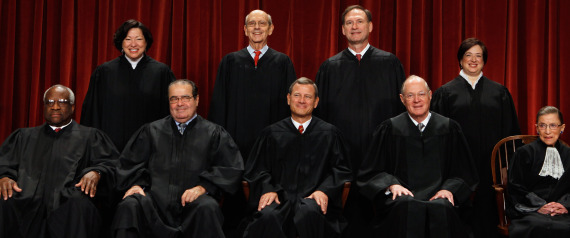
There are potentially three Justices who can retire in the next term (unless Ginsburg steps down while Obama is still president). The two oldest are Kennedy and Scalia - the first to retire will likely be Kennedy (Scalia is just too mean to retire - he'll probably live to be 100 or something, just out of spite for the rest of us).
Replacing Kennedy, now considered the swing vote on many cases, with a liberal or progressive justice could swing the balance of power to the point that the "progressive agenda" outlined below might actually be possible.
Fantasy or Forecast? A Progressive Agenda for the Supreme Court
Peter Dreier - E.P. Clapp Distinguished Professor of Politics, Occidental College
Posted: 07/04/2014
"It's always darkest before the dawn" sang Pete Seeger. "And that's what keeps me moving on."
The recent spate of reactionary decisions by the Roberts Supreme Court -- including this week's outrageous Hobby Lobby ruling -- triggers thoughts of a better day, when the right wingers on the court will have retired or died, replaced by thoughtful liberals who will restore some semblance of fairness and democracy to this great country. On this July 4th, let's consider what it would be like if our nation's highest court was actually committed to the notion of "liberty and justice for all."
Doing so requires making a few leaps of faith, but none of them are far fetched. It depends on the outcome of the next few election cycles.
If the Democrats retain a majority in the Senate after this November, the feisty, brilliant Ruth Bader Ginsburg, now 81 years old, should retire so Obama can appoint another (younger) liberal member who will have a long tenure on the court. That won't shift the current 5-4 conservative majority, but it will guarantee that Ginsburg won't be replaced by conservative.
It would great if one or both of the older conservatives -- Antonin Scalia (now 78) or Anthony Kennedy (78 later this month) -- would retire, too, so Obama could appoint their successors. But they'll probably try to hang on until a Republican president enters the White House. Let's pray (and organize) so that doesn't happen.
Best-case scenario: A Democrat becomes president in 2016, the Democrats keep control of the Senate, and Scalia and/or Kennedy are so enfeebled by then that they have to quit. At that point, a Democratic president can replace one or both with a liberal justice.
It has become a no-no in American politics for candidates for president or Senate to discuss the characteristics they'd like to see in new Supreme Court justices, except in the vaguest, general terms. They are not supposed to have a "litmus test" for justices. Everyone knows this is bogus. Presidents generally appoint justices who agree with their political views -- compromising only enough to get their nominations confirmed by the Senate or to avoid a huge controversy.
Occasionally presidents miscalculate -- or, more accurately, their nominees change their views -- and upset the ideological applecart. The most famous example is President Dwight Eisenhower's appointment of California Gov. Earl Warren as Chief Justice in 1953. Eisenhower thought he was appointing a conservative Republican. Warren turned out to be (or became as a result of changing social and political conditions) a liberal and turned the Warren Court into one of the most liberal in history. Another turncoat was David Souter, who turned out to be more liberal - or at least centrist -- than George H.W. Bush had anticipated. Among other things, Souter dissented in Bush v Gore, but his side was outvoted 5-4, handing the presidency to GHWB's son. "Poppy" Bush wouldn't make that mistake again. His next, and last, Supreme Court appointment was Clarence Thomas.
So don't expect Hillary Clinton (or any other Democratic candidates for president) to discuss her thoughts about what kind of person she'd appoint to the Supreme Court. She won't want to get boxed in by any dreaded "litmus test," which the Republicans would use against her. But if she (or another Democrat ) wins the White House in 2016, and has a Democratic majority, liberals and progressives should push her (and the Senate Dems, especially those on the Judiciary Committee) to make appointments that will dramatically change the court's direction. Under that scenario, liberals could have a 5-4, perhaps even a 6-3, majority on the court for the next 20, 30, or even 40 years.
What would that mean in terms of public policy? A liberal majority on the Supreme Court could, and should, address the following issues:
Progressives can surely add to this list of issues that a Supreme Court with a liberal majority should address. Unfortunately, presidential candidates won't directly address these issues or the views of candidates they would appoint to the Supreme Court when vacancies arise. But as we watch the Roberts Court eviscerate our democracy, and protest its outrageous (usually 5-4) rulings, we should also recognize that part of why we want liberal Democrats in the White House and Congress is to make sure that the third branch of government reflects what's best about country's values -- fairness, equality, civil liberties, and civil rights.
- Campaign Finance: Overturn Citizens United and McCutcheon rulings in order to allow real campaign finance reform that eliminates our current system of corporate-dominated legalized bribery. As David Gans recently wrote in the New Republic: "The Roberts Court is leading a free speech revolution of its own, but this time for the benefit of corporations and the wealthy." Citizens United (2010) equated "free speech" with money, giving corporations a stranglehold on elections. The McCutcheon (April 2014) ruling eliminated dollar limits for super-rich donors like the Koch brothers. Both have been boondoggles for the super-rich, big business, and the right, undermining democracy and tilting the political playing field in the wrong direction.
- Workers Rights: Reverse the Robert Court's anti-union rulings, including last week's Harris v Quinn decision. This was yet another decision in which, by a 5-4 majority, the court sided with wealthy special interests to weaken worker protections and undermine workers' right to organize. It should come as no surprise that the right-wing National Right to Work Legal Defense Foundation -- funded by the Koch and Walton families and other corporate groups - was responsible for filing the Harris v. Quinn suit against SEIU. The Court ruled that workers who benefit from a union contract (with higher pay, health benefits, paid vacations, etc) don't have to pay union dues. They can be "free riders." Here again, the Court equates money with free speech. In this case, workers can exercise their "free speech" to avoid supporting the union, even if their lives are significantly improved by a collective bargaining contract negotiated by the union in their workplace. The Court decided that the "free speech" interests of those who object to paying for representation outweigh the right of the democratically elected majority that formed the union. Unions are the strongest bulwark to strengthen the middle class, challenge widening inequalities, and lift hardworking Americans out of poverty. The U.S. has the weakest workers' rights laws of any democratic country, which accounts in part for the decline of union membership and big business' ability to violate existing labor laws (such as firing workers who support union organizing efforts in their workplace) without suffering serious consequences. The Roberts court has piled on, siding at every turn with employers over workers.
- Same-Sex Marriage: Make same-sex marriage a federal right and not leave it up to the states. As I've written elsewhere, the Roberts Court's June 2013 rulings on same-sex marriage favored states rights over equal rights. In its two decisions (on the Defense of Marriage Act and California's Proposition 8), the Court stopped short of proclaiming same-sex marriage a basic right. It left it to the states to determine whether gay Americans have the same right to marry as their straight counterparts. As a result, same-sex marriage advocates have to mobilize and litigate to overturn bans on same-sex marriage in those states that have them. That could take five, 10, 20, or more years, and some states may resist legalizing same-sex marriage forever. In 1967, in Loving v. Virginia, the Supreme Court knocked down all state anti-miscegenation laws that banned inter-racial marriage. It did not leave it up to the states to decide for themselves. That was a bold move, way ahead of public opinion. The Roberts Court was far more cautious. A liberal Supreme Court should apply the same logic to same-sex marriage as the Warren Court applied in Loving to inter-racial marriage. It is a basic right for all Americans, regardless of where they live.
- Women's Rights: Overturn Hobby Lobby. This decision, rendered last week, is yet another ruling that treats corporations like "citizens" with rights -- in this case, endowing a corporation the "right" of "religious freedom." Under this outrageous ruling, corporate owners who object to birth control don't have to provide contraceptives and other forms of birth control to employees if it violates the owners' religious beliefs. This is little different from saying that a segregationist restaurant owner can avoid serving black customers if it violates his belief in white supremacy. The Hobby Lobby ruling favors corporations' so-called "religious" freedoms over women's right to control their bodies. Did anyone notice that, by the accident of history, the five conservatives on the current Supreme Court who voted in favor of Hobby Lobby, each appointed by Republican presidents, all happen to be Catholic men? They are Samuel Alito, Roberts, Scalia, Thomas and Kennedy. The three women justices -- Ginsburg (Jewish), Elena Kagan (Jewish) and Sonia Sotomayor (Latina Catholic) -- plus Stephen Breyer (Jewish) dissented in the Hobby Lobby case. This isn't meant to stereotype all Catholic men. One of the greatest liberals and civil libertarians in the Supreme Court's history -- William Brennan -- was male and Catholic. He was a staunch supporter of abortion rights and joined the pro-choice majority in Roe v Wade. But it is clear that at least one or more of the five justices who supported Hobby Lobby (certainly Scalia) were guided by religious beliefs over constitutional logic. When and if a Democrat gets to appoint the next one, two or three justices, the choices should be based on the nominees' judicial views, not their religion, but if their previous judicial decisions or writing reveal that their religious views (strict Catholicism, Orthodox Judaism, fundamentalist Protestantism, traditional Islam) lead them to reject basic rights for women, gays, people of color, or other groups, they shouldn't be appointed to any federal court, much less the Supreme Court.
- Voting Rights: Strengthen enforcement of the Voting Rights Act (VRA), thus reversing the Robert Court's Shelby v Holder (June 2013) ruling that allows voter suppression under the guise of states rights. The 1965 act, which outlawed literacy tests and other obstacles to voting, was an important tool for civil rights activists to challenge other barriers to black political participation, such as gerrymandering of city council, state legislature, and congressional districts in order to dilute black voting strength. It had huge consequences. In 1970 there were only 1,469 black elected officials in the entire country. By 2000, that number had reached 9,040. Today, the figure is close to 11,000. In 1965, only 6.7 percent of Mississippi's black citizens were registered to vote. But four years later the number had jumped to 66.5 percent. By 2000, Mississippi had 897 black elected officials in local and state offices, plus Congress--the largest number of any state in the country. Roberts had been trying to weaken the 1965 Voting Rights Act ever since he was a young lawyer in Ronald Reagan's Justice Department. He finally got his way last year when his court, by a 5-4 margin, ruled that Section 5 of the Voting Rights Act is unconstitutional. That's the provision that requires states with the worst history of voting discrimination have to get Justice Department approval before they can revise their voting laws. Roberts said that blatant racial discrimination in voting no longer exists, so Section 5 isn't needed. As Cong. John Lewis, a veteran civil rights activist, said about the Supreme Court ruling: "There are more black elected officials in Mississippi today not because attempts to discriminate against voters ceased but because the Voting Rights Act kept those attempts from becoming law." In recent years, Republican politicians and operatives, including Karl Rove, have sought to restrict voting rights to keep people of color, young people, and poor people from voting. The Roberts Court's Shelby ruling gave them permission to declare war on voting rights. As soon as the Court made its ruling, a host of states (mostly but not entirely Southern states) began adopting laws to suppress voting rights -- such as requiring IDs in order to vote and setting the stage to gerrymander political districts to weaken black and Latino voting strength.
- Education Funding: Mandate sufficient funding for all public K-12 schools as a basic right of all students regardless of the tax base of the surrounding community or the political/spending priorities of the states. The famous unanimous 1954 Brown vs. Board of Education ruling stated that "separate but equal" schools were inherently unequal. The justices were writing about racial segregation and later mandated that states and localities desegregate their schools "with all deliberate speed." Today, America's public schools are segregated by race and income, as Jonathan Kozol reported in his book Savage Inequalities, as UCLA professor Gary Orfield and his colleagues have documented in recent reports, and as many other studies have revealed by examining per-student spending in different school districts. As many scholars and journalists have observed, our public schools are beset with outrageously unequal funding. Students from well-off families generally go to public schools with much higher per-student spending levels than students from less affluent families. The solution is not busing or charter schools but adequate funding for all students and all schools, regardless of the size of a community's tax base. Since the 1970s, an increasing number of state courts have sought to address these disparities by requiring state legislatures to spend more money on education and/or to distribute those funds more equally. Although these rulings have made some difference, huge disparities persist. This is true within metro areas and states, but also true between states. In 2012, New Jersey spent $18,485 per student while Oklahoma spent only $8,285 per student. Differences in the cost of living do not account for these differences; it is not more than twice as expensive to live in New Jersey than in Oklahoma. And within each state, there are huge disparities. In Illinois a few years ago, New Trier Township High School District (in an affluent Chicago suburb) spent $19,927 per student while the Farmington Central Community Unit School District (a rural area in central Illinois) spent only $6,548 per student. Across the country, the accident of geography determines the quality of education that students get. We need a Supreme Court that will rule that a decent K-12 education is a basic right and that the federal government needs to enforce this right by taking over responsibility for funding public education, or requiring states not only to provide "equal" funding (per student) for every school district but also to provide "equal opportunity" for all students, which would mean spending more money in schools and school districts with a higher percentage of disadvantaged students.
Peter Dreier teaches Politics and chairs the Urban & Environmental Policy Department at Occidental College. His most recent book is The 100 Greatest Americans of the 20th Century: A Social Justice Hall of Fame (Nation Books, 2012).
Follow Peter Dreier on Twitter: www.twitter.com/peterdreier