Over Time, Buddhism and Science Agree
Understanding the impermanence of everything—including ourselves.
By David P. Barash | Illustration by Chad Hagen
January 9, 2014

I REMEMBER my grandfather commenting—wry amusement tinged with grim resignation—that what made him finally feel old was seeing his children reach middle age. I was a child then. Now I see my own children, not quite middle aged, starting to have children of their own.
Becoming a grandparent is quite lovely, an affirmation of continuity and a front-row-seat to watch (and even, on occasion, participate) as life itself is conveyed into the future. But aging is also our most undeniable memento mori, a reminder not so much of life as one’s own eventual death. My grandfather’s death frightened me as few things have since, except for the recurring recognition (usually at night, alone, in the dark) that his life, everyone’s life, even—astoundingly—my own, is short indeed.
All things, especially living ones, are marinating in the river of time. We see and understand that our bodies will wear out and we will die. At least that’s how it looks through the lens of Western science, where all things come to an end, winding down in a final surrender to entropy. But there’s another perspective, surprisingly in harmony with science, that helps us revisit that huge and ancient terror—fear of time itself—in a new and perhaps even reassuring way. And that is the perspective offered by Buddhism.
For Buddhists, the “center cannot hold,” as the poet W.B. Yeats pointed out, because it doesn’t exist as something rigidly separate from everything else. Nothing is permanent and unchanging, ourselves included. Attempting to cling to a solid, immutable core of a self is a fool’s errand because time not only creates anarchy, it provides the unavoidable matrix within which everything—animate and inanimate, sentient and insensate—ebbs and flows.
As Buddhists see it, and as scientists increasingly agree, all organisms are necessarily, unavoidably—even marvelously and gloriously—impermanent. In Sanskrit, the word for impermanence is anitya. To understand anitya is to achieve something remarkable: opening a door onto the accord between modern western science and ancient eastern wisdom.
In his book, Physics and Philosophy, Werner Heisenberg—one of the commanding figures in the development of modern quantum physics—wrote that “in the history of human thinking the most fruitful developments frequently take place at those points where two different lines of thought meet.” Contrary to Rudyard Kipling’s injunction, “East is East, and West is West, and never the twain shall meet,” I have found, as a trained biologist, that some of the most fruitful developments in modern thinking occur precisely where the twain of biology and Buddhism meet.
Even inanimate objects that appear solid and persistent are revealed by modern physics to be in a constant state of flux. An iron bar is mostly empty space, and even the ostensibly solid, sub-atomic particles occupying that space are either moving so rapidly as to be unimaginable or, alternately, exist as clouds of probability rather than as stationary monuments to permanence.
With living things, the world is even less fixed. As Yeats observed: “O body swayed to music, O brightening glance / How can we know the dancer from the dance?” Biologists as well as Buddhists know that living stuff is always dancing, constantly replenished by, and created from, nonliving components. At every moment, our existence takes place only on the instantaneous, knife-edge of Now, which can never be captured and held immobile.
The story goes that as a young man, the Buddha sought to overcome the imperfections of the real world—sickness, old age, and death—by following the path of traditional Hindu asceticism, mortifying the flesh and nearly starving himself. His eventual enlightenment, however, is said to have involved recognition that all things are temporary, ever-changing, and impermanent. Unlike Christ, who promises eternal life, the last words of the Buddha reportedly began, “Decay is inherent in all things.”
But even decay—an unavoidable consequence of time impacting the real world—isn’t something to regret. As the Vietnamese Buddhist monk and scholar, Thich Nhat Hanh, put it, impermanence (anitya) is intimately tied to continuity. “Look back,” he counsels, “and you will see that you not only exist in your father and mother, but you also exist in your grandparents and in your great grandparents.” Look again, and you will see we “have been gas, sunshine, water, fungi, and plants,” he writes. “Nothing can be born and also nothing can die.” To understand this, and to do so deep in our ever-changing bones, may forever change our sense of time and what it means to participate in life on earth.
AGING is undoubtedly the most apparent and unavoidable manifestation of how anitya is both revealed by time and produced by it, how impermanence is manifest in every body. Precisely how bodies age is the domain of biological gerontology, which studies such events as the increased accumulation of somatic mutations, reductions in tissue elasticity, increase in autoimmune responses, and diminished length of telomeres (end-pieces of chromosomes that can be likened to the plastic tips at the end of shoelaces, and which evidently protect chromosomes as they undergo cell division). Most human cells poop out after about 60 or so replications, apparently in conjunction with the loss of telomeres, which become a bit shorter with every bout of mitosis—although it isn’t clear whether aging-related decrepitude results from this reduction in telomere length, or vice versa.
Whatever the causative sequence, there is no fountain of youth. We can reduce the rate of decline by eating healthy foods, reducing stress, and exercising regularly. But the effect, at best, is to slow the process, never to stop it altogether. To be a museum conservator, exercise fanatic, or just a dedicated daily dental flosser is to be more Sisyphus than Ponce de León.
But this is too pessimistic. A Buddhistically informed view suggests that even as everything changes over time, this very impermanence is connected to a deeper kind of persistence. One of the more striking visual demonstrations of this is the practice among Tibetan monks of constructing gorgeous sand mandalas, complex designs and patterns laboriously built over many days, after which they are ceremoniously swept away. Proxies for ourselves, mandalas symbolize the impermanence of everything, no matter how lovely, complex, treasured, or important.
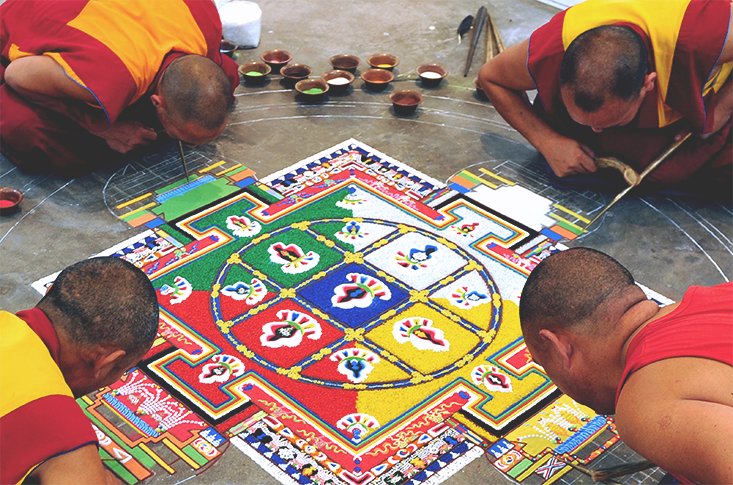 Sands of Time: Tibetan Buddhist monks create a mandala of colored sand, a symbol of impermanence.DIBYANGSHU SARKAR/AFP/Getty Images
Some years ago, while waiting for a wilderness permit at a Forest Service ranger station in the small town of Sedro Woolley, Wash., I overheard a radio message sent in by a ranger: “Dead elk in Agnes Creek decomposing nicely. Over.” The ranger was ecologically sophisticated as well as Buddhistically accurate. Although a decomposing elk might not be everyone’s idea of “nice,” the process is as necessary to a healthy ecosystem as it is unavoidable. (The “over” was an especially nice touch.)
For another good example of biological anitya, one that overturned prior biological dogma, consider Dolly, who famously emerged as the world’s first artificially cloned sheep. Before Dolly, it was widely held that once vertebrate cells had fully differentiated—becoming, say, muscle or skin or, in the case of Dolly’s “mother,” mammary gland tissue—they were permanently fixed and couldn’t become a different kind of cell.
Dolly was created when an already differentiated nucleus was implanted into an enucleated egg cell, and a new animal emerged, complete with a full array of distinctly different cell types. Cell differentiation is evidently not a one-way street, as previously believed. One of the things built into life itself is, ironically, impermanence and the capacity to change.
The reality of anitya extends to whole genomes, which are permeable to genes introduced from other lineages. This is why we can put cold-resistance genes from halibut into frost-vulnerable tomatoes. (Whether we should is another question.) Even without high-tech human intervention, the evolutionary reality of continuity among all living things is inseparable from the fact that all lineages have themselves evolved—that is, they have changed over time, and continue to do so. The seemingly rigid boundaries between cells and within species are flexible and inconstant. Living things do not simply have the capacity for impermanence; rather, at what we might oxymoronically call their “core,” they are profoundly and deeply impermanent and ever-changing.
What about whole organisms taken in their entirety? After all, each halibut, hickory tree, or human being appears to be distinct and fixed in time—or at least identifiable as this object, this creature, this person. But each “this” is largely an artifact of our own limited perception of time and its impact. Wait long enough, give time the opportunity to work its way, and every living thing changes, undergoing embryogenesis, growth, senescence, and finally death. In short, time will tell.
Question: When a Buddhist nun goes to a beauty parlor, what is she is likely to get? Answer: an impermanent.
IT would seem, nonetheless, that living things struggle to defy anitya, to resist change. The technical term among physiologists is “homeostasis,” the process whereby organisms maintain their internal environment within limits. This is notably true of mammals, which possess various adaptations to keep their internal temperature independent of the outside environment. At least as important, however, is the internal chemical environment: not too acid, not too alkaline, enough sodium, potassium, and calcium. Without a precisely stable Goldilocks balance, life ceases.
In a narrow sense, that is a defiance of anitya. But the physiological constancy required by life can only be achieved in what physicists label an “open system,” which receives regular inputs of energy and material from elsewhere. In the case of living things, this means that even the temporary, seeming defiance of impermanence can only occur via a never-ending introduction of new stuff. In the short term, that means energy-carrying molecules that permit respiration and metabolism; in a longer perspective, that means proteins and other substances involved in growth, maintenance, and repair.
Paradoxically, maintaining a state of apparent constancy (i.e., life) requires continual openness to change, in this case exchange with an organism’s environment. When that exchange ceases, so does life; although even then, every body continues to change, whether via decomposition, incorporation into another body, or incineration. Recall that elk undergoing its mandatory changes oh so nicely.
Let’s consider that elk—or ourselves—in an earlier and more sprightly state, and look at two phenomena essential to that condition we call “alive”: respiration and digestion/metabolism. We regularly inhale about a half liter of air, relatively high in oxygen and low in carbon dioxide. Our bodies combine some of that oxygen with food molecules we earlier consumed, generating energy. The half-liter that we subsequently exhale contains less oxygen and more CO2, a by-product of metabolism. “New” atoms are incorporated into our bodies at every moment, and “old” ones are rearranged, while some are pushed out. Every few days we essentially recycle ourselves, reminiscent of an old advertising jingle for milk, “There’s a new you coming every day!” Except it’s more like every hour, minute, second, instant.
Then, of course, there is evolution, the process that has produced and underlies all life. Evolution is change—change in the make-up of a lineage over time. Although certain organisms have evolved rapidly (human beings, elephants, bacteria), others do so slowly. They include such peculiar creatures as coelacanths (lobe-finned fishes believed extinct before one was caught in the deep ocean off Madagascar in the 1930s), tuataras (peculiar lizards found only on several islands off the coast of New Zealand), or horseshoe “crabs” (closely related to spiders and which appear not to have changed significantly in a few hundred million years). But even these “living fossils” have themselves evolved—that is, changed over time—compared to their ancestral, soft-bodied pre-Cambrian ancestors, just as they will continue to do so—or go extinct—when their environment changes.
What about genes themselves? Aren’t they permanent rather than temporary? As Richard Dawkins effectively popularized in his book, The Selfish Gene, bodies are merely temporary structures constructed by their constituent genes, for their—the genes’—benefit. Bodies, suffused as they are with anitya, come and go, whereas genes go on and on, catapulted into the future either as offspring or in the bodies of other relatives. One chapter in Dawkins’ book is titled “Immortal Coils.”
Although the potential immortality of genes is an effective simile, it is not strictly true. Biologists know that some genetically based traits are “highly conserved,” which means they are unlikely to change over time. These include the commands undergirding such basic intracellular activities as how energy is derived from hydrocarbon molecules, and the coding system by which nucleic acids are translated into proteins. The fidelity with which these genes are accurately replicated between generations is remarkable, but also not surprising, given that errors in such fundamental processes are quickly selected against, leaving the unchanged to persist.
But not forever. Mutations happen. On average, genes mutate at a rate of about once in a million replications. Given enough time, errors are inevitable. Given changes in their environment, beneficial mutations are selected for, while hurtful ones are selected against. Everyone’s eventual and unavoidable death has been dramatically expressed by W. Somerset Maugham as “The Appointment in Samarra.” Even genes do not—and cannot—escape their appointment with anitya.
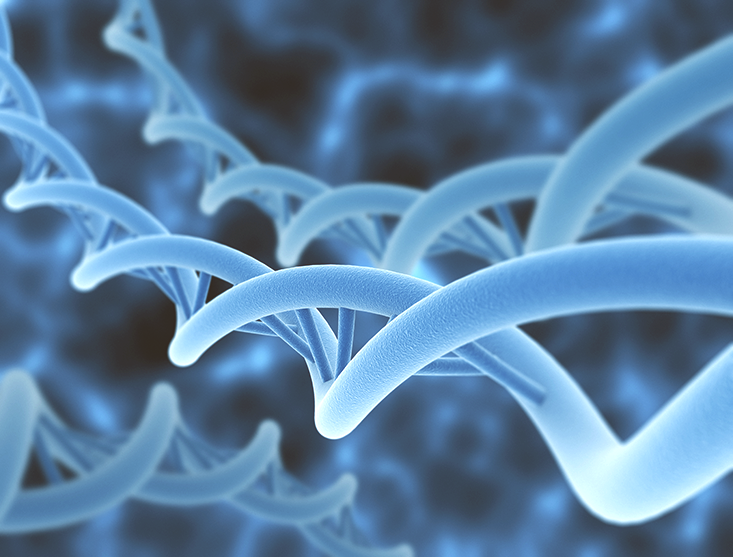 This Mortal Coil: Even genes, selfish as they are, are subject to mutation and change.
Most mutations result from incorrect base pairings, involving the four key molecules of heredity: adenine (A), cytosine (C), thymine (T), and guanine (G), when by accident they fail to line up according to the normal pattern of A-with-T and C-with-G. By contrast, the remarkably rigid spiral backbone of DNA—which gives rise to its double helix structure—consists of repeating sugar and phosphate groups, which are more stable than the base pairings, since the former rely on “regular” chemical bonds whereas the latter occur via weaker “hydrogen bonds.”
But even here, change is inevitable, although presumably less consequential. Hydrogen atoms that are ubiquitous throughout DNA molecules are constantly switching places with other hydrogen atoms in their immediate surroundings; the resulting “hydrogen exchange” is well documented, insuring that even a non-mutated DNA molecule is something of a shape-shifter, even when it is ostensibly resting. So even the most unchanging component of potentially immortal DNA is immersed in anitya, constantly refashioning itself.
ZEN koans are riddles intended to shake seeker-monks free of their excessive dependence on linear thought processes. A famous koan asks the novitiate to describe her face before she was born. A good answer these days would have something to do with DNA, but it would also have to incorporate ebb and flow, process and pattern, contingency and probability, a paradoxically permanent state of impermanence.
Over time, anitya is manifested at many different levels: the ecological flux of biogeochemical cycles, the unavoidable conveyor belt of birth to aging to death, and the instantaneous transformations in all parts of living organisms. While our illusion of permanence may be fostered by our sense of continuous memory, psychologists now understand that memories are not only frequently incorrect but as impermanent as our physical substance.
From a scientific perspective, there is every reason for biologists to join with Buddhists in rejecting what the latter call svabhava, fixed and unchanging essence. At our deepest, molecular levels, we have no essence. “Time is the substance I am made of,” wrote Jorge Luis Borges. “Time is a river which sweeps me along, but I am the river; it is a tiger which devours me, but I am the tiger; it is a fire which consumes me, but I am the fire.”
In Eastern mythology, the story is told about a king who called his Wisdom Council together and asked for an observation that would always be true, for all living things, at all times. They agreed upon the following: “This too shall pass.” The universal recipe for anitya is as simple as it is inevitable: Start with the stuff of the world, then marinate in tincture of time.
When Alice Munro was awarded the 2013 Nobel Prize for Literature, a New York Times editorial observed that the writer “can do anything with time that she wants, hasten it, elide it, slow it down. But when we put the story down, we feel that time has happened to us.” My grandfather felt that time was happening to him most keenly when he saw its impact on those around him, especially those he loved, who were much younger than he was, and should have been less impacted by it.
But the truth, of course, is that time happens to all of us, well, all the time! And a Buddhist perspective helps us to understand and even revel in the impermanence that results.
~ David P. Barash is an evolutionary biologist and professor of psychology at the University of Washington. His most recent book is Buddhist Biology: Ancient Eastern Wisdom Meets Modern Western Science (Oxford University Press).
Showing posts with label impermanence. Show all posts
Showing posts with label impermanence. Show all posts
Sunday, January 12, 2014
David P. Barash - Over Time, Buddhism and Science Agree
From the ever-interesting Nautilus, evolutionary biologist and professor of psychology (University of Washington) David P Barash offers a brief and interesting overview of his most recent book, Buddhist Biology: Ancient Eastern Wisdom Meets Modern Western Science (2013).


Saturday, September 15, 2012
One Day - A Short Animated Film on Impermanence

Via io9, this is a cool little animated film about a man whose house jumps around the world, spending only day in each location. So what happens when he wants to stay someplace?
Film blurb: “One man always on the move will have an encounter that puts into question everything he knows.”
A Sweet Animated Short about a Man Whose House Teleports All Over the World
The short animated film One Day features a man with an incredible gift: his home jumps around the world, spending just one day in each location. But what happens when the house's occupant finds a place where he wants to stay.
This short comes out of Paris' Gobelins School of the Image. There are shades of Doctor Who in the house that jumps around, unbidden by its owner, but it has a very different, very travel-weary protagonist who might be swayed to stay put after a simple, human encounter.
For non-French-speakers, "rien à faire" means "nothing to do."
[via Geek Art Gallery]
Wednesday, July 25, 2012
Thanissara - Embodied Dharma

This is a whole series of 18 talks by Thanissara on Embodied Dharma that were give at the Cloud Mountain Retreat Center over ten days in June, 2012. All of these talks are posted at Dharma Seed, a wonderful resource for Buddhist teachings offered at various retreat centers around the country.
Embodied Dharma
2012-06-14 (10 days) Cloud Mountain Retreat Center
Thanissara

Donate to Thanissara
Thanissara's Website
Thanissara, a practitioner since 1975, was a Theravada nun for 12 years in the tradition of Ajahn Chah and has taught internationally the last 20 years. She is co-founder and director of Dharmagiri Hermitage and Outreach in South Africa and spends time between there and the US. She has an MA in Mindfulness Psychotherapy Practice from Karuna Institute and Middx University UK and is currently co-facilitator of the Community Dharma Leader at Spirit Rock
2012-07-04 1. Buddha's Essential Guidance 19:45 Thanissara path as both gradual and immediate - succinct teaching of 'refrain from the unwholesome, lift up the good & purify the heart.'
2012-07-04 2. First Foundation of Mindfulness 39:25Thanissara training of 'mano-vinnana' attention - withdrawing the mind from its preoccupations, working with the breath, way to one.
2012-07-04 3. Basic Sanity 43:51Thanissara sanity of mindfulness, mindfulness leading to insight into the nature of the body, simplicity, getting back on track
2012-07-04 4. Guided Meditation on the Body 41:28Thanissara
2012-07-04 5. Samadhi - Path into Here & Now 42:15Thanissara deepening presence here & now, 5 jhana factors, fruits of samadhi
2012-07-04 6. Jhana Factors & Balanced Effort 25:22Thanissara cultivating balance and depth of inner well being
2012-07-04 7. Hindrances & Stopping 39:49Thanissara stopping the momentum of the mind.. a serial killer stops and awakens
2012-07-04 8. Balance of Calm & Insight 36:15Thanissara mindfulness & clear comprehension in tandem with insight & wise reflection - two kinds of peace
2012-07-04 9. Contemplating Change & Worldly Winds 30:45Thanissara reflecting on change - the doorway into the changeless - maintaining well being in the face of change through wisdom
2012-07-04 10. Training of Mind 37:52Thanissara practice as preparation for when the hindrances hit - vitakkasantana sutta - skilful training of thought
2012-07-04 11. Four Truths 42:10Thanissara contemplation and practice of the 4 truths
2012-07-04 12. Practice of the Four Truths 33:45Thanissara where there is samsara is nibbana
2012-07-04 13. Leap Beyond 54:29Thanissara heart sutra and kuan yin
2012-07-04 14. Original Mind 35:36Thanissara guided meditation pointing out 'mind'
2012-07-04 15. Divine Within Human 53:57Thanissara 4 brahma viharas & bodhicitta
2012-07-04 16. Guided Brahma Vihara Meditation 35:17Thanissara drawing on themes of the 4 brahma viharas - kindness, compassion, joy & equanimity - infused with the divine bodhicitta of Kuan Yin
2012-07-04 17. Daily Life Practice 31:29Thanissara
2012-07-04 18. Taking Precepts 29:45
Thanissara the value of ethics as a foundation for practice and as a protection of all beings


Friday, September 10, 2010
Dharma Quote - Life is a party on death row
Heart Essence of the Vast Expanse
A Story of Transmission
by Anne C. Klein,
foreword by Adzom Paylo Rinpoche,
preface by Tulku Thondup Rinpoche
more...Dharma Quote of the Week
Life is a party on death row. Recognizing mortality means we are willing to see what is true. Seeing what is true is grounding. It brings us into the present and, eventually, into presence. It also brings us into our bodies, especially if we combine meditation on impermanence with an energetic awareness at the base of the spine. At first, the important thing about impermanence seems to be the limited time we have in this precious life. This is crucial and foundational, and yet it is not the whole story.
The teachings on impermanence concern the death of a self that never existed. Our sense of such a false and finite self, which initially is inseparable from our wish to practice, can dissolve. Understanding impermanence, Khetsun Rinpoche says, will lead you into the natural clarity of your own mind. To know impermanence is thus not only a path leading to what Dzogchen traditions speak of as "unbounded wholeness" (thigle nyag cig), it is also integral to that wholeness.
--from Heart Essence of the Vast Expanse: A Story of Transmission by Anne C. Klein, foreword by Adzom Paylo Rinpoche, preface by Tulku Thondup Rinpoche, published by Snow Lion Publications
Heart Essence of the Vast Expanse • Now at 5O% off
(Good until September 17th).From September 1st through 5th, the Chinese government featured "Tibet Week" with the theme "Heaven in Tibet" at the Shanghai Expo in an attempt to claim Tibetan culture as its own and whitewash its abysmal human rights record in Tibet. Read more at
"Shanghai Exposed 2010: Stop the Attack on Tibet's Culture"
Courtesy of Students for a Free Tibet.

Tags:
Friday, July 23, 2010
We have to admit impermanence into our lives
IMPERMANENCE:
Embracing Change
by David Hodge
and Hi-Jin Kang Hodge
more...
We have to admit impermanence into our lives. It's important to live with impermanence as a frame of reference so that we can approach each moment or each day with a sense of humility about what we are able to do and what we are not able to do and relinquish control over things we cannot have control over. It is important to live as if things are as permanent as stone.
You have to invest yourself in love and concern for people, accept people's love as if that's the only thing that exists. The commitment to living as if everything is always there forever with the acceptance that nothing is going to survive.
--from Impermanence: Embracing Change by David Hodge and Hi-Jin Kang Hodge, published by Snow Lion Publications.
Click the book link to watch a video clip from the DVD.
Impermanence • Now at 5O% off
(Good until July 30th).

Tags:
Friday, June 18, 2010
Susan Piver - Love, Spirituality and Four Noble Truths

Great new post from Susan Piver - author of the recent The Wisdom of a Broken Heart: An Uncommon Guide to Healing, Insight, and Love among other books - over at Huffington Post.
Relationships are one of those tough areas where we often know that we are struggling to get it right, yet still seem in the fog about how to do so. Susan identifies our desire for lasting love, for the relationship to be permanent as one of our major blocks, rather than simply allowing the relationship to be what it is - bound by the same laws of impermanence as are all things, nothing is permanent.
Read the whole post to find out how she tries to work through her ideas about relationships.Love, Spirituality and Four Noble Truths
I have been a student of Buddhism since 1995, and the study and practice of dharma inform my actions, friendships and creative focus. When you become a Buddhist, part of the commitment is to take off the training wheels and do your best to put the dharma into play in all situations. It's no longer theoretical. It is your life. It's a fun, scary, and noble challenge.
When the Buddha became enlightened, the first thing he handed out was the four noble truths and upon becoming a Buddhist, they are your benchmarks.
- Life is suffering. (Doesn't mean "life sucks," by the way. More like, "life changes.")
- Suffering is caused by attachment. (Wanting things to be other than they are.)
- It is possible to stop suffering. (Phew.)
- There is an eight-fold path to liberate yourself from suffering, which includes such things as Right Speech, Right Action and so on.
There have been countless words written on each of these four and you could definitely spend a lifetime in contemplation of just one of them. To apply them to everyday life means to accept that things won't ever quite work out (at least not in any conventional sense) -- that when you hold on to anything too tightly (even the idea of not holding on to anything too tightly), it backfires; you can definitely figure all this out, and, finally, that there is a step-by-step explanation for how to do so, via practices, insights, devotion and so on.
Okay, all very well and good. It's not like I can do any of this, but I am fairly diligent about trying to in every area of my life. Well, every area but one. Work -- check. Money -- check. Family -- check. Society -- check. Romantic relationships -- check NOT.
When it comes to love and partnership, I definitely try to wiggle out of the four noble truths.
Tags:
Subscribe to:
Comments (Atom)