Showing posts with label glutamate. Show all posts

Saturday, August 02, 2014

How Does a Neuron “Know” to Modulate its Epigenetic Machinery in Response to Early-Life Environment/Experience?


Here is another article from the Frontiers in Molecular Psychiatry topic collection on Epigenetic pathways in PTSD: how traumatic experiences leave their signature on the genome.

This review article looks at how sensory input from the mother during the first few postnatal months can trigger epigenetic changes in brain neurons.
We focus on the lasting effects of this early-life experience on corticotropin-releasing hormone (CRH) gene expression in the hypothalamus, and describe recent work that integrates organism-wide signals with cellular signals that in turn impact epigenetic regulation. We describe the operational brain networks that convey sensory input to CRH-expressing cells, and highlight the resulting “re-wiring” of synaptic connectivity to these neurons. We then move from intercellular to intracellular mechanisms, speculating about the induction, and maintenance of lifelong CRH repression provoked by early-life experience.
If we can understand the links between experience and gene expression, they postulate (correctly, in my opinion), we may then understand how stress responses trigger those mechanisms such that a child is either vulnerable to or resilient against PTSD. 

Full Citation: 
Karsten, CA, and Baram, TZ. (2013, Aug 15). How does a neuron “know” to modulate its epigenetic machinery in response to early-life environment/experience? Frontiers in Molecular Psychiatry 4:89. doi: 10.3389/fpsyt.2013.00089

How does a neuron “know” to modulate its epigenetic machinery in response to early-life environment/experience?

Carley A. Karsten [1,2] and Tallie Z. Baram [1,2]
1. Department of Anatomy and Neurobiology, University of California-Irvine, Irvine, CA, USA
2. Department of Pediatrics, University of California-Irvine, Irvine, CA, USA

Abstract

Exciting information is emerging about epigenetic mechanisms and their role in long-lasting changes of neuronal gene expression. Whereas these mechanisms are active throughout life, recent findings point to a critical window of early postnatal development during which neuronal gene expression may be persistently “re-programed” via epigenetic modifications. However, it remains unclear how the epigenetic machinery is modulated. Here we focus on an important example of early-life programing: the effect of sensory input from the mother on expression patterns of key stress-related genes in the developing brain. We focus on the lasting effects of this early-life experience on corticotropin-releasing hormone (CRH) gene expression in the hypothalamus, and describe recent work that integrates organism-wide signals with cellular signals that in turn impact epigenetic regulation. We describe the operational brain networks that convey sensory input to CRH-expressing cells, and highlight the resulting “re-wiring” of synaptic connectivity to these neurons. We then move from intercellular to intracellular mechanisms, speculating about the induction, and maintenance of lifelong CRH repression provoked by early-life experience. Elucidating such pathways is critical for understanding the enduring links between experience and gene expression. In the context of responses to stress, such mechanisms should contribute to vulnerability or resilience to post-traumatic stress disorder (PTSD) and other stress-related disorders.

Introduction

Neuronal gene expression is amenable to re-programing by environment and experience (13). The neuroendocrine stress axis is influenced by environment and experience during early postnatal development, and these changes endure. For example, maternal-derived sensory input is critical for setting the tone of the hypothalamus-pituitary-adrenal (HPA) axis for life via changes in the expression of glucocorticoid receptor (GR) in the hippocampus and of hypothalamic corticotropin-releasing hormone (CRH). High levels, or predictable bouts, of maternal-derived sensory stimulation result in an attenuated stress response and resilience to stress (4, 5). In contrast, early-life stress causes adults to exhibit augmented stress responses and cognitive impairments, associated with changes in expression of CRH and GR (68). Recently, it has been proposed that it is the patterns of maternal care that contribute crucially to the perception of stress early in life, and to the subsequent modulation of brain function. Thus, chaotic, fragmented sensory inputs from the mother influence neuronal networks involved in stress for the life of the animal in a direction opposite to that of predictable and consistent patterns (9). Thus, an important common basis may exist for both the beneficial and the adverse consequences of early-life experiences: the pattern of sensory input onto the developing brain might constitute an important parameter that influences the function of stress-sensitive neurons throughout life.

It is suspected that the endurance of the effects of sensory input during this critical period derives from activation of epigenetic mechanisms leading to changes in gene expression that are maintained throughout the lifetime. Here we review the neuroanatomical and molecular pathways bridging sensory input on a whole-brain scale with gene expression programing after distinct early-life experiences. We discuss the implications of these processes to post-traumatic stress disorder (PTSD).

Epigenetics and Early-Life Experience

The nature of epigenetic mechanisms is amply discussed throughout this collection of papers, and will not be described in detail here. Epigenetics offers an enticing explanation for how relatively brief sensory experiences may lead to long-lasting changes in neuronal function. Indeed, changes in components of chromatin, including DNA methylation or histone modifications have been examined after early-life experience, and found in several key genes involved in regulation of the HPA axis [GR, (10); CRH, (11); arginine vasopressin, (12)]. Here we focus on the lasting repression of CRH in hypothalamic neurons that results from positive maternal care early in life (13). This finding has been confirmed by numerous subsequent studies (4, 5). We focus on the CRH gene both as an important regulator of the stress response (14) and as a likely contributor to the phenotype engendered by nurturing early-life maternal signals, because modulation of CRH function through blocking of CRH receptor type 1 recapitulated the effects of augmented maternal care in non-nurtured pups (15). A second reason for a focus on the CRH gene is its use as a “marker” gene: the reliable detection of CRH repression after augmented maternal care suggests that understanding the mechanism that represses CRH expression enduringly might provide a key to understanding general processes that influence expression programs involving numerous other genes as well. Finally, in the context of the current review, a significant body of literature has implicated aberrant expression and central (CSF) release of CRH in the pathophysiology of PTSD (1619).

How Does a CRH-Expressing Neuron Know to Modulate CRH Gene Expression?

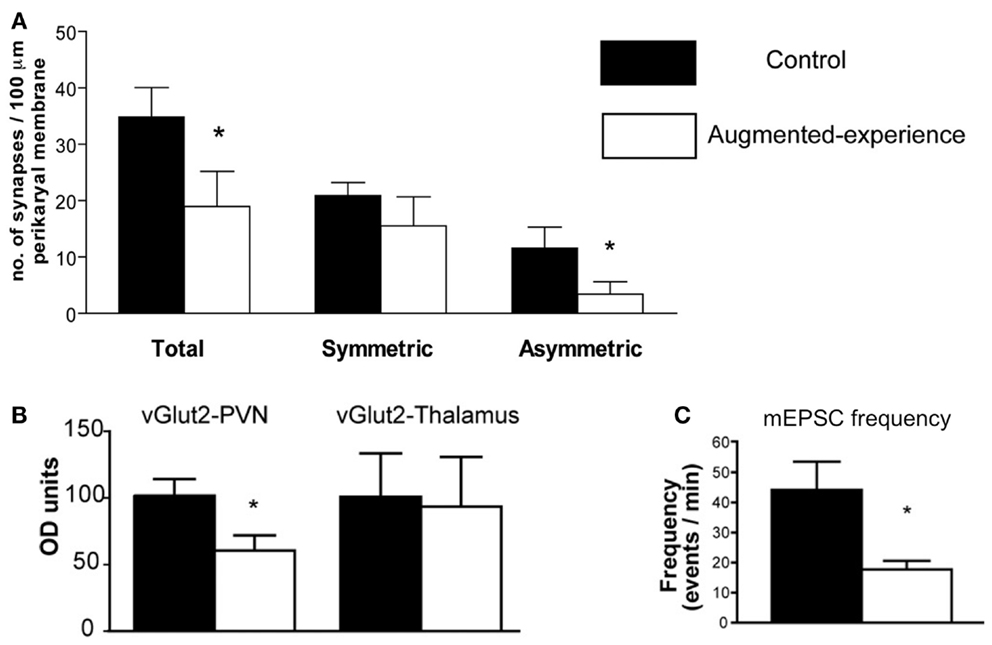
Corticotropin-releasing hormone gene expression is regulated by transcription factors, and these in turn are activated by signals that reach the nucleus from the membrane, and often involve calcium signaling (20). Synaptic input onto the CRH-expressing neuron includes a number of neurotransmitters, of which glutamate constitutes a major excitatory input (21). Indeed, glutamatergic signaling in the PVN is necessary for the initiation of the endocrine stress response, and glutamate receptor agonists delivered to the PVN drive CRH release (22, 23). Recent research has revealed that early-life augmented care leads to a transient reduction in the number and function of glutamatergic synapses to CRH neurons in the PVN (11). Using several methods (immunohistochemistry, electron microscopy, and electrophysiology), Korosi et al. discovered that (1) the number of glutamatergic terminals abutting CRH-positive neurons was reduced, (2) the number of asymmetric, putative excitatory terminal boutons onto CRH neurons was reduced, and (3) the frequency of spontaneous excitatory postsynaptic currents to PVN neurons was dramatically reduced (Figure 1). The same measures were taken in the thalamus and yielded no changes. Similarly, there were no changes in markers of inhibitory transmission. Together these data strongly support the notion that augmented maternal care reduces excitatory drive to the CRH-expressing neuron in the PVN.
FIGURE 1
http://www.frontiersin.org/files/Articles/57518/fpsyt-04-00089-HTML/image_m/fpsyt-04-00089-g001.jpg

Figure 1. Augmented early-life experience reduces the number and function of excitatory synapses in the paraventricular nucleus of the hypothalamus (PVN). (A) Total number of synapses was reduced by 50%, attributable to a 70% reduction of asymmetric (excitatory) synapses onto CRH-expressing neurons in the PVN. (B) Levels of the vesicular transporter vGlut2, a marker of glutamate-containing synaptic vesicles, were reduced by approximately 40% in rats with augmented early-life experience relative to controls. (C) Miniature excitatory postsynaptic currents (mEPSC) frequency was reduced by 60% in putative CRH neurons. Adapted from Ref. (11) with permission from the Journal of Neuroscience.
Whereas the correlation between reduction in excitation and reduction of CRH expression is suggestive, it does not answer the question of causality: is reduced glutamatergic input to a CRH cell required and sufficient to repress CRH? To address this question, in vitro methods have been initiated, with the use of organotypic hypothalamic slice cultures to isolate the PVN. In this system, application of glutamate receptor antagonists (blocking both AMPA- and NMDA-type receptors) can effectively eliminate ionotropic glutamatergic transmission. Pilot data suggests that this manipulation may suffice to repress CRH mRNA levels compared to vehicle-treated controls (24). These initial findings are consistent with the notion that augmented maternal care reduces excitatory drive to the PVN, which in turn leads to reduced CRH mRNA production.
How Does the Sensory Signal from Maternal Care Reach the PVN and Serve to Reduce Excitatory Synapse Number and Function?

Maternal input to her progeny consists of a variety of stimuli, among which sensory stimuli and especially touch (licking, grooming) appear to be the most important (2527). Levine’s group demonstrated that augmented HPA responses to stress caused by 24 h maternal deprivation could be prevented by stroking the pups, highlighting the importance of tactile stimulation to normal development of HPA activity (28). Using brain-mapping methods, the pathways through which these signals reach the PVN have been identified (29).

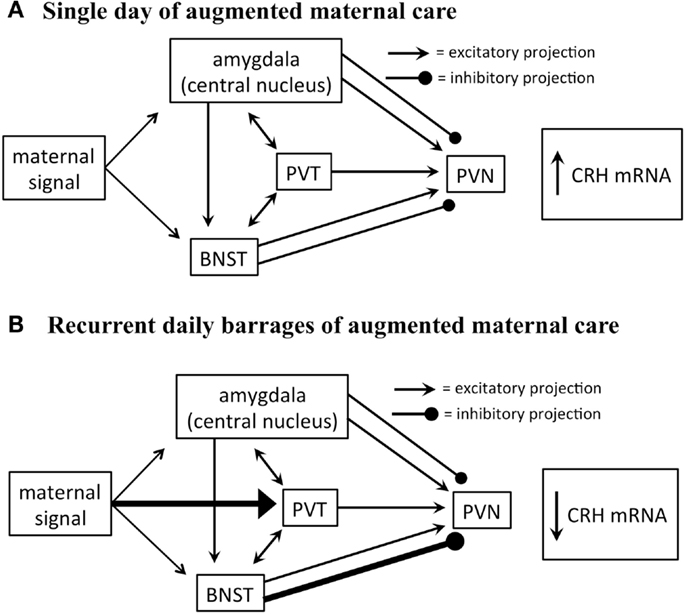
Glutamate-specific retrograde tracing revealed that excitatory afferents terminating in the PVN originate in the paraventricular thalamus (PVT), lateral septum, bed nucleus of the stria terminalis (BNST), and amygdala (30). The BNST integrates and relays signals from the limbic forebrain and amygdala and provides both inhibitory and excitatory drive to the PVN. Specifically, posterior sub-regions inhibit stress-induced CRH expression in the PVN, whereas anterior regions facilitate it (31). The central nucleus of the amygdala (CeA), important for integration of autonomic inputs, facilitates CRH release from the PVN (Figure 2), likely via the BNST (32, 33).
FIGURE 2
 http://www.frontiersin.org/files/Articles/57518/fpsyt-04-00089-HTML/image_m/fpsyt-04-00089-g002.jpg

Figure 2. Proposed circuitry involved in conveying maternal-derived sensory input to CRH-expressing neurons in the PVN. The PVN receives excitatory and inhibitory projections, including projections from the amygdala, paraventricular thalamic nucleus (PVT), and bed nucleus of the stria terminalis (BNST). These regions are also interconnected by excitatory projections (solid black lines). (A) The amygdala and BNST are both activated after a single day of handling-evoked augmented maternal care, and in turn stimulate the PVN (29). (B) The PVT is not activated after a single day of augmented maternally derived sensory input, but is recruited by recurrent daily barrages. This is thought to activate regions of the BNST that inhibit CRH-expressing neurons in the PVN (31). It is not fully known how this series of events promotes reduced numbers of excitatory synapses on CRH-expressing neurons.
Importantly, both the CeA and BNST are activated by maternal care. Handling rat pups evokes a burst of nurturing behavior (licking and grooming) by the dam upon the pups’ return to the home cage. A single instance of handling results in c-fos activation in both BNST and CeA (29), yet did not influence CRH expression. In contrast, recurrent handling for a week, which led to repression of CRH expression, was associated with c-fos activation also within the PVT (29). This suggests that the contribution of the PVT to the overall circuit that conveys maternal signals to the CRH cells in the PVN is important to reduce the expression of the gene. The PVT has been shown to play an important role in stress memory and adaptation (34, 35). The PVT sends afferents to the PVN, and possesses bidirectional connections with the CeA and BNST (36). Considering that the majority of PVT output to the structures described above are excitatory, how might PVT activation result in repression of the PVN? Here, we speculate that activation of the PVT might excite BNST regions that are known to inhibit CRH expression in the PVN (Figure 2).
Initiation vs. Maintenance of Epigenetic Repression of CRH by Early-Life Experience

When considering the changes in gene expression that occur after augmented maternal care, it is important to note two key differences in timing. Repression of CRH begins around postnatal day 9 and persists through adulthood, while changes in glutamatergic signaling to the PVN were noted only at P9 and were back to control levels by P45 (11). This suggests that following the initiation signal mediated by reduction of glutamatergic signaling, there may be additional factors that are involved in maintaining the repression of gene expression that persists long past the initiating signal. Such factors are likely to be epigenetic in nature.

A likely suspect is the neuronal repressor neuron restrictive silencer factor (NRSF). NRSF is a transcription factor that silences gene expression via epigenetic modifications. The CRH intron contains a functional NRSF binding sequence (37), suggesting that the programing of the crh gene during early postnatal life may be due to NRSF activity. In fact, NRSF levels in the PVN are dramatically upregulated following augmented maternal care, starting at P9 and persisting into adulthood (11). This pattern is an inverse correlate of CRH expression levels following augmented maternal care, supporting the idea that NRSF may be involved in mediating CRH repression.
Implications for PTSD

Post-traumatic stress disorder is often associated with a history of early-life trauma (19, 3840), and more specifically with chronic stressful situations such as abuse and long-lasting war rather than an acute event (4147). PTSD is characterized by a persistently dysregulated stress response (19, 48, 49), and it is reasonable to assume that chronic early-life stressful events influences an individual’s stress response to promote PTSD. There are several processes that might account for altered stress responses in PTSD. It has been posited that the hypothalamic-pituitary-adrenal axis is permanently sensitized by chronic early-life abuse, and this creates a vulnerability to subsequent trauma, resulting in PTSD. However, the mechanism of such sensitization is unclear. Here we provide a novel and plausible solution: if chronic early-life predictable and nurturing maternal care can reduce excitatory synaptic input onto stress-sensitive neurons in the hypothalamus, and hence “desensitize” future stress responses, then might abusive, erratic, or neglectful maternal behavior provoke the opposite? Augmentation of excitatory input to hypothalamic CRH cells may well serve to sensitize CRH release to future stresses. Whereas this notion is speculative at this point, it is highly amenable to direct testing in animal models. A second possible basis of the abnormal stress response in PTSD that follows early-life chronic stress/abuse may include aberrant regulation of the expression of relevant genes, such as CRH. Here we provide insight into how early-life experience – nurturing or adverse – can result in persistently altered regulation of CRH expression. The lifelong changes in CRH release and expression that result from chronic early-life experiences may provide the neurobiological basis for resilience or vulnerability to subsequent stress, and hence to the development of PTSD.

Conflict of Interest Statement

The authors declare that the research was conducted in the absence of any commercial or financial relationships that could be construed as a potential conflict of interest.

Acknowledgments

The excellent editorial assistance of Mrs. Barbara Cartwright is appreciated. Authors’ research has been supported by NIH grants NS28912; MH73136 NS 45260 (CM Gall, PI).

References available at the Frontiers site

Friday, November 22, 2013

Would an 'Anti-Ketamine' Also Treat Depression?


Ketamine works, at the explanatory level (the actual mechanism is still debatable), by blocking one of the targets for the neurotransmitter glutamate in the brain, the N-methyl-D-aspartate (NMDA) glutamate receptor. A new study in Biological Psychiatry reports that enhancing, instead of blocking, that same target - the NMDA glutamate receptor - also causes antidepressant-like effects.

Would an 'Anti-Ketamine' Also Treat Depression?


Nov. 18, 2013 — Thirteen years ago, an article in this journal first reported that the anesthetic medication, ketamine, showed evidence of producing rapid antidepressant effects in depressed patients who had not responded to prior treatments. Ketamine works by blocking one of the targets for the neurotransmitter glutamate in the brain, the N-methyl-D-aspartate (NMDA) glutamate receptor.

Now, a new study in Biological Psychiatry reports that enhancing, instead of blocking, that same target -- the NMDA glutamate receptor -- also causes antidepressant-like effects.

Scientists theorize that NMDA receptor activity plays an important role in the pathophysiology of depression, and that normalizing its functioning can, potentially, restore mood to normal levels.

Prior studies have already shown that the underlying biology is quite complex, indicating that both hyperfunction and hypofunction of the NMDA receptor is somehow involved. But, most studies have focused on antagonizing, or blocking, the receptor, and until now, studies investigating NMDA enhancement have been in the early phases.

Sarcosine is one such compound that acts by enhancing NMDA function. Collaborators from China Medical University Hospital in Taiwan and the University of California in Los Angeles studied sarcosine in an animal model of depression and, separately, in a clinical trial of depressed patients.

"We found that enhancing NMDA function can improve depression-like behaviors in rodent models and in human depression," said Dr. Hsien-Yuan Lane, the corresponding author on the article.

In the clinical portion of the study, they conducted a 6-week trial where 40 depressed patients were randomly assigned to receive sarcosine or citalopram (Celexa), an antidepressant already on the market that was used as a comparison drug. Neither the patients nor their doctors knew which one they were receiving.

Compared to citalopram, patients receiving sarcosine reported significantly improved mood scores, were more likely to experience relief of their depression symptoms, and were more likely to continue in the study. There were no major side effects in either group, but patients receiving citalopram reported more relatively minor side effects than the patients being treated with sarcosine.

"It will be important to understand how sarcosine, which enhances NMDA receptor function, produces the interesting effects reported in this study. There are ways that its effects, paradoxically, might converge with those of ketamine, a drug that blocks NMDA receptors," commented Dr. John Krystal, Editor of Biological Psychiatry. "For example, both compounds may enhance neuroplasticity, the capacity to remodel brain networks through experience. Also, both potentially attenuate signaling through NMDA receptors, ketamine with single doses and sarcosine, with long-term administration, by evoking an adaptive down regulation of NMDA receptors."

Better understanding the reported findings may help to advance the development of medication treatments for patients who do not respond to available treatments. This is an important goal, with estimates indicating that as many as half of all patients do not experience complete relief of their depression.

Full Citation:
Chih-Chia Huang, I-Hua Wei, Chieh-Liang Huang, Kuang-Ti Chen, Mang-Hung Tsai, Priscilla Tsai, Rene Tun, Kuo-Hao Huang, Yue-Cune Chang, Hsien-Yuan Lane, Guochuan Emil Tsai. (2013, Nov 15). Inhibition of Glycine Transporter-I as a Novel Mechanism for the Treatment of Depression. Biological Psychiatry, 74(10): 734-741. DOI: 10.1016/j.biopsych.2013.02.020


Abstract

Background

Antidepressants, aiming at monoaminergic neurotransmission, exhibit delayed onset of action, limited efficacy, and poor compliance. Glutamatergic neurotransmission is involved in depression. However, it is unclear whether enhancement of the N-methyl-D-aspartate (NMDA) subtype glutamate receptor can be a treatment for depression.
 

Methods

We studied sarcosine, a glycine transporter-I inhibitor that potentiates NMDA function, in animal models and in depressed patients. We investigated its effects in forced swim test, tail suspension test, elevated plus maze test, novelty-suppressed feeding test, and chronic unpredictable stress test in rats and conducted a 6-week randomized, double-blinded, citalopram-controlled trial in 40 patients with major depressive disorder. Clinical efficacy and side effects were assessed biweekly, with the main outcomes of Hamilton Depression Rating Scale, Global Assessment of Function, and remission rate. The time course of response and dropout rates was also compared.
 

Results

Sarcosine decreased immobility in the forced swim test and tail suspension test, reduced the latency to feed in the novelty-suppressed feeding test, and reversed behavioral deficits caused by chronic unpredictable stress test, which are characteristics for an antidepressant. In the clinical study, sarcosine substantially improved scores of Hamilton Depression Rating Scale, Clinical Global Impression, and Global Assessment of Function more than citalopram treatment. Sarcosine-treated patients were much more likely and quicker to remit and less likely to drop out. Sarcosine was well tolerated without significant side effects.
 

Conclusions

Our preliminary findings suggest that enhancing NMDA function can improve depression-like behaviors in rodent models and in human depression. Establishment of glycine transporter-I inhibition as a novel treatment for depression waits for confirmation by further proof-of-principle studies.

Monday, September 02, 2013

Like Ketamine, Isoflurane Anesthesia Is as Effective as ECT, Without the Cognitive Side Effects

At the end of a recent BBC article (Why are we still using electroconvulsive therapy? Jul 24, 2013) on the contemporary use of electroconvulsive therapy (ECT) for treatment-resistant depression, Professor Ian Reid (University of Aberdeen) is quoted as saying, "No one would be happier than me if we could reproduce the changes that ECT has on the brain in a less invasive and safer way for patients."

ECT shock being applied to patient

Earlier in the article, the reporter offers a brief summary of the current theory of how ECT can be effective in reducing depressive symptoms in those who have not responded to other approaches (mostly pharmaceutical).
The latest theories build on the idea of hyperconnectivity. This new concept in psychiatry suggests parts of the brain can start to transmit signals in a dysfunctional way, overloading the system and leading to conditions from depression to autism.
Prof Reid and his colleagues used MRI scanners to map the brains of nine patients before and after treatment.

In an academic paper in 2012 they claimed ECT can "turn down" overactive connections as they start to build, effectively resetting the brain's wiring. "For the first time we can point to something that ECT does in the brain that makes sense in the context of what we think is wrong in people who are depressed," Prof Reid says.
There is new research (just published this week) that supports the idea that ECT works by disrupting brain activity and neural patterns, essentially acting as a reset for brain function.
Citation:
C. Challis, J. Boulden, A. Veerakumar, J. Espallergues, F. M. Vassoler, R. C. Pierce, S. G. Beck, O. Berton. (2013, Aug). Raphe GABAergic Neurons Mediate the Acquisition of Avoidance after Social Defeat. Journal of Neuroscience; 33 (35): 13978-13988. DOI: 10.1523/JNEUROSCI.2383-13.2013
In a recent study, from the lab of Olivier Berton, PhD (assistant professor, department of Psychiatry), in collaboration with Sheryl Beck, PhD (professor, department of Anesthesiology) at Children's Hospital of Philadelphia, the researchers discovered that bullying and similar social stresses (chronic unavoidable stress, or CUS) appear to create symptoms of depression in mice. This stress response activated GABAergic neurons in the dorsal raphe nucleus (DRN), they found, which directly inhibited serotonin levels. With low serotonin levels (although no one has ever determined exactly what those levels might be [1]), a depressed mouse (and presumably a person) is more likely to be depressed and socially withdrawal.

When the researchers were able to mute the GABA neurons, the mice became more resilient to bullying and didn't avoid once-perceived threats.
"This is the first time that GABA neuron activity -- found deep in the brainstem -- has been shown to play a key role in the cognitive processes associated with social approach or avoidance behavior in mammals," said Dr. Berton. "The results help us to understand why current antidepressants may not work for everyone and how to make them work better -- by targeting GABA neurons that put the brake on serotonin cells."
This where the research into ketamine as a powerful tool in alleviating treatment-resistant depression.

Ketamine is known primarily as a NMDA receptor noncompetitive antagonist (inhibits action of the NMDA receptor), used most often as an anesthetic, but known to have a wide range of effects in humans, including analgesia, anesthesia, hallucinations, elevated blood pressure, and bronchodilation. Like other drugs of its class, such as tiletamine and phencyclidine (PCP), ketamine induces a state referred to as "dissociative anesthesia" and, known on the street as Vitamin K, is used as a recreational drug.

The development of depressive behaviors, notably anhedonia (inability to experience pleasure), with CUS exposure (as in the mice studied above) make CUS one of the most valid research models for depression. There is already considerable and still building evidence that glutamate NMDA receptor antagonists can rapidly reverse behavioral and synaptic deficits caused by chronic stress exposure (Li et al., Biological Psychiatry, 2011).

From Li, et al:
Chronic stress paradigms have been demonstrated to profoundly alter brain structure and function in rodents, causing atrophy of pyramidal neurons in the PFC and the hippocampus (12,13,15-18,20,32). Studies were conducted to determine if our CUS paradigm results in alterations of synapse-associated proteins, as well as the number and function of spine synapses, and if ketamine can reverse these effects. CUS exposure (21 d) decreased levels of several well-characterized synaptic proteins in synaptoneurosome preparations of PFC (Figure 3).
Administration of single dose of ketamine rapidly reversed the CUS-induced behavioral deficits in various feeding behaviors, as well as restoring CUS-decreased levels of the presynaptic protein synapsin I and the postsynaptic proteins GluR1 subunit and PSD95.


The following is from a paper by Rujescu, et al (2006: A Pharmacological Model for Psychosis Based on N-methyl-D-aspartate Receptor Hypofunction: Molecular, Cellular, Functional and Behavioral Abnormalities; Biological Psychiatry; 59:721–729):
Blocking NDMA receptors leads to an excessive release of glutamate (Glu) in the cerebral cortex (Moghaddam et al 1997). This in turn can have deleterious effects on the blocked neuron as well as on downstream corticolimbic brain regions. The paradox of eliciting increased excitation by blocking an excitatory receptor becomes intelligible in view of the functional interaction of gamma-aminobutyric acid (GABA)ergic (inhibitory) interneurons and glutamatergic (excitatory) neurons in local circuits. Activation of GABAergic interneurons via NMDA receptors exerts an inhibitory tone on the major excitatory neurons (Olney et al 1991). As we have demonstrated, GABAergic interneurons are tenfold more sensitive to NMDA receptor inhibitors than pyramidal neurons (Grunze et al 1996). Application of these agents would therefore result in a disinhibition of pyramidal cell activity with widespread downstream glutamate mediated excitotoxicity through alpha-amino-3-hydroxy-5-methyl-4-isoxazole propionic acid (AMPA) and kainate receptors, which remain largely unaffected by NMDA inhibitors like MK-801 (Ikonomidou et al 1989,1999).
And even if this dysregulation created by blocking (or inhibiting, in the case of ketamine) NMDA receptors was not severe enough to cause structural damage, there are likely to be considerable functional consequences "because of the crucial role of inhibitory GABAergic output for information processing":
According to in vitro data, GABAergic neurons yield an oscillatory synchronization of anatomically distributed cell groups, which is considered essential for proper integration of temporospatial information in memory operations (Buzsaki and Chrobak 1995; Buzsaki and Draguhn 2004; Ritz and Sejnowski 1997; von der Malsburg 1995).
As discussed in the Challis, et al article above, CUS causes GABAergic neurons to become much more excitable, which leads to symptoms of depression and anxiety. Increased GABA levels cause a commensurate drop in serotonin levels, which researchers associate with expressions of social defeat, withdrawal, and anhedonia.

Based on the available research, it seems the ketamine "cures" depression so quickly by shutting down the excitability of GABAergic neurons (which become excitable as a result of the organism being exposed to chronic unavoidable stress). Reduced GABA allows for increased serotonin levels, which are associated with "a positive shift in the perception of socio-affective stimuli, promoting affiliation and dominance."

This is a much more targeted approach than ECT, which likely also shuts down GABAergic neuron excitability, but has a much wider range of effects as well. The brain reset associated with ECT is done much more efficiently with ketamine. Like ECT, ketamine (an anesthetic) also probably generates a "electrocortical quiescence" in the brain that functions as a reset mechanism.

Like ketamine, a newer anesthetic substance, Isoflurane, also seems to demonstrate rapid decreases in depressive symptoms for those who have been unresponsive to other pharmaceutical treatments. From Wikipedia:
Isoflurane reduces pain sensitivity (analgesia) and relaxes muscles. Isoflurane likely binds to GABA, glutamates and glycine receptors, but has different effects on each receptor. It potentiates glycine receptor activity, which decreases motor function. It inhibits receptor activity in the NMDA glutamate receptor subtype. Isoflurane inhibits conduction in activated potassium channels. Isoflurane also affects intracellular molecules. It activates calcium ATPase by increasing membrane fluidity. It binds to the D subunit of ATP synthase and NADH dehydrogenase.
There is increasing evidence of isoflurane effectiveness in treating major depression.


Citation:
Weeks HR III, Tadler SC, Smith KW, Iacob E, Saccoman M, et al. (2013, Jul 26). Antidepressant and Neurocognitive Effects of Isoflurane Anesthesia versus Electroconvulsive Therapy in Refractory Depression. PLoS ONE 8(7): e69809. doi: 10.1371/journal.pone.0069809
When isoflurane is compared head-to-head with ECT, the outcomes are similar, except that the ECT subjects suffered greater cognitive deficits. Over the course of 3 weeks, patients with "medication-refractory depression" received an average of 10 treatments of bifrontal ECT (N=20) or an equivalent number of deep-inhalation isoflurane treatments (N=8).

Here is a nice summary of the results from Medscape Medical News:
Both therapies produced significant (P < .0001) reductions in depression scores on the Hamilton Rating Scale for Depression–24 immediately following the end of treatment, and the benefits persisted at 4 weeks' follow-up. ECT patients had "modestly better" antidepressant effect at follow-up in severity-matched patients, the researchers note.

As expected, ECT caused thinking problems. Immediately after the treatments, ECT patients showed decline in memory, verbal fluency, and processing speed. Most of these ECT-related deficits resolved by 4 weeks. However, autobiographic memory, or recall of personal life events, remained below pretreatment levels for ECT patients 4 weeks after treatment.

In contrast, patients treated with isoflurane showed no performance decrement on any of the traditional cognitive impairment measures at any point. In fact, the isoflurane patients showed significant improvements in some tests, which could be a result of the combined effects of decreased depressive state and practice.
The next step in the research should be a head-to-head, placebo controlled double-blind study comparing isoflurane with ketamine. At the moment, it seems that isoflurane requires more treatments (they used 10 deep-inhalation isoflurane treatments over three weeks in the PLoS ONE study) than ketamine (a 2012 study used 6 intravenous infusions treatments over two weeks [2]).

In fact, this second study (Murrough, 2012) postulated a mechanism of action similar to what I have proposed above:


A series of studies found that ketamine and other NMDAR antagonists enhance glutamateric signaling in the cortex of rodents, potentially through inhibition of GABAergic interneurons and subsequent disinhibition of cortical pyramidal neurons (26,27). Enhancement of activity at pyramidal glutamatergic synapses by ketamine would be consistent with the observations of enhanced cortical synaptic plasticity and function described above. Neuroimaging studies in humans likewise suggest that subanesthetic doses of ketamine result in elevated cortical activity, including in regions of PFC and ACC (2831). A functional MRI (fMRI) study found that ketamine resulted in decreased activity in ventromedial PFC (VMPFC), OFC and SGACC accompanied by increased activity in posterior cingulate and other cortical regions (32).

So while ECT seems to affect much of the brain, which no doubt accounts for the cognitive deficits and the loss of autobiographical memory, ketamine (and presumably isoflurane) dampens activity in the ventromedial prefrontal cortex (vmPFC), the orbital frontal cortex (OFC), and the subgenual anterior cingulate cortex (sgACC), while it also increases activity in the posterior cingulate and other cortical regions.


The vmPFC is associated with emotional processing, decision making and, according to Antonio Damasio (1996) [3], via Wikipedia:
the vmPFC has a central role in adapting somatic markers—emotional associations, or associations between mental objects and visceral (bodily) feedback—for use in natural decision making. This account also gives the vmPFC a role in moderating emotions and emotional reactions because whether the vmPFC decides the markers are positive or negative affects the appropriate response in a particular situation.
The sgACC is also associated with emotion regulation (Drevets, Savitz, and Trimble, 2009), and it shows a size decrease in those with depression:
In a combined positron emission tomography/magnetic resonance imaging study of mood disorders, we demonstrated that the mean gray matter volume of this “subgenual” ACC (sgACC) cortex is abnormally reduced in subjects with major depressive disorder (MDD) and bipolar disorder, irrespective of mood state. Neuropathological assessments of sgACC tissue acquired postmortem from subjects with MDD or bipolar disorder confirmed the decrement in gray matter volume, and revealed that this abnormality was associated with a reduction in glia, with no equivalent loss of neurons. In positron emission tomography studies, the metabolic activity was elevated in this region in the depressed relative to the remitted phases of the same MDD subjects, and effective antidepressant treatment was associated with a reduction in sgACC activity.
The OFC is more of a switching station, processing sensory data from a variety of somatic inputs and sharing extensive connections with other association cortices, primary sensory and association cortices, limbic systems, and other subcortical areas. Corticocortical connections include extensive local projections to and from other prefrontal regions, as well as with motor, limbic, and sensory cortices. Areas projecting to motor areas are densely interconnected with other prefrontal cortical regions, reflecting integration for executive motor control (Cavada, Company, Tejedor, Cruz-Rizzolo, and Reinoso-Suarez, 2000).

From this it seems that part of the effect of ketamine infusion is a dampening of the parts of the brain associated with emotional regulation, affective processing, and the interplay between somatic states and emotional states. Since isoflurane also seems to work on the glutamate system, it will be interesting to see if it produces the same outcomes and affects the same brain structures and functions.

Bottom line: both ketamine and isoflurane are effective and safer therapeutics for treatment-resistant depression.


NOTES:

1. "There is now substantial evidence that unmedicated depressed patients have abnormalities in brain 5-HT function; however, the relation of these abnormalities to the clinical syndrome is unclear." [Cowen, PJ. (2008, Sep 1). Serotonin and depression: Pathophysiological mechanism or marketing myth? Trends in Pharmacological Sciences, Volume 29, Issue 9, 433-436. doi: 10.1016/j.tips.2008.05.004]

2. Citation for this study:
Murrough, JW. (2012, Feb). Ketamine as a Novel Antidepressant: From Synapse to Behavior. Clinical Pharmacology & Therapeutics; 91(2): 303–309. Published online 2011 December 28. doi:  10.1038/clpt.2011.244


3. Citation for the Damasio study:
Damasio, AR, Everitt, BJ, Bishop, D. (1996, Oct 29). The Somatic Marker Hypothesis and the Possible Functions of the Prefrontal Cortex. Philosophical Transactions: Biological Sciences, Vol. 351, No. 1346, Executive and Cognitive Functions of the Prefrontal Cortex, pp. 1413-1420.