Showing posts with label gender. Show all posts

Friday, June 01, 2012

An Evening with Jeanette Winterson


At the Sydney Opera House for the Sydney Writers' Festival, Jeanette Winterson reads from her new memoir Why Be Happy When You Could Be Normal? and talks about books, life, love, death, madness and creativity.

Jeanette Winterson is the author of 10 novels including Oranges Are Not The Only Fruit, The Passion, and Sexing The Cherry; a book of short stories, The World And Other Places; a collection of essays, Art Objects, as well as many other works including children’s books, screenplays and journalism.

I was especially fond of her collection of meditations on art, literature, and identity, Art and Lies. The novel that launched her from a relatively unknown postmodern academic author to critical and public acclaim was Written on the Body, a fascinating novel with a nameless, genderless narrator.

Presented by Sydney Writers' Festival, May 2012. Duration: 01:00:42


Tuesday, February 28, 2012

Pierre Côté - The Relative Happiness Index

  Interesting . . . . You test your own happiness at the RHI website.


ABSTRACT

Can happiness be a science? Can we actually qualify happiness with scientific notions instead of esoteric ones? How can happiness be useful? Are women happier than men? Is Montreal a happier metropolis than Quebec city? What can we learn from happiness? Brace yourself for Pierre Côté, the creator of the Relative Happiness Index, who is ready to answer all of these questions and more!

Speaker: Pierre Côté
Marketing and communication senior consultant
President and founder of the RHI (Relative Happiness Index)
Participant in the TV series Castaway Cities
Author

Join us for this unique tech talk on The Relative Happiness Index (RHI), a unique social observatory tool.

A bold visionary and very sensitive to the social reality, Pierre Côté founded in 2006 the Relative Happiness Index. The main objective of this index is to develop from happiness a real and a scientific variable that will be useful to establish a judgment or to evaluate a society, a community or a group of people.

An independent social observatory tool, the Relative Happiness Index, through the forty inquiries realised since 2006, surveyed no less than 70 000 Quebecers by asking over 800 questions.

The Pierre Côté experience and his profound knowledge of Quebec's society acquired through the Relative Happiness Index makes him a unique consultant. As such, he's regularly invited by the media to share and explain the results of his researches and to comment on different aspects of society.
This is from their website - it offers some definitions for what they are looking at trying to measure.

Abstract Concept or Tangible Reality?

[ A Selective and Relative Notion ]
[ Happiness: a Social Paradox ]
[ Happiness: Aptitude or Attitude? ]
[ Personal Assessment ]

A Selective and Relative Notion

According to French author and politician André Malraux, "happiness is for imbeciles," in the sense that it is utopian to believe that anyone can attain an absolute state in a relative world. It follows that only an absolute imbecile could believe in achieving it some day.

"We should die when we're happy," opined singer Jacqueline Dulac, in clearly demonstrating the difficult, even impossible, quest of attaining perfect happiness and the ultimate value of this state.

While many philosophers, intellectuals, and researchers have given their opinions on the issue of happiness, they agree on only a single point: happiness is subjective and relative. And it's because happiness is so subjective and relative that so much discussion and debate has focused on defining it and, to a greater degree, on determining the various methods for attaining it.

Happiness: a Social Paradox

Today, happiness appears to be turned more outwardly than inwardly. Moreover, the view of success that society imposes on us is such that saying you're unhappy is like admitting your life has been a failure. Undoubtedly, this accounts for the paradox that, while the great majority of people tend to consider themselves happy or very happy, everyday life gives us an increasing number of signs to the contrary.

Many thinkers criticize today's consumer society and its various requirements for its focus on having rather than being and on the obligation to perform, as if quality could only be achieved by quantity.

Some even claim that the many pleasures of modern society—artificial, sensational, and ephemeral—mask the true quest for happiness, push the individual further away from a minimal but essential spirituality, and reduce happiness to a simplistic, materialistic, and quantifiable notion.

Happiness: Aptitude or Attitude?

Is achieving happiness related to an ability that each of us has to accept or reject life as it is? Do some people have a greater aptitude for happiness than others?

Abraham Maslow, the father of humanistic psychology, believed so. He identified two fundamental factors defining this aptitude for happiness: solving concrete problems rather than withdrawing into one's self and avoiding social norms and conditions.

Moreover, Maslow positively stated that happiness is achieved through a higher degree of self-actualization.

There are many other models and theories that advocate striving for and focusing on the "here and now" to attain a certain level of happiness. In fact, any activity whatsoever that requires concentration here and now brings us closer to this state, with the objective being to recreate these conditions as often as possible in everyday life. This attitude then becomes a kind of philosophy and happiness takes root in all kinds of small daily gestures.

Happiness can also be expressed through "cosmic participation" which is the feeling of taking part in something bigger than yourself, something that both surrounds and contains you. This refers to the very meaning of life and to a much more spiritual definition of happiness.

From a more existentialist standpoint, can happiness only be achieved after death? Some people think so and that our time in this world is only a preparatory step. Such thinkers consider that the journey, not the destination, is what counts.

Nevertheless, most intellectuals and thinkers agree that happiness does not occur by itself: it requires personal work. The world we perceive in our minds is not the real world. The discrepancy between the two is what makes us unhappy. It's never good to maintain dissonance and illusion. We need to strive to ensure that the world in our minds resembles the real world as closely as possible.

Personal Assessment

So, is happiness an abstract concept or a concrete reality…or does it is way back and forth between the two? Certainly, it's not easy to demarcate, delimit, or, even less so, define. The Relative Happiness Index (RHI) doesn't aim or claim to do so. The assessment of happiness, however, does interest us when it is firmly rooted in the individual's perception of him- or herself and his or her life.

And who knows, you might find elements on this site that help you in your personal development.

Happy browsing!

Wednesday, February 22, 2012

Bookforum's Omnivore - A Point of Critique

Another interesting collection of links for Bookforum's Omnivore - this one looks at criticism and critical theory, including philosophy.
 

Friday, July 22, 2011

Alva Noë - Social By Nature (on Sex Differences)

http://webpages.scu.edu/ftp/mgaletto/wagons/Gender%20roles.JPG

In his most recent 13.7 Cosmos and Culture blog post, philosopher Alva Noë looks at the evidence for cognitively significant differences between men and women. Notice the title says "sex" differences, not gender - sex is biological, gender is social. Many of the differences discussed here are inborn, or quite possibly epigenetic (for example, women get PTSD more often and worse than men, but men are more likely to be ADHD or autistic). But then he goes back to his original thesis, that the largest differences are social and cultural - gender roles - not neurobiological.

This is a follow-up to an earlier post - Gender Is Dead! Long Live Gender! - in which he looked at the
known cognitive and psychological differences between men and women. But here he warns:

The question we need to take seriously is: Do the known sex differences in neurobiology go any way toward explaining the known cognitive and psychological differences that find expression in the lives of men and women?

The answer to this is a resounding no. This is so, even if it turns out, as work by Jacobs suggests, that female sex hormones modulate neurotransmitters that play a role in cognition.

You're looking in the wrong place if you look to the brain for an understanding of what makes us different.

What makes us different? We do. We don't just happen to be boys and girls, men and women; we identify with ourselves as such, and we shape ourselves to conform to the rigid matrix of ideas and values that make up our conception of what it is to be male and female.

Gender differences are partly based in sex differences, there is no escaping this, but there are also incredibly powerful cultural forces that force into gender boxes, through unconscious acculturation, social learning, shame, and even violence.
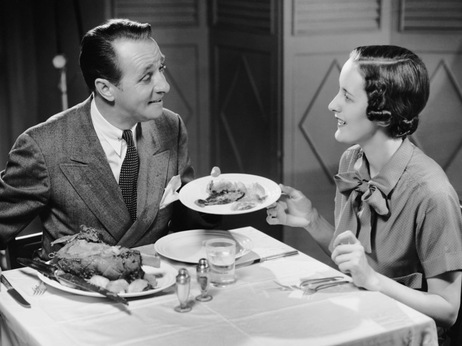
CIRCA 1950s:  Husband serving wife dinner.
Enlarge George Marks/Getty Images

Are there cognitively significant neurobiological differences between men and women? According to the best cognitive science, as I have suggested in recent posts, the answer is clearly no.

I've received a fair bit of friendly criticism from smart neuroscientists about this.

As a community, neuroscientists are a pretty progressive lot; they like the idea that there is no biological justification for gender stereotyping that has tended to be harmful to women. At the same time, they are rightly wary of letting this sort of political consideration obscure what is an undeniable fact: there are widespread and substantial differences between male and female brains.

The neural differences show up all over the place and go way beyond the effects on brain chemistry of estrous and menstrual cycles (effects which are not small). As UC Irvine's Larry Cahill explains, there are sex differences not only in the incidence but also the nature of a large number of diseases of the central nervous system, including, e.g. Alzheimer's, PTSD and other anxiety disorders, schizophrenia, stroke, multiple sclerosis, autism, addiction, fibromylagia, attention deficit disorder, irritable bowel syndrome, Tourette's syndrome, and eating disorders.

There may well be cognitively significant differences, too.

As neuroscientist Emily Jacobs (now at Harvard, then at Berkeley) has shown, there is reason to think estrogen may have a positive effect on neural activity in prefrontal cortex, an effect that translates directly into an improvement in working memory. Her research, and that of others, points in the direction that differences in male/female neurobiology may advantage women!

I agree one-hundred percent that we don't get to pick our findings to support our political beliefs. But I reject the idea that it might somehow be politically dangerous to admit that there are biological differences between men and women. After all, we know that there are such neurobiological differences (see above). Moreover, as I stressed in my first post, we know that there are cognitive and psychological differences between men and women, differences that show up in testing and performance.

The question we need to take seriously is: Do the known sex differences in neurobiology go any way toward explaining the known cognitive and psychological differences that find expression in the lives of men and women?

The answer to this is a resounding no. This is so, even if it turns out, as work by Jacobs suggests, that female sex hormones modulate neurotransmitters that play a role in cognition.

You're looking in the wrong place if you look to the brain for an understanding of what makes us different.

What makes us different? We do. We don't just happen to be boys and girls, men and women; we identify with ourselves as such, and we shape ourselves to conform to the rigid matrix of ideas and values that make up our conception of what it is to be male and female.

Why do girls do less well than boys on math tests? Because they understand that they are supposed to do less well. As the studies described earlier show, if you screen out gender by priming girls to self-identify not as girls but as, say, students at elite colleges, performance improves, just as if you prime boys for thinking of themselves as boys, rather than students, their performance on verbal tests drops.

Gender is real. People are men and women. And this makes a difference not only to how they live, to how much they earn, to how well they perform, but also to how they experience themselves, their bodies and their lives.

But gender doesn't happen in the brain, whatever sex differences on the brain there are. Gender, rather, is something we enact together in a social and political realm.

It is important to realize that this does not make it any less real or less natural for all that.

To understand human nature, we need to expand our conception of what the natural is.


Thursday, March 03, 2011

The Body and the State - Session Two: The Sexual Body - The New School for Social Research

As promised, another installment in the THE NEW SCHOOL FOR SOCIAL RESEARCH conference on The Body and the State. This one is cool - some very interesting topics.

The Body and the State - Session 2 - Part 1
THE SEXUAL BODY

Moderator: William Hirst, Professor of Psychology, The New School for Social Research

How do various forces compete to impose their conception of what is "normal" sexual behavior? How do we come to see particular sexual practices as legitimate (or not) and therefore legally acceptable? Cross-cultural comparisons and case studies.

HISTORY
Understandings of gender and the sexual body change. These changes are reflected in art, literature, and myth, as well as in policy. What can the history of discourse about the sexed body contribute to contemporary discussions about policy questions concerning sexuality?

God's Body: Historical Conflicts over the Representation of the Sexual Body of the Hindu God Shiva
• Wendy Doniger, Mircea Eliade Distinguished Service Professor of the History of Religions, University of Chicago Divinity School

Does Sexuality Exist Without the State?
• Sharon Marcus, Orlando Harriman Professor of English, Columbia University

GENDER
What are the policy implications of the forces shaping contemporary understandings of gender and the male or female body, including feminism, transsexuality, genital mutilation, and debates about gender and biology? Is a gender-neutral legal system possible?

Verdicts of Science, Rulings of Faith: Transgender/Sexuality in Contemporary Iran
• Afsaneh Najmabadi, Francis Lee Higginson Professor of History and of Studies of Women, Gender, and Sexuality, Harvard University

Securing Gender: States, Bodies, and Identity Verification
• Paisley Currah, Associate Professor, Department of Political Science, Brooklyn College, City University of New York (Paper co-authored by Tara Mulqueen)


The Body and the State - Session 2 - Part 2
THE SEXUAL BODY

RACE AND CLASS
Race and class are often tied to reproductive rights, access to health care, and sexual violence (e.g. rape, human trafficking). How is the struggle for race and class justice connected to struggles surrounding policies concerning the body?

Body Politic, Bodies Impolitic
• Charles W. Mills, John Evans Professor of Moral and Intellectual Philosophy, Northwestern University

Violence and Humanity: Or, Thinking Vulnerability as Political Subjectivity
• Anupama Rao, Associate Professor of South Asian History, History Department, Barnard College

SEXUAL BEHAVIOR
Who we are, what we do, and with whom affect how sexual behavior is controlled and judged. How does this play out in different cultures and legal systems?

Sexual Orientations, Rights and the Body: Immutability, Essentialism, and Nativism
• Edward Stein, Vice Dean, Professor of Law, and director of the program in Family Law, Policy, and Bioethics at Benjamin N. Cardozo School of Law, Yeshiva University

Gender Pluralism: Muslim Southeast Asia Since Early Modern Times
• Michael G. Peletz, Professor, Department of Anthropology, Emory University


Thursday, August 12, 2010

Mindfulness, Meditation, Psychology, and Personal Growth on Huffington Post

Some interesting recent articles. Here is a little taste from each article, follow the links to read the whole piece.

Keeping Your Prefrontal Cortex Online: Neuroplasticity, Stress and Meditation

Jeanne Ball Posted: August 11, 2010

As we go through life, our brain is always changing and adapting, say neuroscientists. During the first 18-20 years of life the brain is developing circuits that will form the basis of decision-making for a lifetime. Brain researchers have found that unhealthy lifestyles can inhibit normal brain development in adolescents and lead to impaired judgment and destructive behavior that carries over into adulthood. Traumatic experiences, alcohol and drug abuse, growing up neglected in a broken home, living in fear of violence and crime, or even a bad diet can interfere with development of the frontal lobes, the brain's executive system. This can cause behavioral problems. Brain researcher Dr. Fred Travis explains: "When a person's frontal lobes don't develop properly, he lives a primitive life. He doesn't -- and can't -- plan ahead. His world is simplistic, and he can only deal with what's happening to him right now. Thinking becomes rigid: 'You're either with me or against me,' or 'Me and my gang are good, and everyone else is bad.'"


* * * *

Mindfulness and Having Nothing to Say

Deborah Schoeberlein Posted: August 10, 2010

Sometimes, having nothing to say is such a relief! Know what I mean?

Of course, at other times, having nothing to say can feel uncomfortable, embarrassing and nonconstructive.

So what's the difference between these two experiences?

Here's what I've observed . . .

* * * *

A Brief History of a Meditator

Gotham Chopra Posted: August 10, 2010

A series of new studies have recently come out touting the benefits of teaching kids to meditate.

Well stop right there: allow me to say with utmost humility -- here stands the expert.

My sister Mallika and I learned to meditate when we were about four and seven years old respectively (she's older). This was early on in my father's discovery phase of the transcendental meditation movement. Contrary to popular belief, he was not always the go-to-Guru that many now see him as. He was in fact a chain-smoking, hard-drinking, cantankerous by-the-book old school physician who ironically had little faith in the ways of alternative medicine and stress relieving techniques like meditation. On somewhat of a lark he discovered a TM Center in Cambridge Mass not far from where we lived and he worked and figured he may as well give the hippie delight a try.

* * * *

The Lives Of Therapists and the Limits of Analysis

Tamara McClintock Greenberg Posted: August 9, 2010

Daphne Merkin's penetrating, moving, and poignant article in the New York Times Magazine, which describes the hopes and disappointments of nearly 40 years in various forms of analytic treatment, is likely familiar to many. Her article has the blogosphere frenetic, with many bloggers hurling critiques at psychoanalysis. Though many of these critiques are justified, it is a bit like shoving the small kid off of the monkey bars on the playground; it's just too easy to be satisfying.

That said, maybe traditional psychoanalysis still needs a wake-up call about the limitations of the theory and the ways that patients have been let down, or even failed.

* * * *

Get High on Gratitude

Maddisen K. Krown Posted: August 9, 2010

Here's a question from a reader regarding the value of gratitude:

Several of my friends extol the power of being grateful and of keeping a daily gratitude log, and I just don't get it. I tried listing what I'm grateful for a few times, but it didn't do much for me; in fact, it feels trite and almost trendy to do so. Yet, I sense there may be some value underneath all of the commotion about gratitude. What's your take on it?

Interesting question, and I'm happy to share my take on it. I keep a gratitude log myself and will share more about that below. I can understand how too much lip service or an unquestioned obedience to doing it or how trying it only a few times might play down the value and meaning of such a potent practice, making it feel trite or trendy. So, let's look gratitude in the eyes and reconnect with its inherent power.

* * * *

Why Gender Neurology Matters in Political Decision Making

Ruth Bettelheim, Ph.D. Posted: August 4, 2010

Sex and Stress: Male Vs. Female Political and Domestic Strategies

Neuroscience research confirms that when stressed, men tend toward 'fight or flight' reactions, while women prefer to talk -- and that men take more risks, while women are generally more cautious. However, neither the mechanisms underlying these findings, nor their implications for businesses, politics and families, have been adequately explored.

One month ago, Kathleen Parker's column in the Washington Post called President Obama "The First Female President" and concluded that his "feminine" political style is a liability that's making him less popular. However, Ms. Parker's conclusions are based neither on scientific understanding of male and female negotiation strategies nor on persuasive evidence.

* * * *

Confessions of a Psychoanalyst: Performance Anxiety and the Dread of Shame

Helen Davey Posted: August 9, 2010

This blog started out as a speech. To improve my skills as a public speaker, I joined Toastmasters International, an organization where members cultivate public speaking skills by studying manuals, practicing and helping one another. Soon after joining I was called upon to give my first speech. As I expected, all my old fears and insecurities emerged. Since that experience, I've given a number of speeches at Toastmasters, and yet continue to struggle with those same issues of performance anxiety. Realizing that I'm not alone with these feelings, I wanted to share my experiences with you.

Childhood is the air that we breathe. As a psychoanalyst, I've spent many years as a patient in psychoanalysis myself, understanding as deeply as I can the different aspects of my personality and how I developed. I'm at a crossroads now, and I'd like to share with you how issues from childhood having to do with performance anxiety and the dread of shame bring me face to face with a very deep conflict within me.


Sunday, May 23, 2010

Hsiao-Lan Hu: "A Feminist Exegesis of Non-Self: On Classical Buddhist Understanding of Personhood and Identity"

This is a very interesting lecture on the nature of no-self as seen from a feminist perspective. The video comes from The Metanexus Institute's Subject, Self, and Soul: Transdisciplinary Approaches to Personhood collection of videos.

Hsiao-Lan Hu: "A Feminist Exegesis of Non-Self: On Classical Buddhist Understanding of Personhood and Identity"

One of the most widely known and perplexing teachings of Buddhism is Non-Self, which seems to categorically negate the existence of individuals. Coincidentally, one of the contemporary feminist theories that draws the most critical attention is the social constructedness of gender and subjectivity. With this and other similarities, Buddhism and feminism can very well provide an exegetical framework, as well as serve as an interpretive tool and as a corrective to the gender-blindness in the understanding of the Buddhist Dhamma. Non-Self may be easier to comprehend with the feminist analysis of the constructedness of gender identity, which has been ironically overlooked in the discourses of Buddhism, a tradition dedicated to reflecting on habitual patterns of conventional ego.

2008 July 15

Hsiao-Lan Hu: "A Feminist Exegesis of Non-Self: On Classical Buddhist Understanding of Personhood and Identity" from Metanexus Institute on Vimeo.


Saturday, November 07, 2009

FORA.tv - Lise Eliot: Pink Brain, Blue Brain

Interesting . . . .

Lise Eliot talks about Pink Brain, Blue Brain. Based on research in the field of neuroplasticity, Eliot zeroes in on the precise differences between boys and girls' brains and explains the harmful nature of gender stereotypes.

She offers parents and teachers concrete ways they can help all children reach their fullest potential.

Dr. Lise Eliot, Associate Professor in the Department of Neuroscience at the Chicago Medical School, received her Ph.D. in Physiology and Cellular Biophysics from Columbia University in 1991. Working in Eric Kandel's laboratory, she combined electrophysiology and calcium imaging methods to analyze the synaptic mechanisms underlying learning in the marine mollusc, Aplysia californica.

Dr. Eliot has published more than 50 works, including peer-reviewed journals articles, magazine pieces, and the book, What's Going on in There? How the Brain and Mind Develop in the First Five Years of Life (Bantam, 2000). Honors include a Magna cum laude bachelor's degree from Harvard, a predoctoral NSF fellowship, a postdoctoral NIH fellowship, a Grass Fellowship in Neurophysiology, a Whiteley Scholarship from the University of Washington, and a Rosalind Franklin Award for Excellence in Teaching.

Dr. Eliot's newest book, Pink Brain, Blue Brain: How Small Differences Grow into Troublesome Gaps and What We Can Do About It, was published in September 2009 by Houghton-Mifflin-Harcourt.


Friday, September 05, 2008

The Root - From Clarence Thomas to Sarah Palin, Nobody Plays Cynical Identity Politics Like the GOP

The right always accuses the Left of playing identity politics, and often with good reason -- feminism, race, and cultural diversity are all important elements of the Leftist stance.

But the Right is just as guilty, though in different ways, as The Root points out in this article. I agree with her in principle, but she seems to favor old fashioned Lefty identity politics, so it's a wash. We need to remove considerations of race and gender completely, and have a merit-based culture - but that isn't going to happen in my lifetime.

The Grand Old Bait and Switch

From Clarence Thomas to Sarah Palin, nobody plays cynical identity politics like the GOP.

Getty Images

Sept. 3, 2008--John McCain's choice of Sarah Palin as the GOP vice presidential nominee has re-inserted the "woman" question into the presidential debate.

By choosing the second white female vice presidential candidate, McCain is trying to fashion himself, Sarah Palin, and, by extension, the entire Republican Party as more committed feminists than the Democrats.

But what is being called a "maverick" decision by McCain, is in fact just another version of the old Republican game of bait and switch with identity politics. Starting with George H. W. Bush's nomination of Clarence Thomas to the Supreme Court, the GOP has been trying to convince Americans that any "woman," "African American" or "candidate of color" will do. And while the argument can be made that any diversity is better than no diversity, this Republican version is especially egregious because it often appoints minority candidates who vote against public legislation that insure that other members of their group have the same opportunities, choices and paths to success as they did. In effect, diversity, which dismantles affirmative action programs and women's reproductive rights, is the worse form of political fraud.

In 1991, when Thomas succeeded Thurgood Marshall, the Republicans created a new playbook for identity politics. Instead of re-creating an all-white Supreme Court, President George H. W. Bush maintained symbolic racial diversity while also appointing a judge who would vote against long-term diversity measures such as racial preference and affirmative action programs.

Even more cleverly, he nominated a significantly inexperienced African-American candidate whose presence reiterates the anti-affirmative rhetoric of unqualified minorities unfairly taking the jobs of more competent whites. With Thomas, the Republicans not only overlooked the exceptional and better qualified African-American men and women who did exist (and therefore could reinforce the benefits and necessity of affirmative action), but they appointed him with the intent of destroying that racial equity policies for which Marshall has so valiantly fought.

Unfortunately, because McCain's choice of Sarah Palin as a stand-in for Hillary Clinton may help galvanize those McCain-weary, anti-choice, evangelical members of the Republican Party, it is even more important that we do not misread his decision as "maverick," "fresh" and anti-Bush.

In many ways, Palin is the anti-Hillary Clinton. As a member of the generation of second-wave feminists, Clinton had both symbolic and practical appeal to women and feminist voters. Her presidential bid was historic and groundbreaking because she was a woman candidate who is pro-choice, defends affirmative action policies, demands equal pay for women, had women of all colors in key campaign leadership positions, is an avid supporter of gay and lesbian rights and survived the onslaught of the Republican-dominated Congress as first lady and the "vetting" of the corporate media during this year's presidential primaries. In contrast, Palin represents the paradoxes of the post-feminist generation. Even though she is a member of Feminists for Life and actively opposes a woman's right to choose. While Palin supports equal pay for women, McCain has an even longer record of voting against legislation designed to close the pay gap between men and women. One such piece of legislation is the Ledbetter Fair Pay Act, which McCain opposed just this spring.

Today, as a result of the bait and switch of Thurgood Marshall with Clarence Thomas, many African Americans are more prone to express racial skepticism rather than automatic racial solidarity with even highly qualified black politicians like Colin Powell, Condoleezza Rice and Michael Steele because their political conservatism is often at odds with African-American group interest. Likewise, supporters of women's rights need to be pre-emptive and see Palin's nomination as a rejection of long-term gender equality.

In the end, McCain's is not as much a bold move as it is an old page from the Republican playbook.

Salamishah Tillet is an assistant professor of English at the University of Pennsylvania and co-founder of the non-profit organization, A Long Walk Home, Inc., which uses art therapy and the visual and performing arts to document and to end violence against underserved women and children.