Showing posts with label enteric nervous system. Show all posts

Wednesday, October 08, 2014

Paul Whiteley: The Gut-Brain Axis and Schizophrenia


Paul Whiteley, who blogs at Questioning Answers (mostly on autism research), posted this intriguing research summary from Progress in Neuro-Psychopharmacology and Biological Psychiatry on the relationship between the "gut-brain axis" and schizophrenia, which is not a new avenue of research, but is nonetheless still considered a fringe notion in the mainstream schizophrenia research.

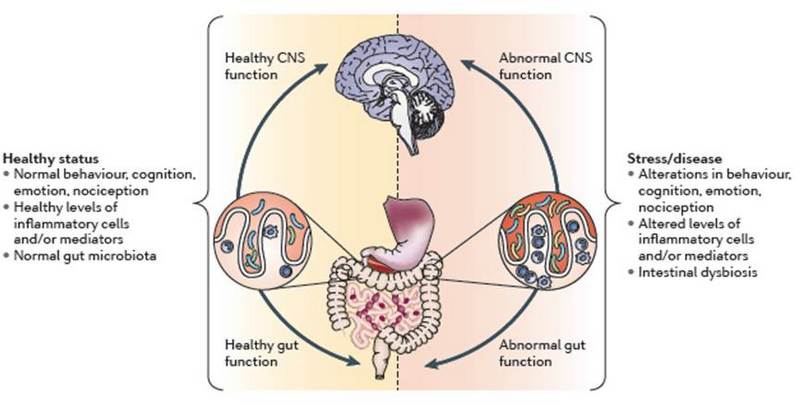
It only makes sense that if we have an unhealthy microbiome (enteric nervous system), which we already know can cause depression, disease, and cognitive issues (a major symptom cluster in schizophrenia is cognitive distortion), then the entire system is at risk.


The full article is, of course, paywalled, but Whiteley offers a good, though too brief for me, summary of the study; and I have included the abstract from the original article.

The gut-brain axis and schizophrenia


Posted by Paul Whiteley
Saturday, 4 October 2014

A micropost to direct your attention to the recent paper by Katlyn Nemani and colleagues [1] titled: 'Schizophrenia and the gut-brain axis'. Mentioning words like that, I couldn't resist offering a little exposure to this review and opinion piece, drawing on what seems to be some renewed research interest in work started by pioneers such as the late Curt Dohan [2].

The usual triad of gastrointestinal (GI) variables - gut barrier, gut bacteria and gut immune function - are mentioned in the article, concluding that: "A significant subgroup of patients may benefit from the initiation of a gluten and casein-free diet" among other things. Not a million miles away from related suggestions when it comes to something like the autism spectrum disorders (ASDs) (see here) bearing in mind the concept of overlapping spectrums (see here) and the [plural] schizophrenias.

I'm also minded to hat-tip another research team including Emily Severance and colleagues who are going great guns when it comes to the whole GI-food link in cases of schizophrenia and beyond (see here for my recent discussion of some of her work). Another of her quite recent papers [3] on cerebrospinal fluid (CSF) levels of antibody response to wheat gluten and bovine milk in first-episode schizophrenia represents another master-class of research in this area. Their suggestion of potential evidence for a leaky blood-CSF barrier is something else which might stimulate further research in this area including some mention for the molecular handyperson that is melatonin among other things to "protect against blood-brain barrier and choroid plexus pathologies". Such findings might also be relevant for other CSF issues reported with schizophrenia in mind (see here).

And whilst we're talking all-things biological membrane permeability and schizophrenia, I'll also link to the paper by Julio-Pieper and colleagues [4] (open-access) reviewing some of the evidence on the 'controversial association' between intestinal barrier dysfunction and various conditions (also covering some of the literature with autism in mind too). Mainstream here we come?

----------

[1] Nemani K. et al. Schizophrenia and the gut-brain axis. Prog Neuropsychopharmacol Biol Psychiatry. 2014 Sep 17. pii: S0278-5846(14)00168-7
[2] Dohan FC. Cereals and schizophrenia data and hypothesis. Acta Psychiatrica Scandinavica. 1966; 42: 125–152.
[3] Severance EG. et al. IgG dynamics of dietary antigens point to cerebrospinal fluid barrier or flow dysfunction in first-episode schizophrenia. Brain Behav Immun. 2014 Sep 17. pii: S0889-1591(14)00462-0.
[4] Julio-Pieper M. et al. Review article: intestinal barrier dysfunction and central nervous system disorders - a controversial association. Aliment Pharmacol Ther. 2014 Sep 28.

----------

ResearchBlogging.org Nemani, K., Ghomi, R., McCormick, B., & Fan, X. (2014). Schizophrenia and the gut–brain axis. Progress in Neuro-Psychopharmacology and Biological Psychiatry. 56(2): 155–160. DOI: 10.1016/j.pnpbp.2014.08.018
* * * * *

Schizophrenia and the gut–brain axis

Katlyn Nemania, Reza Hosseini Ghomib, Beth McCormickc, Xiaoduo Fanc  

Highlights
  • Several risk factors for the development of schizophrenia can be linked through a common pathway in the intestinal tract
  • The microbiota composition may impact the gastrointestinal barrier, immune regulation, and metabolism seen in schizophrenia.
  • A significant subgroup of patients may benefit from the initiation of a gluten and casein-free diet
  • Antimicrobials and probiotics have therapeutic potential that will be elucidated by further research
Abstract

Several risk factors for the development of schizophrenia can be linked through a common pathway in the intestinal tract. It is now increasingly recognized that bidirectional communication exists between the brain and the gut that uses neural, hormonal, and immunological routes. An increased incidence of gastrointestinal (GI) barrier dysfunction, food antigen sensitivity, inflammation, and the metabolic syndrome is seen in schizophrenia. These findings may be influenced by the composition of the gut microbiota. A significant subgroup of patients may benefit from the initiation of a gluten and casein-free diet. Antimicrobials and probiotics have therapeutic potential for reducing the metabolic dysfunction and immune dysregulation seen in patients with schizophrenia.

Wednesday, October 23, 2013

Ed Cohen - Gut Wisdom, Or Why We Are More Intelligent than We Know


In the past few days I have posted an episode of NPR's Radiolab on Guts and another article on the gut microbes (the microbiome) that may be a powerful driver of evolution. And here, from Somatosphere, is another article on "guts," this one by a man living with Crohn's Disease.

Since Cohen mentions the enteric nervous system, and that 90-95% of the serotonin production in the human body occurs in the gut:
Approximately 90% of the human body's total serotonin is located in the enterochromaffin cells in the alimentary canal (gut), where it is used to regulate intestinal movements.[7][8] The remainder is synthesized in serotonergic neurons of the CNS, where it has various functions. These include the regulation of mood, appetite, and sleep. Serotonin also has some cognitive functions, including memory and learning. Modulation of serotonin at synapses is thought to be a major action of several classes of pharmacological antidepressants.
Drugs which block 5-HT2C receptors (several antidepressants) make the body unable to recognize when it is no longer hungry or otherwise in need of nutrients, and are associated with increased weight gain, one of the common side effects of these drugs, as well as the atypical antipsychotics.

If we want to avail ourselves of the natural intelligence of the enteric nervous system (the gut), drugs that affect serotonin are likely to make that more than a little challenging.

Gut Wisdom, Or Why We Are More Intelligent than We Know

By Ed Cohen


Gut feeling. Go with your gut. Gut of the problem. By default I’m a gut guy. At the age of thirteen I was diagnosed with acute Crohn’s Disease. For the next ten years I was borderline incontinent. Then I had a small bowel occlusion that resulted in complications precipitating a near death experience after which several feet of festering small intestine were excised from my viscera. Since then I’ve been living with the guts I have left. Needless to say I’ve had a few opportunities to reflect on “the gut” over the last forty years.

In evolutionary terms, the gut localizes and intensifies a paradox familiar to all living organisms: to live entails being simultaneously open and bounded. Francisco Varela succinctly defined this vital conundrum when he described “the intriguing paradoxicality proper to an autonomous identity: the living system must distinguish itself from its environment, while at the same time maintaining its coupling; this linkage cannot be detached since it is against this very environment from which the organisms arises, comes forth.”[i] In order to maintain this distinctive coupling, the permeable cell membrane has been as continuously conserved through the course of evolution as the crystalline DNA molecule, suggesting that the organism’s lively paradox constitutes an irreducible tension from which the living stretches itself out in time and space. Be that as it may, the gut contains this lively paradox in the most literal way: it folds the outside inward in order to keep the perturbations entailed by that paradox contained. In other words, it helps us hold our shit together. And by incorporating the open/bounded situation of the living, the gut constitutes the paradox that we are. If the gut is the way the outside lives inside of us — which of course in a topological sense it must be — then we are twisted around our guts, rather than our guts being twisted up inside of us, no matter how often we might feel the latter to be the case.

Single celled organisms don’t have guts. Guts evolve in multi-celled beings in order to govern the complex flows of nutrients and toxins that pervade the cellular world. The more convoluted the flows become the more the gut matters. Some argue that the first creatures to develop organized nervous systems were worms. Guts with brains. It’s hard to imagine, then, why people were so surprised when the enteric nervous system, the so-called “brain-in-the-gut,” was “discovered” at the end of the twentieth century. Yet, until then, for as long as anatomists had been dissecting human viscera they managed to miss this possibility. Oops. And how did the enteric nervous system finally come to our attention? Psycho-pharmacologists began prescribing SSRIs to people with depression and they noticed that one of the side effects was constipation. But why should a drug that helps us hold our shit together literally hold our shit together? It turns out the gut has all the same neuro-receptors and makes all the same neuro-transmitters as the brain does (and more recently the same has been found to be the case for the heart). Indeed the gut makes 95% of all the serotonin in the human body.[ii] So now bioscience finally acknowledges what non-scientists have been saying for quite some time: the gut has a mind of its own. Quelle surprise. After all, what does “gut wisdom” mean besides this? Seems like now that we are finally giving the gut its due, we’re finding out that we are more intelligent than we ever knew.

Perhaps the motto of gut wisdom, then, ought to be: We are more than we know, for when it comes from the gut, intelligence does not take the form of knowledge. When Kant proposed his motto for the Enlightenment: Sapere Aude—Dare to Know, he ensconced a precept that privileged knowing over not-knowing as a properly human goal, the path to “maturity” as he would have it. In the two centuries since, this precept garnered the not-unself-interested backing of neuroscience, which invested heavily in an egregious cephallocentrism that has swelled the heads of many humanoid researchers. The intelligence of the gut, however, has a more humble ambition. Our guts do not seek to distinguish us from other living beings; they do not affirm human specialness as a species imperative. Rather they remind us that “specialness,” insofar as it pertains to “species” in general, does not make us different from one another or from other life forms; the special is what we all have in common. The titles of two of the greatest children’s books of recent years, Everyone Poops and the equally important, The Gas We Pass, suggest that this is a lesson that all children can learn. Our guts remind us that we are not only a species, but also a kind of organism, the kind whose guts mediate our relations to each other and to the world, and thereby contain the vital paradox that we are. If we begin to appreciate that we are this kind of being, then our guts may help us to appreciate that kindness, even more than specialness, is a lively virtue — a virtue which our guts have known for quite some time.


~ Ed Cohen teaches Modern Thought in the Women’s and Gender Studies Department at Rutgers University. His most recent book is A Body Worth Defending: Immunity, Biopolitics and the Apotheosis of the Modern Body (Duke 2009). He is currently writing a new gut wrenching opus entitled Shit Happens: Ruminations on Living with Crohn’s Disease.

[i] Francisco Varela. “Organism: A Meshwork of Selfless Selves.” In Alfred Tauber, ed. Organism and the Origins of Self. Boston: Kluwer Academic Publishers, 1991. 85. 
[ii] Adam Hadhazy. “Think Twice: How the Gut’s “Second Brain” Influences Mood and Well-Being.” Scientific American Online. http://www.scientificamerican.com/article.cfm?id=gut-second-brain. Accessed December 21, 2012.

Image: “Repair in progress,” Thirteen of Clubs, flickr.

Friday, November 11, 2011

Trusting your gut can actually get the best results

Here is some more support for trusting our enteric nervous system (our gut). It bothers me that when people write these articles that they do not give real credit to the brain in our guts. For example, the enteric nervous system contains 100 million neurons - more than the spinal cord. Most of the major neurotransmitters - serotonin, dopamine, glutamate, norephinephrine, and nitric oxide - can be found in the gut. There are also two dozen small brain proteins, called neuropeptides are there along with the major cells of the immune system. This literally is another brain.

Trusting your gut can actually get the best results

by Mark Fenske
From Thursday's Globe and Mail

How much trust do you put in hunches or intuition? Would you allow part of your liver to be removed, for example, if your surgeon mentioned having a “gut feeling” that this would be best? Or would you rather hear some concrete reasons outlining exactly why the procedure might be needed?

A growing body of research by experimental psychologists and neuroscientists alike has revealed that going with your gut can be surprisingly effective at getting the best out of your brain. But it also seems to critically depend on your level of expertise (if you're the surgeon making that call, you may want to have a few years under your belt) and on your ability to trust your feelings.
Experiencing a hunch can seem almost mystical. This may explain why such judgments are often described as arriving through inspiration or by way of a still small voice.

Recent research findings suggest that such feelings and impressions may actually arise through brain circuits that are optimized for fast, automatic evaluations of a situation, which take place without our awareness. Other findings suggest that such non-conscious appraisals may recruit memory-intensive regions of the brain that can access neural representations of our prior knowledge and experiences, such as midline areas of the parietal lobe and the front-most sections of the temporal lobes.

From this perspective, intuition can be seen as the brain acting as a master predictor – taking whatever information is available at a given moment and analyzing its similarity to prior experiences to allow us to anticipate what is most likely to happen next and which course of action might be best.

This suggests that the greater our expertise in an area, the better our hunches should be in that domain. Brain scans of individuals playing shogi – a chess-like game popular in Japan – support this notion. Shogi experts rely extensively on an intuitive sense of which of the possible next moves is best. When each game scenario was revealed, players showed increased activity in the precuneus – a memory-related structure in the medial parietal lobe. Furthermore, during quick, intuitive judgments, there was increased activation of the caudate nucleus, a region of the basal ganglia previously shown to be involved in other automatic, highly learned responses. And the strength of this caudate signal was directly associated with accuracy of the corresponding judgment.

But this pattern occurred only in expert shogi players. Game-related brain activity in amateur players appeared to rely far more exclusively on the top and outermost regions of the frontal and parietal lobe – areas typically closely associated with deliberate, conscious analysis.

Neuroimaging during jazz improvisation provides another illustration of how a reduction in conscious control can be a good thing. When compared to brain activity during rote repetition of a tune, brain scans of jazz musicians “in the groove”– composing on the fly – show a dramatic reduction of activity in those top and outermost regions of prefrontal cortex associated with deliberate control and self-conscious awareness, and a simultaneous increase in activation in lower and inner structures associated with more implicit expertise.

But here's where trust comes in. Another set of recent studies has revealed that the power of the brain in making intuitive predictions critically depends on the extent to which individuals trust in their feelings when making decisions. Those expressing higher levels of trust in their feelings were later up to 20-per-cent more accurate in predicting such things as the weather, the outcome of a college football match or who would win a popular televised talent show.

But, like the shogi players, expertise also mattered. Trusting in your feelings will contribute little toward your Fantasy-Football standing unless you have some knowledge about football and the teams and players involved. The same surely applies to success in the operating room.

Mark Fenske, co-author of The Winner's Brain: 8 Strategies Great Minds Use to Achieve Success, is a neuroscientist and associate professor at the University of Guelph