Saturday, January 21, 2006

Preliminary Observations on Integral Relationship, Part One

Part One: Foundations

A while back, Joe Perez posted on the idea of polyamory as a post-conventional form of relationship. I suspect there are many who would disagree and see the desire to be in more than one intimate relationship at a time as immoral. I certainly do not think it is immoral, but I am undecided regarding its place as part of an integral model of relationship.

Joe's post also contained a developmental model of relationship based on Lawrence Kohlberg's stages of moral development. This is how Joe described his model:

In the first (pre-conventional) stage, dynamics are characterized by a desire for fluid and polymorphously perverse sexual play with multiple partners, and/or sexual role playing based on power dynamics (fetish, sadomasochistic play, etc.) Non-monogamy is valued; monogamy is derided as something for fuddy duddies and uptight squares.

In the second (
conventional) stage, sexual relationships are characterized by a desire for a balanced relationship with one primary partner, usually in a conventional marriage/domestic partnership. Monogamy is held to be virtuous, and non-monogamous liaisons are forbidden as adulterous or cheating.

In the third (
post-conventional) stage, sexual relationships are characterized by a desire for deep intimacy and passionate sexual aliveness that may be found with one or more partners in either conventional or unconventional relationships. Monogamy and non-monogamy are both recognized as playing important roles in the development of a mature sexuality.

I like these distinctions, but I disagree with a few points in Joe's model.

I would argue (from my perspective) that the pre-conventional stage is not as fun-loving as is presented. At this stage, power and control are more important than anything else. Most of the time, it will be male domination and conquest--one partner will possess the other. At this stage there is no emotional content or concern for the other's well-being. It is a physical act. We see this in the primate world where sex is a form of currency, or in tribal cultures where "wives" are accumulated to ensure the birth of sons. Sexuality at this stage may also be attended by various taboos based on pleasing the Gods, protecting the hunt or the fertility of crops, or preventing birth defects (incest taboo). In modern cultures, this stage may take on some of the traits Joe mentions, but only among those who are consciously participating at a stage below their overall center of gravity.

The conventional stage contains what we think of as traditional relationship forms, especially marriage. Joe nailed this one, aside from perhaps the "balanced" part, which is more appropriate to post-conventional egalitarianism.

I agree for the most part with Joe's post-conventional stage. As I mentioned above, I haven't decided where I come down on the polyamory element that Joe argues is part of the post-conventional stage. My experience tells me that multiple intimate partners is not often tolerated and, even more, seldom works for all involved.

I would like to take the idea of developmental stages for relationship a little deeper using Spiral Dynamics as a model to look at how different worldviews might influence relationship patterns and eventually lead to an integral model of relationship. What I am proposing is a unique "relationship" developmental line that progresses up the Spiral. Of course, a relationship line will be influenced by the moral development line, by emotional development, by intellectual development, and so on, up to and including the spiritual development line.

This exploration is meant to be a first step toward an integral model of relationship. I do not pretend to know how an integral relationship might look, though I have some ideas. I am hoping that this might generate some discussion so that we might work together to create an imprint, an archetype for integral relationship. To my knowledge, this is a new frontier waiting to be explored.


At the animistic/tribal (Purple) stage, most behavior is organized around maintaining safety in an unsafe world. Magic and superstition are primary modes of manipulating the world. Family bonds are important, but families will often have more than one wife per husband. Ancestors are respected and customs, including relationships, are based on how things have always been done. Relationship at this stage is mostly about procreation and commerce (sex for food and safety). There may be recreational sexuality, but there is not likely to be much "sharing" in the sense that we think of it.

As people move into egocentric/exploitive (Red) stage, personal gratification becomes even more central, as do control and domination. Power is the currency of this stage where strength is the key to survival. The world is seen as hostile and dangerous, and each person is on his/her own. Needs gratification is central for men, while women are still looking for safety and status within the group (determined by the man she is with). Rigid rules are not as important here, and individuals might be more open to experimenting with whatever feels good, including same-sex partners, group sexuality, and other previously taboo expressions of relationship.

When the absolutist/traditionalist (Blue) stage emerges, divine authority becomes the central focus of rules and conduct. There is only one right way to do things, including relationships, and all other expressions of relationship are sinful. At this stage, monogamy becomes the preferred form of coupling. Stability and order are seen as necessary for a successful community life, and monogamy fits that model. There is often some form of divinely revealed reason for this model (Adam and Eve for Jews, Christians, and Muslims). At this point in human development, relationship is often seen as solely for the purpose of procreation, but now there is the added element of duty (the father to his wife and children, or a wife to her kids and husband). Sexual taboos are present again, often as a way to limit enjoyment of sexuality so that people will focus more of their attention on serving God (or country, community, church, and so on). For the first time in any large numbers, genuine love can become an element of the relationship.

Eventually, the individual ego will reassert itself and its needs in the materialist/achiever (Orange) stage of development. Rather than subordinate needs and desires to divine authority, individuals begin to seek out what feels good to them. But it's different than it was at the egocentric stage because the individual is entering a post-conventional moral stage where right and wrong are felt from the inside rather than imposed from the outside. Relationships at this stage are built around self-expression and forming alliances. Romantic love is usually the initial magnetism, but a lasting bond will be a partnership of equals who both get their needs met through the relationship. Because self-expression is important, individuals at this stage will experiment more with previously taboo partnerships and modes of relating. Same-sex, role playing, and bondage/fetish expressions are now on the table. Emotion is still not a central element, though feeling "good," desired, sexy, and so on is important to both (or all) partners. This is the stage where I see polyamory being a viable option.

At some point, emotions, equality, and egalitarianism will become central concerns. This stage is known as the relativistic/social (Green) stage, often referred to as postmodernism. Relational expressions become a central concern at this stage. Individuals are more aware of their own emotional life and feel the need to have emotional needs met in their relationships. Reproduction, sexual satisfaction, and status are no longer sufficient. A person at this stage wants to be able to express his/her feelings and feel an emotional connection with her/his partner. Post-conventional relationship patterns are even more likely at this stage. The primary focus, no matter what form the relationship takes, is on experiencing and sharing emotions, building relationships, expressions of spirituality, and creating equality and liberation for all involved.

Having reached this point, and it's fair to say that few really have reached this stage in American culture, a major transition is possible. Integral relationship is on the horizon.

In the next installment I will attempt to outline a preliminary sketch of what an integral relationship might look like and how it might work.

Go to Part Two.

Friday, January 20, 2006

Equanimity and Compassion


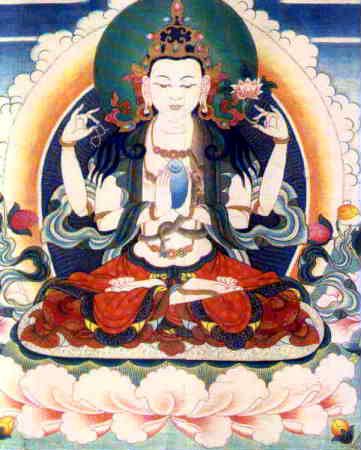
[Buddha of Compassion]


Joe Perez has a good post on equanimity. What follows is a slightly edited and expanded version of my response to his post. I'm glad Joe is thinking about this and took the time to post his thoughts. It's an important topic for all of us as the world we live in becomes more and more polarized.


Equanimity is something I struggle with all the time. For what it's worth, thinking about how we respond when our buttons get pushed is the most important act we can take in moving toward equanimity (at least in my experience).

We all have "hot buttons" that get pushed by other people. Most of mine, and I have MANY, revolve around the various forms of intolerance and attempts to restrict individual freedoms to live as we please (providing we are not in any way harming someone else).

What works for me when my buttons get pushed (when I can do it) is to follow the Shambhala path of Chogyam Trungpa. I try to take a step back from the situation and remember that the other person is also a human being who has gone through certain experiences, usually specific kinds of wounding/trauma, that created the worldview they now hold.

If and when I can humanize the person, it becomes much easier not to become reactive in the face of their intolerance. The goal is to feel compassion for whatever experience they have had that makes them so miserable that they have to hold hate for other people in their hearts (even when they don't call it hate). If we feel compassion for our enemies, they have no power to push our buttons.

Now this does not mean we do not act to change their hearts and minds. The Shambhala path requires us to work for the enlightenment of all sentient beings, so doing nothing is never an option. But we are much more likely to create allies with compassion than we are with anger. Maybe we can't change their hearts, but we will have acted with integrity and the tender heart of the warrior (as Trungpa calls it).

I agree with what Joe says about the progression of history toward greater depth and span, greater freedom and compassion (my words, I guess, not his).


The challenge for a liberal spirituality is to locate Spirit in the right place: in the midst of the evolution of nature and culture, in the thick of multicultural diversity, as the ground for liberal freedoms and all authentic liberation.
Equanimity is the act of aligning ourselves with that movement of Spirit, that drive, the Eros of evolution. When we are aligned with Eros, when we feel compassion for all beings, when we are no longer attached to the pettiness of ego, we are free in the truest sense of the word.

That is my sense of equanimity.

If we hope to be great, in any sense, we must do it with tender, open hearts. And we must do it together, with compassion, aligned with Spirit.

Easier said than done, but that is why we have this lifetime to work at getting it right.

Thursday, January 19, 2006

Follow-Up: Painful Confession

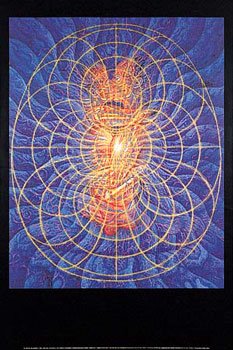
[Image by Alex Grey]

Thanks to everyone who commented on or mentioned my previous post on their blog.

After thinking about this for a while, and feeling as if I had been foolish to surrender my critical thinking capacity to Wilber for several years, I have come to understand what happened in a new way. Rather than being self-critical, I am looking for the deeper lesson in this experience (thanks to Maude for helping me sort through this).

What really bothered me was that I had surrendered to Wilber as though he were my guru. It wasn't a conscious choice--my rational brain and clinging ego can't tolerate the idea of surrender inherent in the guru/student relationship. However, there is meaning in the desire to surrender--a desire that is now conscious.

Wilber and his work provided a sense that the Universe has meaning, purpose, and order, and that I could possibly get a taste of that. For much of my life until reading Wilber (and Jung, among others, all in a two-year period), I held a very nihilistic view of life. Yet I craved the meaning I once found as a child in the Catholic church. Not in their idea of God, but that there was a God who was wise and compassionate (don't ask me how I got this out of Catholicism, because I have no idea).

One other element, the shadow side of this, also was important. I am a control junky, and I consume information as a way to feel a measure of control in a chaotic world. Wilber presents himself as almost "all-knowing," which allowed my shadow need for control to think that if I simply read all of his books, I too will know enormous amounts of information--therefore, I will have more control.

The shadow stuff is a minor detail, however. The important element that I have discovered is the craving for wholeness, meaning, and safety that is at the base of every human being's quest for the divine. Having dismissed God as a teenager, and having not yet found Buddhism, I sought the surrender to God through a surrender to Wilber as my guru--no matter how unconscious that process was.

Yesterday I was beating myself up for even holding that need. Today I see it as the fuel for the next phase of my growth. I crave the experience of being enfolded into nonduality, of surrendering ego with a full sense of safety. I crave the knowledge that I am loved by some power/force greater than me and my little ego. I don't think I am alone in this feeling.

Ego doesn't want to surrender. I have rejected the guru relationship in my Buddhist work because my ego rejects the idea that anything is greater than it is. Realistically, I know there are few teachers who have transcended their ego enough to be true gurus. Still, there are many who can be good teachers. I am now open to seeking that out.

Looking back over the past several years, I can ask myself if any good came from simply allowing myself to accept Wilber's worldview without question. The answer is yes. I moved out of the hopelessness I once felt as an angry teenager. I have grown as a person as a result of the work I have done with integral theory. I have a magnificent tool for understanding my world. And a door has been opened in me that I can work toward--a door into a region of my life that is beyond ego.

Finally, I have discovered that the only place I ever feel the sense of wholeness and meaning that I now realize has been driving me is with my girlfriend. In surrendering to Kira and the love she offers me, I move beyond my little ego. In feeling my love for her and giving it without condition, I also transcend my little ego.

Relationship can be an integral path. There is no gender distinction in this, no man/woman thing. We all contain a masculine and feminine element. When we are in true relationship, it is no longer one + one = two (male-female, female-male, or primary gender combination of your choice); it is one + one = four (male-female, female-male, male-male, female-female). Add this to the four quadrants, consider the developmental lines, think about states and stages, get to know your various subpersonalities, and never forget the Great Chain of Being, and relationship--the way all these elements interact between two people--becomes an amazing path to self-knowledge and self-transcendence.

In surrender to relationship, I get a taste of that enfolding into divinity that I crave. And I am a better person for allowing myself to need this kind of surrender.

Lu Yu: Poem


[Spring Rain at Yangtze River by Le Ran.]

Rain

In twilit crosslight begins
as cocoon unthreads,

brushes earth,
then hard arrowheads, airborne.

Through mosquito net light rays
to daybreak-dreams

as the brass stove's sweet grass
steam spring clothes.

Pond fish whip caudal fin
to follow spillway;

over weir swallows zoom, wheel,
touch wings, return.

Petals have only fallen
not yet blown away,

but wet blooms ruddling bough
are where I put trust.


Lu Yu [Translated by David M. Gordon, The Wild Old Man]

Wednesday, January 18, 2006

Painful Confession

[Image from RavenCrow]

This morning Matthew Dallman posted a link to a summary of Geoffrey Falk's criticisms of Ken Wilber. Not content to simply read a list of bullet points, I read the Wilber chapter (Norman Einstein) from Falk's book, Stripping the Gurus. I'm late to the game on this since the book has been around--and generally dismissed by anyone who likes Wilber--for a quite a while now.

My first impression was that Falk is an asshole. That was also my second and third impression as I read other chapters of his book. However much Falk acts like the stupid kid in the class who has caught the smart kid making a mistake, some of the critics of Wilber that he quotes have valid concerns that have either been ignored or derided. I find this disturbing.

I followed the back and forth between Wilber, de Quincey, and Hargens back when it happened, but I did not know about some of the behind-the-scenes stuff that went into the exchange. I found both Wilber and de Quincey wanting in that exchange, but I sided with Wilber.

I have generally sided with Wilber even when I found him to be egotistical and belittling of his critics. Because I have found Wilber's overall model useful and insightful, I didn't question some of the smaller details that Falk addresses. I committed the cardinal sin: I found the Buddha beside the road and did not kill him.

I was a Wilber follower. My girlfriend recently referred to me as a "Wilber freak," which I sort of took as a compliment and sort of felt embarrassed by. "Am I that obsessive? Am I that fanatical?" I thought to myself later. Painfully, the answer has been yes, at least some of the time.

Let me say right now that I found Falk's attack on Wilber to be a kind of nitpicking, overlooking the big picture so that he can show Wilber's mistakes. But there is some truth behind the smartass comments and ridicule that Falk espouses.

Wilber's critics have not been given a place at the integral table. They have not be included in the new integral paradigm. It can't be a truly integral model unless it is open to debate, to criticism, to the possibility that it is not the only answer, or even the best answer. The value of any good theory is its testability. Will the Integral Institute allow a non-member peer review of its central tenets? Will it permit dissenters to be heard by its members and followers?

When will Wilber have a non-believer as a guest on his "Get Naked" series? When will Wilber allow a guest on Get Naked to disagree with Wilber's version of integral?

I have not abandoned the four quadrants, developmental lines, states and stages, or much else of Wilber's basic model. However, I will never again be as accepting of everything Wilber says as I have been in the past.

When I talked with my girlfriend about this a little while ago, she asked me how I felt about this new "revelation." I told her I was not disillusioned with Wilber--all men are mortal, as Simone de Beauvoir claimed in her book by the same title. I was angry with myself for not questioning Wilber's work in the same way that I am critical of every other writer/thinker I read.

More than anything else, I am disturbed that I so easily accepted most everything Wilber wrote as though it were the god-given truth. That has been shifting in the last year (largely due to my misgivings about how he has treated SDi), but it was true for a number of years. "I wanted to believe," as Mulder might have said.

I wanted to practice a kind of jhana yoga (the path of intellect) with Wilber as my guru. I feel foolish for having even wanted that. Yet I understand the desire in myself and where it may have come from--but that's another post.

[Thanks to MD for pointing me where I needed to go.]

Paul Chek Interview

[This interview is also posted at Integral Fitness Solutions.]

If you don't know who Paul Chek is, you should. He is the leading voice in the world of integral fitness. His ideas are way outside of the mainstream of performance athletics, yet he is enormously successful. He must be doing something right.

While most trainers look only at the physical elements of weight loss or muscle building (and maybe the emotional), Chek includes the physical, the emotional, the mental, subtle energies, earth energies, and the soul. Not your normal fitness guru.

T-Nation is not exactly known for its integral approach to training (aside from the occasional article on getting "psyched" for your workout or some other low-grade attempt at including the interior-individual quadrant), so this interview is unique for them, as the introduction indicates:
I'd been assigned to interview Paul Chek, I'd been on the phone with him for close to four hours, and I didn't understand a single goddamn thing he was saying.

How was I going to transcribe this? How was I supposed to cut it down to 5000 words for an article? How was I supposed to get info out of this guy when every question I asked about protein and training garnered me an hour long diatribe about magnetic poles, chi, God, the planets, "cosmic consciousness," and the soul?

Shit.

Was this interview a bust? Had I wasted his time and mine?

No, I didn't think so. Because in the back of my mind, I knew that Chek was one of the best in the world in his field: corrective and high-performance exercise kinesiology. In fact, with his holistic approach, he's practically reinvented the field. I knew that, at 44 years old, Chek could outperform a lot pro-athletes in their twenties. (In his own words, he can "hammer the shit out of them in the gym." And he really can.) And his physique is pretty damn impressive too. There was something to learn here. Maybe a lot.

I also knew that while a lot of Chek's ideas were "out there," all really innovative and powerful concepts sound a little crazy at first... Or hell, maybe he's just a nutcase. I'll leave that for you to decide.

Read the rest here.

Tuesday, January 17, 2006

Who We Really Are


In the Dzogchen teachings the primordial state of the base is not defined only as being void, but is explained as having three aspects or characteristics, called the "three primordial wisdoms": essence, nature, and energy.

The essence is the void, the real condition of the individual and of all phenomena. This base is the condition of all individuals, whether they are aware of it or not, whether they are enlightened or in transmigration. It is said to be "pure from the beginning" (ka dag), because, like space, it is free of all impediments, and is the basis of all the manifestations in existence.

The manifestation of the primordial state in all its aspects, its "clarity," on the other hand, is called the nature. It is said to be "self-perfected" (lhun grub), because it exists spontaneously from the beginning, like the sun which shines in space. Clarity is the pure quality of all thought and of all perceived phenomena, uncontaminated by mental judgment. For example, when we see a flower, we first perceive its image without the mind entering into judgment, even if this phase of perception only lasts for a fraction of a second. Then, in a second phase, mental judgment enters into the situation and one categorizes the perception, thinking, "That's a flower, it's red, it has a specific scent, and so on." Developing from this, attachment and aversion, acceptance and rejection all arise, with the consequent creation of karma and transmigration. Clarity is the phase in which perception is vivid and present, but the mind has not yet entered into action. It is the spontaneous manifestation of the individual's state. The same is true for thoughts: if we don't follow them, and don't become caught up in mental judgment, they too are part of our natural clarity.

The third of three primordial wisdoms is energy. Its characteristic is that it manifests without interruption. The explanation of energy in Dzogchen is fundamental to understanding the base. All dimensions, whether pure or impure, material or subtle, are manifestations of one aspect or another of energy.

[Chogyol Namkhai Norbu, Dzogchen: The Self-Perfected State, Snow Lion Press]

Sunday, January 15, 2006

On Karma

How is it that we suffer? We suffer through our engagement in nonvirtuous actions. Suffering is the natural result of nonvirtuous actions. In terms of relationships between actions and their effects called the law of karma, the result of nonvirtue is suffering and the result of virtue is joy. So it is we ourselves who are punishing ourselves. We ourselves are inflicting the retribution for our acts. We are experiencing the natural consequences of our own acts. There is no external agent who is punishing or rewarding us for them.
___

In terms of the relationship between actions and thier consequences, nothing is ever wasted. No action--be it wholesome or unwholesome, virtuous or nonvirtuous--is without its own consequences. It's very easy to think in our present situation that we can get away with lots of things and that our nonvirtuous actions are insignificant because we won't have to experience their consequences. In fact, this is an error.

Gyatrul Rinpoche, "Introduction" to Natural Liberation.

It's easy, as Rinpoche says, to believe that we can skate by with sketchy actions and not pay the debt, but it seldom happens that way. Just because we cannot remember the cause does not mean the effect is not directly related.

I have been observing my life over the past year as I work at mindfulness and at trying to be a better, more compassionate person. This is certainly a subjective study with no control group, but I feel that as I have worked to be a better person the quality of my life has improved. Cause and effect? Maybe. It feels that way to me.

Nonlocal influence might be a way to explain it. But then the physicists would be displeased that a distant event could influence a current event with no direct physical trail of causality. So why does causality have to be physical, or even energetic in the quantum sense?

What Does Your Integral Practice Look Like?

For the last several years, I have been working to find an integral practice that fits me and my life (ever since reading The Life We Are Given by Murphy and Leonard). I've tried various combinations of practices until I think I've found something that is working. I can't say for sure that I've made global vertical transformations as opposed to horizontal translations, but I'm sure that I have experienced transformation in some developmental lines.

I thought it might be interesting to read what the rest of you are doing in your practices. Maybe we can learn some things from each other.

Here is my current integral practice. I do all of these things in a given week, and many of them are a part of my daily life.

BODY: weight training, nutrition, various supplements
HEART: relationship with my girlfriend, therapy, journal writing
MIND: reading, writing, more reading, blogging, did I mention reading, workshops
SOUL: meditation, girlfriend, therapy (occasional transpersonal work)
COMMUNITY: getting to know online integral community, getting to know Tucson Buddhist community
SERVICE: my job is my service (personal trainer)--nice to be paid to help people

What does your integral practice look like?

Sunday Poem: Li Po

Something Said, Waking Drunk on a Spring Day

It's like boundless dream here in this
world, nothing anywhere to trouble us.

I have, therefore, been drunk all day,
a shambles of sleep on the front porch.

Coming to, I look into the courtyard.
There's a bird among the blossoms calling,

and when I ask what season this is,
an oriole's voice drifts on spring winds.

Overcome, verging on sorrow and lament,
I pour another drink. Soon, awaiting

this bright moon, I'm chanting a song.
And now it's over, I've forgotten why.

[Translated by David Hinton: Selected Poems of Li Po; New Directions.]

In China, there is a phrase that suggests Li Po more as a phenomenon than a man: "Winds of the immortals, bones of the Tao." He is often referred to as the Banished Immortal, a reference to the seeming ease of his verse, his mysticism, and his itinerant life. His lack of attachment to self and his willingness (maybe eagerness) to transcend the self through love, wine (especially wine), and nature are the foundation of his poetry. His poetry reflects the spontaneous unfolding of the ten thousand things, but it also carries the energy of that unfolding in such a way that we feel it directly through his words.

From Hinton's "Introduction" to the Selected Poems:
To live as part of the earth's process of change is to live one's most authentic self: rather than acting with self-conscious intention, one acts with selfless spontaneity. This spontaneity is wu-wei (literally: "doing nothing"), and it is an important part of Taoist and Ch'an (Zen) practice, the way to experience one's life as an organic part of tzu-jan [translates as "nature"].
Here are a few excerpts from the Wikipedia entry on Li Bai (better known as Li Po in the West).
Called the Poet Immortal, Li Bai is often regarded, along with Du Fu, as one of the two greatest poets in China's literary history. Approximately 1,100 of his poems remain today. The Western world was introduced to Li Bai's works through the very liberal translations of Japanese versions of his poems made by Ezra Pound.

Li Bai is best known for the extravagant imagination and striking
Taoist imagery in his poetry, as well as for his great love for liquor. Like Du Fu, he spent much of his life travelling, although in his case it was because his wealth allowed him to, rather than because his poverty forced him. He is said to have drowned in the Yangtze River, having fallen from his boat while drunkenly trying to embrace the reflection of the moon.
___

Over a thousand poems are attributed to him, but the authenticity of many of these is uncertain. He is best known for his
yue fu poems, which are intense and often fantastic. He is often associated with Taoism: there is a strong element of this in his works, both in the sentiments they express and in their spontaneous tone. Nevertheless, his gufeng ("ancient airs") often adopt the perspective of the Confucian moralist, and many of his occasional verses are fairly conventional.

Much like the genius of Mozart there exist many legends on how effortlessly Li Bai composed his poetry; he was said to be able to compose at an astounding speed, without correction. His favorite form is the jueju (five- or seven-character
quatrain), of which he composed some 160 pieces. Li Bai's use of language is not as erudite as Du Fu's but impresses equally through an extravagance of imagination and a direct
correlation of his free-spirited persona with the reader. Li Bai's interactions with nature, friendship, and his acute observations of life inform his best poems.
Rather than expound on the greatness of this poet, who once was very influential in my own poetry, I'd rather leave today with another of his poems--one that stands as a fine example of the Taoist influence in his writing.
Ancient Song [also known as Chuang-tzu and the Butterfly]

Chuang-tzu dreams he's a butterfly,
and a butterfly becomes Chuang-tzu.

All transformation this one body,
boundless occurrence goes on and on:

it's no surprise eastern seas become
western streams shallow and clear,

or the melon-grower at Ch'ing Gate
once reigned as Duke of Tung-ling.

Are hopes and dreams any different?
We bustle around, looking for what?

Saturday, January 14, 2006

Birth of Poet: Fourth Meditation

Meditation IV: Dionysus and Apollo

As I've explored the Birth of a Poet concept, I've been circling around the idea of cyclical time as opposed to linear time. [Please see the first, second, and third posts as a background for this one.] Vocation was the first archetype I wrote about, setting it as the way into deeper meaning in our lives. William Everson, the original impetus for this series of essays, posited two major archetypes for the poet--or anyone who seeks deeper grounding into the mystery of living. To those I will add a third that transcends and includes the first two.

Everson thought that all poets operated under either the Dionysian or the Apollonian archetype. In this view he was echoing Nietzsche and Jung. Nietzsche's The Birth of Tragedy offered the archetype of Dionysus as the source of intoxication, celebration of nature, cruelty, music, dance, pain, dissolved individuality, orgiastic passion, dissolution of all boundaries, excess, and destruction. Dionysus lives in the realm of cyclical time, closely tied to feminine energies, the seasons, and the consciousness of the body. Nietzsche then offered Apollo as the source for individuation, beauty, adherence to boundaries, individuality, reason, celebration of appearance, self-control, perfection, exhaustion of possibilities, and creation. Apollo lives in the realm of linear time, closely tied to the power of the sun, masculine energy, and rational thought. In essence, Dionysus is god the senses and Apollo is god the mind.

These two archetypes represent the split between body and mind that has plagued humanity for all of our conscious existence. Nietzsche felt that one of these forces was always in control, which would relegate the other aspect to shadow (to use a Jungian term Nietzsche didn't have). The highest form of art, as claimed in The Birth of Tragedy, was dramatic tragedy because it combined the Dionysian chorus with the Apollonian drama.

Jung took up this split in his attempts to explain the psychological sources of creativity. For Jung, the Apollonian artist works with the intent to create an artwork with a specific, well-reasoned message or meaning. The meaning precedes the artwork. On the other hand, the Dionysian artist allows the artwork to flow nearly complete from his/her psyche without conscious intervention. The following quotes from Jung's "On the Relation of Analytical Psychology to Poetry" (The Spirit in Man, Art, and Literature, 65-83), illustrate the point.
There are literary works, prose as well as poetry, that spring wholly from the author's intention to produce a particular result. He submits his material to a definite treatment with a definite aim in view; he adds to it and subtracts from it, emphasizing one effect, toning down another, laying on a touch of color here, another there, all the time carefully considering the over-all result and paying strict attention to the laws of form and style. He exercises the keenest judgment and chooses his words with complete freedom. His material is entirely subordinated to his artistic purpose; he wants to express this and nothing else.

Compare that description of the Apollonian artist to this one of the Dionysian artist.

The other class of works . . . flow more or less complete and perfect from the author's pen. They come as it were fully arrayed into the world, as Pallas Athene sprang from the head of Zeus. These works positively force themselves upon the author; his hand is seized, his pen writes things that his mind contemplates with amazement. The work brings with it its own form; anything he wants to add is rejected, and what he himself would like to reject is thrust back at him.

These are idealized views of the creative process. He based his views on his reading and interpretations of how the text may have been composed.

Yet these ideas are useful and do offer a way to understand two very distinct modes of creation. Most artists/writers fall somewhere toward one mode or the other, but never as extreme as Jung has presented them.

Jung goes on to suggest that the Dionysian artist is working with material erupting from the unconscious mind, and that its wholeness reveals something akin to a complex. For the Dionysian artist, the creative process amounts to being a conduit for symbolic energy to spring from the depths of the unconscious mind--and sometimes, from the collective unconscious. [Jolande Jacobi, the Jungian writer, has written about the close association between the complex, the archetype, and the symbol (Complex/Archetype/Symbol in the Psychology of C.G. Jung), a useful source for understanding Jung's views in the area of creativity.]

William Everson began reading Jung while he was a lay brother in the Dominican Order. The material eventually found its way into two separate books on Robinson Jeffers, both of which approached Jeffers as a religious poet.

Everson saw the Apollonian poet as working on a vertical axis, becoming a prophetic voice working to solve a problem, "a deficit, a hiatus, between the myth, let's say, and the ego-consciousness of the mind. And so he sets himself the great goal of bridging that gap by an adequate symbol" ("The Presence of the Poet," Earth Poetry).

On the other hand, the Dionysian poet works in the manner of a shaman on the horizontal axis, "primitive . . . directly to the infra-rational, the instinctual, the deeps of the memory and imagination. And out of this exposure of themselves, the Dionysian forces in the human psyche will produce a kind of dissolved state of consciousness, where the ego is not sharply focused, is more exposed and open. And out of this open, intuitive state of being the words will begin to find their center of reference and body themselves forth" (Earth Poetry).

To Everson, the Dionysian poet was a shaman, while the Apollonian poet was a prophet. Both are religious, but one is ecstatic (ex stasis, outside of the self) and one is rational. The shaman is a visionary who brings new information from the unconscious into the world. The prophet is the teacher and accuser who both delivers and indicts. As an example, T.S. Eliot's The Wasteland may be the most well-known prophetic poem, while Allen Ginsberg's Howl is primarily shamanic with some prophetic qualities.

The major flaw in this system--as far as integral theory is concerned--is that the two archetypes only cover the Dionysian prepersonal and the Apollonian personal stages of development. Neither offers a stable entry into the transpersonal. Yet each possesses traits of the others, indicating a close relationship--Apollo buries Dionysus at the foot of Mount Parnassus after he is ritually killed and dismembered. While Dionysus can appear as both the youngest of the Olympians and the oldest of the ancient gods, Apollo replaces Dionysus as the Supreme Being when he becomes the sun. Orpheus--the great god of song and music--betrays his allegiance to Dionysus and worships Apollo as the one true god, for which he is killed by Dionysus' Maenads.

Even though Dionysus and Apollo reflect lower human developmental stages, a poet "possessed" by either archetype could experience higher states of consciousness through various modes of ecstasy (drugs, drink, trance, meditation, and so on). These glimpses of higher states would then be interpreted through the lens of the dominant stage of development. [Understanding the distinction between states and stages is important.]

There is nothing wrong with either the Dionysian or the Apollonian archetypes--both can produce important insights and artwork, as well as an ethos for one's life and vocation. However, what is needed is an archetype that transcends and includes these two. We need to transcend and include prepersonal cyclic time with personal linear time to achieve a transpersonal relationship with time (which obviously becomes null and void at the nondual level). We need an artistic archetype that can reach into the transpersonal realm. After searching the Greek pantheon, the only acceptable figure is Odin, from the Norse and Germanic mythology.

Odin combines many of the traits of both Dionysus and Apollo: shape-shifter, hunter and warrior, poet and musician, fury and madness, psychopomp, keeper of wisdom as well as possessor of magic. Odin is both pre-rational and rational, shaman and prophet, perhaps representing his origin at a time when these developmental stages were in transition. Beyond this integration, there are two traits that allow Odin to become an archetype of transcendence.

The first trait is Odin's quest for wisdom and knowledge. "Odin was a compulsive seeker of wisdom, consumed by his passion for knowledge, to the extent that he sacrificed one of his eyes (which one is unclear) to Mimir, in exchange for a drink from the waters of wisdom in Mimir's well" (Wikipedia). He also sends his ravens, Huginn and Muninn (Thought and Memory), to travel the world collecting information whenever needed. The quest for wisdom represents a drive to transcend limitations. But wisdom was not enough for Odin--he needed more.

The second trait that distinguishes Odin is his ritual death and resurrection. Like Jesus, Odin dies for the benefit of humanity. Like Buddha, Odin's "enlightenment" comes at the base of a tree.

He hanged himself from the tree Yggdrasil, whilst pierced by his own spear, to acquire knowledge. He remained thus for nine days and nights, a number deeply significant in Norse magical practice (there were, for example, nine realms of existence), thereby learning nine (later eighteen) magical songs and eighteen magical runes. The purpose of this strange ritual, a god sacrificing himself to himself because there was nothing higher to sacrifice to, was to obtain mystical insight through mortification of the flesh; however, some scholars assert that the Norse believed that insight into the runes could only be truly attained in death.

Some scholars see this scene as influenced by the story of
Christ's crucifixion; and others note the similarity to the story of Buddha's enlightenment. It is in any case also influenced by shamanism, where the symbolic climbing of a "world tree" by the shaman in search of mystic knowledge is a common religious pattern. We know that sacrifices, human or otherwise, to the gods were commonly hung in or from trees, often transfixed by spears. (Wikipedia)

The connection to Jesus had been thought to be a late addition to the myth, but the evidence suggests that the elements of the story predate Norse contact with Christianity (possibly suggesting Jung's collective unconscious as a source of mythic patterns), and likely predate Christianity.

So what we have in Odin is a mythic archetype that offers transcendence as an attribute. Odin offers the possibility of a transpersonal experience in the creation process, and the greater possibility of an integral, transpersonal stage of development. For the Western psyche, he represents the best possibility for a transcendent developmental archetype for the poet/artist (Shiva fills this role in the East).

To my knowledge, Odin represents the first attempt to transcend and include the Nietzschean, Jungian, and Eversonian dichotomy of the religious poet/artist. This is by no means a definitive statement, and I am open to hearing what others think on this subject.

Friday, January 13, 2006

Dzogchen Khenpo Choga Rinpoche

My first impressions of Khenpo's teaching from this evening:


The Present Moment. Only this and nothing more, reincarnated again and again, ceaselessly. Past thought is present karma. Present thought is future karma. There is no past and no future. Only the present moment.

We are not the body. We are not the mind. We are not the "I." Self is an illusion. There are only discrete moments. Linear time is an illusion. Self exists only in linear time, therefore linear self is not real. Only the present moment. The present moment is Buddha.

We are not Buddha. We exist in duality. Therefore, strive to increase positive thought (good karma) and decrease negative thought (bad karma). When bad karma is gone, we are Buddha. Until then, do not think, "I must not think." That is thinking. Think good thoughts to eliminate bad thoughts.

Be here now. This present moment. There is nothing else.

Thursday, January 12, 2006

Tibetan Master Speaks in Tucson

From the Tucson Daily Star:
Tibetan Buddhist meditation master Dzogchen Khenpo Choga Rinpoche, who has more than seven years of solitary cave meditation experience in the Himalayas, will give two public teachings in Tucson this week.

His first lecture, "Thinking and Belief," is set for 8 p.m. Friday at the Providence Institute, 3400 E. Speedway, Suite 110. The suggested admittance is $10 to $20. The second lecture, "The Nature of the Mind is True Happiness," is set for 7 p.m. Saturday at Bookman's, 6230 E. Speedway, and is free.

Rinpoche is a 33rd generation holder of the Buddhist wisdom lineage of Dzogchen. He also is a lama of Dzogchen Monastery and a professor at Dzogchen Shri Singha University.

I hope to attend one or both of these events.