Thursday, January 08, 2009

Daily Dharma - Buddha as Archetype


Today's Daily Dharma from Tricycle features Joseph Goldstein.

Buddha as Archetype

[We can] view the Buddha as a fundamental archetype of humanity; that is, as the full manifestation of buddha-nature, the mind that is free of defilement and distortion, and understanding his life story as a great journey representing some basic archetypal aspects of human existence. By viewing the life of the Buddha... as a historical person and as an archetype, it becomes possible to see the unfolding of universal principles within the particular content of his life experience. We can then view the Buddha's life not as an abstract, removed story of somebody who lived twenty-five hundred years ago, but as one that reveals the nature of the universal in us all. This becomes a way of understanding our own experience in a larger and more profound context, one that connects the Buddha's journey with our own. We have undertaken to follow the same path, motivated by the same questions: What is the true nature of our lives? What is the root cause of our suffering?

~ Joseph Goldstein, Seeking the Heart of Wisdom; from Everyday Mind, edited by Jean Smith, a Tricycle book.

Daniel Ingram - Models of the Stages of Enlightenment


Daniel Ingram has posted a FREE on-line blook (book in the form of a blog) that is a kick-ass introduction to Buddhism, Mastering the Core Teachings of the Buddha.
Mastering the Core Teachings of the Buddha, An Unusually Hardcore Dharma Book, by Daniel M. Ingram, MD MSPH, Arahat, in blog format to allow easy searching and perhaps easier reading, particularly for those who wish to just look up some specific topic.

The full version is also available in .pdf and .doc formats for download.

The odd thing about making this a blog is that the chapters are in reverse order, so to read the thing in order, which is probably a good idea, please scroll down to the bottom, go to the archive, scroll down to the bottom, start with the Foreword and Warning, and go from there.
~C4Chaos turned me on to this, but I haven't had a chance to read all of it yet. ~C posted a link to this section today. This is a great introduction to and summation to the various models of the stages of enlightenment.

Here is the meat, from Models of the Stages of Enlightenment - be sure to go read the whole section, then read the whole blook.
Any model that tries to drive a wedge between the specifics of what is happening in your world right now and what awakening entails needs to be considered with great skepticism. With the simple exception of the fact of misperceiving the sensations occurring now and coming up with a separate, continuous individual, nearly all of the rest of the dreams are problematic to some degree. This basic principle is essential to practice, as it focuses things on the here and now, and also happens to be true. Ok, back to the complexities…

The mental models we use when on the spiritual path can have a profound effect on our journey and its outcome. Most spiritual practitioners have never really done a hard-hitting look at their deepest beliefs about what “enlightenment” means or what they imagine will be different when they get enlightened. Many probably have subconscious ideals that may have come from sources as diverse as cartoons, TV shows (Kung Fu comes to mind), movies, legends, 60’s gurus, popular music, popular magazines, and other aspects of popular culture in general. More formal and traditional sources include the ancient texts and traditions of Buddhism, Hinduism, Taoism, Sufism, Kabbala (however you spell it), Christianity, Western Mystical Traditions (Alchemy, Theosophy, Golden Dawn related traditions, etc.), the ancient Greek mystery schools (including the fragmentary writings of those like Heraclites), and the non-aligned or ambiguously aligned teachers such as Kabir, Khalil Gibran, J. Krishnamurti, and many others.

Modern fusion traditions, such as the various new versions of Buddhism and other traditions that are present in the West, also have a wide range of explicit and implied ideals about awakening. Plenty of people also seem to take their own inborn higher ideals for themselves or others that have arisen from sources hard to define and made these a part of their working if usually poorly-defined model of enlightenment. There is also a strong tradition in the West of believing that enlightenment involves perfecting ourselves in some psychological sense, though this is also prominent in certain Eastern and traditional models as well in slightly different forms.

Just about all of these sources contain some aspects that may at times be useful and other aspects that at times may be useless or even send people in the wrong direction. The number of contradictions that can be found even within each specific tradition on the subject is much larger than I think most people imagine. For instance, those who attempt a systematic review of the dogmas of enlightenment within the Pali Canon will find themselves tangled in a mass of widely divergent doctrines, myths, stories and ideals, and this is only one tradition.

Thus, to take on the subject of the models of the stages of enlightenment is a daunting task, but by breaking it down into simplified categories, some discussion of this wide mass of dogma and half-truth is possible. I will use both simple, broadly applicable models and also discuss specific models that come from some of the traditions and try to relate these to reality. In the end, relating them to reality is essentially the practice, and that falls to you.

I consider this attempt to be just one addition to an old tradition that attempts to reform the dogma and bring it back in line with verifiable truths. That said, each new culture, place, time and situation seems to need to do this again and again, as the forces within us and society that work to promote models that are out of touch with the truth of things are powerful and perennial, with money, power, fame, ideals of endless bliss and pleasure, and the enticing power of the ideals of self-perfection being chief among them.

In that same vein, this chapter is very much a situation in which I claim a very high level of realization, write as if what I have achieved is sufficient authority to write a chapter such as this one, and then present it as if this is a definitive text on the subject, sufficient to contradict 2,500 years of tradition and the teachings and writings of countless previous and current pundits. While it is hard from my current vantage point to not believe this to be true, anyone with sense will read this chapter with appropriate skepticism, and this, as I see it, is one of the strengths of properly applied Buddhism and rational thought in general. The Buddha was forever asking people to not take his word at face value, but instead to do the experiment and see if they come to the same conclusions. I recommend the same. If you are able to achieve something beyond what I state is possible, more power to you, and please let me know how you did it! I would feel real regret if I thought that this work had hindered anyone from achieving their full human potential, and am always looking for practices and concepts that are useful.

Here is a list of the basic categories of models that I use, though most traditions contain a mix of most or all of these. There are probably other aspects of the dreams of enlightenment that I have failed to address, but this list should cover most of the basic ones. I look at each of these as representing some axis of development, and basically all of them are good axes to work on regardless of what they have to do with enlightenment. That said, from what I have already written, it will not be hard to pick out my favorites:

1. Non-Duality Models: those models having to do with eliminating or seeing through the sense that there is a fundamentally separate or continuous center-point, agent, watcher, doer, perceiver, subject, observer or similar entity.
2. Fundamental Perceptual Models: those that have to do with directly perceiving fundamental aspects of things as they are, including perceiving emptiness, luminosity, impermanence, suffering, and other essential aspects of sensations regardless of what those sensations are.
3. Specific Perceptual Models: those that involve being able to perceive more and more, or all, of the specific sensations that make up experience with greater and greater clarity at most or all times, and usually involve perfected, continuous, panoramic mindfulness or concentration at extremely high speed.
4. Emotional Models: those that have to do with perfecting or limiting the emotional range, usually involving eliminating things like desire, greed, hatred, confusion, delusion, and the like.
5. Action Models: those that have to do with perfecting or limiting the things we can and can’t do in the ordinary sense, usually relating to always following some specific code of morality or performing altruistic actions, or that everything we say or do will be the exactly right thing to have done in that situation.
6. Powers Models: those that have to do with gaining in abilities, either ordinary or extraordinary (psychic powers).
7. Energetic Models: those that have to do with having all the energy (Chi, Qi, Prana, etc.) flowing through all the energy channels in the proper way, all the Chakras spinning in the proper direction, perfecting our aura, etc.
8. Specific Knowledge Models: those that have to do with gaining conceptual knowledge of facts and details about the specifics of reality, as contrasted with the models that deal with perceiving fundamental aspects of reality.
9. Psychological Models: those that have to do with becoming psychologically perfected or eliminating psychological issues and problems, i.e. having no “stuff” do deal with, no neuroses, no mental illnesses, perfect personalities, etc.
10. Thought Models: those that have to do with either limiting what thoughts can be thought, enhancing what thoughts can be thought, or involve stopping the process of thinking entirely.
11. God Models: those that involve perceiving or becoming one with God, or even becoming a God yourself.
12. Physical Models: those that involve having or acquiring a perfected, hyper-healthy or excellent physical body, such as having long earlobes, beautiful eyes, a yoga-butt, or super-fast fists of steel.
13. Radiance Models: those that involve having a presence that is remarkable in some way, such as being charismatic or radiating love, wisdom or even light.
14. Karma Models: those that involve being free of the laws of reality or causes that make bad things to happen to people, and thus living a blessed, protected, lucky, or disaster and illness-free life.
15. Perpetual Bliss Models: those models that say that enlightenment involves a continuous state of happiness, bliss or joy, the corollary of this being a state that is perpetually free from suffering. Related to this are models that involve a perpetual state of jhanic or meditative absorption.
16. Immortality Models: those that involve living forever, usually in an amazing place (Heaven, Nirvana, Pure Land, etc.) or in an enhanced state of ability (Angels, Bodhisattvas, Sorcerers, etc.).
17. Transcendence Models: those models that state that one will be free from or somehow above the travails of the world while yet being in the world, and thus live in a state of transcendence.
18. Extinction Models: those that involve getting off of the Wheel of Suffering, the round of rebirths, etc. and thus never being reborn again or even ceasing to be at the moment of enlightenment, that is, the great “Poof!”
19. Love Models: those that involve us loving everyone and/or everyone loving us.
20. Unitive Models: that you will become one with everything in some sense.
21. Social Models: that you will somehow be accepted for what you may have attained and/or that you have attained something when people think you have.

I'm not the expert that Ingram is, but I'm guessing many of the models we encounter fall into one or more of these categories, so it's not quite so cut and dry as it sounds.


William Irwin Thompson - Thinking Otherwise: On Palestine

An excellent article from William Irwin Thompson in the Wild River Review on the Israel / Gaza situation. He takes a larger, longer-term, and less reactionary view than most of the other people talking about the current conflict.

Thinking Otherwise: On Palestine

by William Irwin Thompson

"We Irish Think Otherwise", Bishop Berkeley

If ever there was a need for thinking otherwise, it is in the Middle East. We need to accept the fact that more of the thinking of the last fifty years cannot resolve our tragic predicament. We cannot bomb our way to peace--not in Gaza, not in Iraq, and not in Afghanistan. The shrapnel of bombs become the dragons teeth through which new terrorists and suicide bombers spring from the exploded earth.


We need to think in a new way. First off, we need to recognize that we become what we hate. In defending itself, Israel has become what it tried to escape: a military state with racist attitudes. Sharon took a page from U.S. history by using the army in its own Cowboys and Indians campaign and establishing reservations to contain the culturally inferior. In effect, Sharon used the Jewish settlers to break up Gaza and the West Bank into reservations and there create a new cheap laboring class for the advanced technological society of Greater Israel. This strategy was a fatal blow to the viability of the two state solution; the present invasion is its coup de grace.


Israel will probably be able to kill off the leadership of Hamas, but the collateral suffering, such as the shelling of the U.N. International School with its forty deaths, will be so great that all the widows and daughters will become an unstoppable flood of suicide bombers.


The Canadian novelist Hugh MacLennan called the unhappy marriage of the French and English in Canada "Two Solitudes." The tragic co-habitation of the Palestinians and Israelis has become two genocides. They will remain genocidal as long as their political thinking is founded on religious identity and efforts to build homelands on the old Nazi conception of "Blut und Boden."


On my WRR Blog posting for Rosh Hashanah and Ramadan last year, I proposed that only a secular state with provincial capitals in Tel Aviv and Ramalah, and a UN internationally policed World City in Jerusalem could provide an alternative to unending war. The Israelis fear that in a secular state in which Israelis and Palestinians are equal citizens, the Palestinians will reduce them to a minority through their reproductive differential.


Societies that deny women equal rights and lock them up so they can do nothing but produce large families will always overwhelm in numbers those societies in which women go to universities and work with men in industry, academe, and the arts. European women, for example, have on average only one child per family; consequently Western Europe is not reproducing itself and Muslim fundamentalists prophecy a time when England and continental Europe will be part of Islam, as they feel it should have been in 732 CE.

The United States has addressed itself, without conscious recognition, to this demographic problem by being more open to illegal immigration, especially from Christian Latin America. We are also seeking to become a multicultural planetary civilization, and are now in the process of trying to establish the presence of Islam in our new culture. The problem is that the Muslims are not giving enough thought to the presence of American Enlightenment values in their culture. In a confrontation between American Constitutional law and Islamic Sharia law, where do the loyalties of Muslim citizens lie? Jesus said to render to Caesar what is Caesar's and to God what is God's, and that idea for the West became the beginning of the separation of Church and State.


In changing our thinking, we have to stop trying to fight our way to peace. Barack Obama's desire to send the cavalry into Afghanistan with bugles sounding the rescue from the Taliban will only work in the movies or in the imagination of a John Wayne President. We already tried that with Ronald Reagan, and then Cheney, Rumsfeld, and Bush. It didn't work--not in Lebanon with Reagan nor Iraq with Bush. The war in Afghanistan will all too easily spill over into Pakistan and Iran and reignite in Iraq. Instead, Barack Husein Obama should convene a World Congress on Islamic Civilization and use his clean record and personal history of being the only U.S. President ever to have gone to an Islamic school to serve as its chair.


After the adventures of Napoleon with his manic visions of a French United States of Europe, and after the misadventures of World War One, the nations of the world tried to address themselves to diplomacy. True, the Congress of Vienna of 1815 was reactionary and locked Europe into monarchy and aristocracy. But that was because one nation, England, sought to make up for the revolutions of America and France by locking monarchy in place with the help of the empires of Austria and Russia. This failure was one, not of diplomacy, but of the diplomats led by Metternich. And after the disasters of World War One, the Treaty of Versailles expressed revenge against Germany and only served to sow the dragons teeth of Hitler and the Nazis. Trying to go back in time or get even in revenge never works.

So we need to go forward. The lines in the sand drawn by the British Empire after the collapse of the Ottoman Empire have not become the outlines of viable nations. And the efforts of the American Empire to reinforce these imaginary nations composed of tribes have not succeeded. So at this proposed World Congress on Islamic Civilization, President Obama should announce that American troops will leave Iraq and Afghanistan in 2010. And in his call to convene, President Obama should formally apologize to Iran for the CIA's elimination of Mossadegh and affirm that Iran is one of the world's great and ancient cultures and invite it to sit at the table, along with Syria, Lebanon, and all the other Islamic nations.

We can talk to our friends and allies at any time; it is precisely our enemies we need to talk to. The agenda for such an international conference should be: 1) the policing of terrorism, 2) the formation of Palestine, 3) the recognition of Israel, 4) the rights of women (including the outlawing of the un-Koranic practice of genital mutilation, and 5) the recognition of the rights of co-existence with other religions, such as Judaism, Christianity, Zoroastrianism, and Ba'hai.

Out of this establishment of a recognition of religious freedom, the UN should establish Jerusalem as the first World City, a shrine of the Abrahamic religions. It should be policed by the Blue Helmets of the UN, who would guarantee equal access to its shrines for Jews, Christians, and Muslims. No provincial military forces or governing administrative offices of Palestine or Israel should be allowed in this United Nations World City.

Is this vision too visionary? Of course, but since all the other so called realistic approaches of the last fifty years have been unviable, new visions are called for. I recognize that in such a World Congress, the Turks might conspire against the Kurds, and the Saudis might seek to block the Iranians, and all the micro-ethnicities of Syria, Pakistan, Afghanistan, and Iran might assert themselves to create a Tower of Babel.

But the United States as a hated imperial presence cannot prevent these conflicts; the best we can hope for as a political force in our weakened economic condition is to force Turkey, Egypt, Saudi Arabia and Iran to move into the vacant space we create to form a new, more European model of nation-states for the Middle East, and thereby help to stabilize the world economy.

If the Islamic nations no longer have us defined as Crusaders, they will be forced to become more responsible to shift from serving as sponsors of anti-semiticism (for example, by publishing The Protocols of the Elders of Zion in Saudi Arabia) or funding terrorist organizations, to become co-operating agents of governance. Such is politics, and much like our politics of Kansas and California -- from the Bible Belt to Castro Street -- what we need to do is to let politics, to paraphrase Clausewitz, become war by other means. Bombast is better than bombs.


Monk at Work Tries to Kill His Inner Perfectionist

Unfortunately, this will NEVER work. We can't "kill" our parts, even the ones we do not like. But the cool thing is that if we give them a chance to act in healthier ways, they can actually serve us well.

Contrary to what the Monk says about his Perfectionist and astrology, the stars and planets have nothing to do with it. It's about coping strategies when we were very young. At some point, the Monk, like me, learned that not making mistakes is a way to get attention or prevent suffering - so the Perfectionist was born.

If we can understand how and why the Perfectionist developed, then we have taken a huge step toward reducing its power over us. In doing so, we can free the Perfectionist to serve us as a useful part of our lives, rather then us serving it as its slave.

Anyway, here is the beginning of The Monk at Work's article.

Why You Should Kill Your Inner Perfectionist

perfectionism sucks

Infinity Rain

Okay, so I’ve got 3 planets in Virgo, and a double-grand-trine (and two T-squares) in Air. What does that mean? For those of us (‘cause I’m one of ‘em) who don’t have much of a background in astrology, it basically means I’m frogged.

Not really. It means I’m smart. Yay for me. But it also means I’m a perfectionist out the wazoo, so all these great ideas I have? All the amazing connections I see between things? All the creative impulses I have? They ride on the backs of turtles, past huge guardians of Quality Control, on their slow march towards freedom. It’s a wonder you’re even reading this. But who knows, you might not - I might edit this before I publish it.

I’m not alone, I know this.

You’re probably a perfectionist, too. And if you aren’t, you’ve probably got enough of an internal censor to grasp what I’m saying, even though you may not be bleeding in the trenches with the rest of us. If that’s you, well, good on ya; pass the gauze, will you?

Perfectionism, in its most beautiful out-picturing, is a valiant effort to maintain a degree of quality that you feel the world deserves. It’s a beautiful place, this world of ours, and dadgum, if you’re going to contribute something to it, it should be as beautiful as the rest, right? “Quality is job #1”, and all that. What a wonderful intention!

Perfectionism, unfortunately, also has a downside. When it’s ugly, it’s really not much more than fear of judgment projected outwards. You fear judgment, so you edit and polish and edit some more until either the thing shines, or withers away to nothingness, with no more substance than those dry, crackly vanilla wafer cookie things they sell at Quickie-Marts.

The bummer, then, is that all too often, your brilliance never gets shared with others. It stays hidden, behind the censors of your fear and doubt, until it dies of loneliness and boredom.

Read the rest of his post.


Wednesday, January 07, 2009

Man Who Crossed Nation In Balloon Only Wants To Talk About Horse Abuse

The Onion News Network reports . . . .


Man Who Crossed Nation In Balloon Only Wants To Talk About Horse Abuse


Psychology Today on Groupthink


An interesting post from Psychology Today on how social pressure or influence can shape our likes and dislikes. They argue that groupthink keeps the "dreck" from rising to the top, but that doesn't explain Adam Sandler or Carrot Top. I tend to think that the masses often make horrible choices, especially in art, film, and music.
This Is So We

Our preferences in art and music are often influenced by the masses.

By: Carlin Flora

Duncan Watts was annoyed to see a rapturous mob swarming around Leonardo da Vinci's Mona Lisa at the Louvre while many other magnificent works at the museum sat unviewed.

A sociologist at Columbia University, Watts traced the Mona Lisa's popularity to a series of events that brought attention to it, among which were its theft by an Italian patriot in 1911 and a refashioning by Andy Warhol in 1963.

"We have this myth of individual people making decisions, but our tastes are shaped by social forces," says Watts's colleague Matthew Salganik, a professor of sociology at Princeton University.

To explore why some works of art top the charts while others languish in the discount bin, the team created a Web site where thousands of subjects could listen to obscure songs. Half of the group simply downloaded the tunes they liked. The other half did the same, but could see how many times each song had already been downloaded.

The second group tended to choose the most popular songs, creating a snowball effect for tunes picked by the first listeners. Though bowing to the influence of others gets a bad rap, there are good reasons to go along with the crowd, Salganik says. "We're social creatures. If everyone at work is talking abut Harry Potter, it's nice to be able to join in." Besides, it's a natural shortcut out of the tremendous consumer-choice overload we face.

Groupthink tends to keep the dreck down, thankfully unappealing songs (as judged by the group who couldn't see which were popular) were not downloaded often. But not all good songs rose to the top. Salganik advises artists not to feel bad if the masses haven't latched on to their work. "Just because you haven't broken through doesn't mean people wouldn't like what you're doing if they were exposed to it."

Psychology Today Magazine, Nov/Dec 2008

Buddhism on Sexual Addiction

On Monday I posted a Big Think piece on sexual addiction, so today I offer up a Buddhist take on sexual addiction from The 12-Step Buddhist (an excellent site if you haven't already checked it out).

Episode 006 - the 12-Step Buddhist Podcast: Sex Addiction is a Brain Disease

January 3rd, 2009

Click here to play:

Samantabhadra Yab-Yum

Format: 128kbps MP3
Time: 44:31


Scott David Foutz - On the Epistemological Status of Belief


I found this interesting philosophy article by accident. Quodlibet Journal seems to be quite Christian in its approach, but still interesting:
Quodlibet Online Journal of Christian Theology and Philosophy is published quarterly, in January, April, July, October, by the Society of Online Christian Theology and Philosophy (SOCTP). Annual subscription and access to all published articles is free.

Quodlibet Online Journal of Christian Theology and Philosophy is designed primarily for articles which address theological and philosophical issues from a Christian perspective, and for articles from any perspective which deal critically with the theological and philosophical credentials of the Christian faith. The journal welcomes submissions in all areas of theology and philosophy, from those who do as well as those who do not share its Christian commitment.
This article looks at religious belief within the context of epistemology.

On the Epistemological Status of Belief

prologue

This paper aims at setting forth a perspective on religious epistemology. As will hopefully become clear through the course of this essay, I understand accurate discussion of issues pertaining to religious epistemology, or more specifically of an epistemology of belief, as necessarily grounded in general epistemology. Thus this essay will begin with a discussion of general epistemology in order to set a foundation for its discussion of belief.

It may be the case that the need for such a dependency is obvious and uninsightful. Highlighting this relation between belief ideas and knowledge ideas does, however, set an initial boundary as to the scope of this paper by suggesting a central argument (namely, that beliefs are grounded in knowledge) which itself will require the support of careful discussions of general and religious epistemologies. It will also become evident that based on the epistemology outlined here, certain theories of general and religious epistemology are precluded. By the conclusion of this essay I hope to have laid out a very specific position on these matters which is both consistent and arguably plausible.

existential and abstract ideas

One should probably begin this discussion of epistemology with an explanation of what is meant in the use of the term "idea". When such an explanation is attempted, however, an immediate need for a distinction presents itself, a distinction between what we will call "ideation" and the idea itself. By ideation I mean the process through which the particular idea is derived. I will turn to ideation in more detail shortly. For purposes of this discussion, by idea I mean to emphasize the notion of content, that cognitive representation of what exists outside the mind. This narrow definition of ideas as those representations of things existing outside the mind would seem to neglect entire categories of "ideas" which we realize do not correspond to reality or at least to actual states of affairs. Such categories would include the fantastic (ideas of unicorns and centaurs, for example), the hypothetical, remembrances, and possible others. However, this narrow definition of idea, as we will see, will provide a very adequate means of accounting for these secondary categories.

More precisely, I would like to distinguish between what we may call existential and abstract ideas. Existential ideas are those which occur (through ideation) from encounters with actual particulars, things which exist, and thus such ideas are consistent with the narrow definition suggested above. Historically, this category of ideas has gone by the names simple (John Locke), intuitive (William Occam), atomistic (Wittgenstein), and others. I prefer the name existential to these others since it provides at least initial reference to what the idea (representationally) consists of and from what it is derived, namely, existents. The existential idea, in addition to containing the collection of perceptions of the existent's various attributes, also carries with it the indelible conviction that 'this exists'. Whether such existence belongs properly to the existent's attributes I will not here discuss. It would seem, however, that one's conviction of the existence of an object does not take place in the same manner one's conviction, for example, that the object is red, since we have no perceptual organ specifically designed to perceive existence. While it could be argued based on this difference that one's notion of the object's existence might more properly fall within the category of abstract ideas (for reasons which will become clear), and thus the term 'existential idea' used in the manner I intend is from the offset problematic, at present I maintain my preference for the term for its explanatory value.

One inevitably encounters numerous existential ideas throughout the course of each day, as a myriad of objects are confronted and perceived. Each subject, then, has a wealth of such existential ideas through his or her life experience. These core ideas serve as the basis for rationation wherein the rational capacity of the subject is able to manipulate or further investigate the content of the existential ideas. Those subsequent ideas resulting from such rationation I designate abstract ideas. This designation points to the fact that the content of such ideas ground in abstractions of the more basic existential ideas. Abstraction itself is not a single process, but is possible through several operations of the mind. John Locke (Essay, I.x-xi) lists the following faculties of the mind: retention, memory, discerning, distinguishing (as to clarity and determinateness), comparing, compounding, naming, and abstraction ("whereby ideas taken from particular beings become general representatives for all of the same kind"). All of these functions of rationation involve a manipulation of or extrapolation from existential or simple ideas.

Such abstraction results in the more commonly recognized variety of ideas alluded to earlier. Using Locke's terms, we see that ideas of unicorns, centaurs, and other fantastic things result from the compounding or combination of existential ideas. Remembrances or memories result from the mind' ability to retain and recall such existential ideas. And, as we will see, hypothetical ideas are possible through our comparison of existential ideas and experiences.

I have categorized ideas into two broad categories, existential and abstract. Existential ideas derive through encounter with existents and serve as the foundation for all other types of ideas. The abstract category contains these other types of ideas, all of which share the characteristic of deriving from a form of rationation of existential ideas. This categorization has left some important questions unanswered, many of which we cannot address in this paper. For example, how existential ideas actually emerge from such encounters is one such question. Here one's stance on empiricism, a priori ideas, and universals would become quite clear. A related question is how one might be sure his or her existential ideas actually correspond to actual states of affairs. In answering this second question a precise definition of knowledge would emerge and the problem of skepticism would be dealt with. Other questions which will be addressed involve notions my system apparently precludes or would seem to given fuller exposition, notions such as a priori knowledge or truths of reason. Before such answers are attempted, though, we must briefly turn to the topic of belief.

Go read the rest of this lengthy article.


Rumi’s Parable of the Three Fish

This was posted in Harper's a couple of weeks ago - I love Rumi!

Rumi’s Parable of the Three Fish

[Image]
An illustration taken from a mid-fifteenth century Ottoman copy
of the Five Principles (Kelileh va demneh) with text in Farsi.

This is the story of the lake and the three big fish
that were in it, one of them intelligent,
another half-intelligent,
and the third, stupid.

Some fishermen came to the edge of the lake
with their nets. The three fish saw them.

The intelligent fish decided at once to leave,
to make the long, difficult trip to the ocean.

He thought,
"I won't consult with these two on this
They will only weaken my resolve, because they love
this place so. They call it home. Their ignorance
will keep them here."

When you're traveling, ask a traveler for advice,
not someone whose lameness keeps him in one place.

Muhammad says,
"Love of one's country
is part of the faith."
But don't take that literally!
Your real "country" is where your heading.
not where you are.
Don't misread that hadith.

In the ritual ablutions, according to tradition,
there's a separate prayer for each body part.
when you snuff water up your nose to cleanse it,
beg for the scent of the spirit. The proper prayer is,
"Lord, wash with me. My hand has washed this part of me,
but my hand can't wash my spirit.
I can wash this skin, but you must wash me.

A certain man used to say the wrong prayer
for the wrong hole. He'd say the nose-prayer
when he splashed his behind. Can the odor of heaven
come from our rumps? Don't be humble with fools.
Don't take pride into the presence of a master.

It's right to love your home place, but first ask,
"Where is that, really?"

The wise fish saw the men and their nets and said,
"I'm leaving."

Ali was told a secret doctrine by Muhammad
and told not to tell it, so he whispered it down
the mouth of a well. Sometimes there's no one to talk to.
You must just set out on your own.

So the intelligent fish made its whole length
a moving footprint and, like a deer the dogs chase,
suffered greatly on its way, but finally made it
to the edgeless safety of the sea.

The half-intelligent fish thought,
"My guide
has gone. I ought to have gone with him,
but I didn't, and now I've lost my chance
to escape.
I wish I'd gone with him."
Don't regret what's happened. If it's in the past,
let it go. Don't even remember it!

A certain man caught a bird in a trap.
The bird says, "Sir, you have eaten many cows and sheep
in your life, and you're still hungry. The little bit
of meat in my bones won't satisfy you either.
If you let me go, I'll give you three pieces of wisdom
One I'll say standing on your hand. One on your roof.
And one I'll speak from the limb of that tree."

The man was interested. He freed the bird and let it stand
on his hand.
"Number One: Do not believe an absurdity,
no matter who says it."

The bird flew and lit on the man's roof. "Number Two:
Do not grieve over what is past. It's over.
Never regret what has happened."

"By the way," the bird continued, "in my body there's a huge
pearl weighing as much as ten copper coins. It was meant
to be the inheritance of you and your children,
but now you've lost it. You could have owned
the largest pearl in existence, but evidently
it was not meant to be."

The man started wailing like a woman in childbirth.
The bird: "Didn't I just say, Don't grieve
for what's in the past?
And also, Don't believe
an absurdity?
My entire body doesn't weigh
as much as ten copper coins. How could I have
a pearl that heavy inside me?"

The man came to his senses. "All right.
Tell me Number Three."

"Yes. You've made such good use of the first two!"
Don't give advice to someone who's groggy
and failing asleep. Don't throw seeds on the sand.
Some torn places cannot be patched.

Back to the second fish,
the half-intelligent one.
He mourns the absence of his guide for a while,
and then thinks, "What can I do to save myself
from these men and their nets? Perhaps if I pretend
to be already dead!
I'll be belly up on the surface
and float like weeds float, just giving myself totally
to the water. To die before I die, as Muhammad
said to."
So he did that.

He bobbed up and down, helpless,
within arm's reach of the fisherman.

"Look at this! The best and biggest fish
is dead."
One of the men lifted him by the tail,
spat on him, and threw him up on the ground.

He rolled over and over and slid secretly near
the water, and then, back in.

Meanwhile,
the third fish, the dumb one, was agitatedly
jumping about, trying to escape with his agility
and cleverness.
The net, of course, finally closed
around him, and as he lay in the terrible
frying-pan bed, he thought,
"If I get out of this,
I'll never live again in the limits of a lake.
Next time, the ocean! I'll make
the infinite my home."

–Mawlānā Jalāl-ad-Dīn Muhammad Rūmī (Rumi) (مولانا جلال الدین محمد رومی), Masnavi-ye Manavi (مثنوی معنوی), iv, 2203-86 (ca. 1265) (Coleman Barks transl.) from: The Essential Rumi


This is a story, as Rumi tells us in the prelude (in a passage that Coleman Barks decided not to include in his admirable translation), taken from the Sanskritic Five Principles or Panchatantra (पञ्चतन्त्र) from the third century BCE, a work which sets forth principles for the governance of a small state through a series of tales in which animals are introduced to present different aspects of the human nature. The book has been called a sort of Machiavelli of Indian antiquity by one of its scholars, since its purpose was apparently to teach young princelings in waiting the essential arts of statecraft. The Panchatantra was brought into Persia shortly before the age of Rumi, was translated and accommodated to Islamic ideas and values in some respects, and established itself as an instant classic. In his recounting, Rumi has adapted the fifteenth story from the first book of Kelileh va demneh, the name by which the book goes in Farsi, but he remains faithful to the essential political message of the original.

The major theme of this story is love of home, or patriotism, and its use and abuse by leaders. The story unfolds through the fate of three fish, one wise, one half-wise and the third a fool. (Barks uses the word “intelligent” instead of wise, which is arguable, but not perhaps the best translation.) Rumi does not challenge the notion that one should love his home, but he challenges us to ask, “Where is that actually?”

The foolish fish understands that the lake in which he was spawned and now lives is his home. He comes to the realization that this vision was false, but only too late, as he sits uncomfortably in a frying pan, about to be the meal of the men who have caught him. The foolish fish is bounded by the world of his immediate perceptions and needs. He lacks vision and foresight.

The half-wise fish is far more cunning in avoiding the traps and nets that the fishermen lay before him, so he escapes. But he is incapable of solving the riddle for himself. He needs a guide, which he recognizes is the wise fish. But the wise fish has set busily about saving himself and is gone. The half-wise fish is able enough, but he also is by his nature a follower who requires the guidance or intermediation of a greater one.

The wise fish recognizes that his true home is not the lake in which he has lived his life up to that point, but the boundless and infinite sea of which he has heard, but which he has never seen. The wise fish commits himself therefore to the quest for that true home, and he uses his skills and cunning to achieve that quest. He suffers and endures in the process, and achieves his goal.

Rumi warns us against those leaders who turn humans against humans with appeals to patriotism and love of home. Only a fool will allow this love, which is understandable and natural, to be transformed into hatred of others he does not know. In this way, he becomes the slave of the schemes and machinations of a nature which is clever but also base. Hence the first warning: Do not believe an absurdity, no matter who says it. These absurdities may and often do roll from the lips of persons set in authority above their fellow men. But those who preach hatred, distrust and hostility against other peoples do not merit our trust. They try to ensnare the feeble-minded with their bile. The foolish fish are their prey and they may capture some of the half-wise as well.

The fish, of course, represent human beings at different stages of awareness. (”The men of God are like fishes in the ocean,” Rumi writes elsewhere, “they pop up into view on the surface here and there and everywhere, as they please.”) But what, then is home? First, Rumi condemns as a fool the man who would define his home in terms of a political creation, be it city, state or empire. The true home is a boundless ocean, he writes. Man must think in terms of his species, linked across time and space. Equally he must cherish the planet on which he dwells and must avoid through love for any locality doing harm to the whole. But finally that “home” is something which the wiseman seeks, accepting suffering and loss as he does so. The way home, as Novalis would tell us, is an inward path.

To all my readers, a happy New Year filled with promise and hope, together with the resignation to bear the burdens that we must to achieve our goals, as each of us defines them. 2009 awaits us, offering new challenges, new obstacles and new prizes to be won. May each of you follow the way of that wise fish, avoid the traps that are placed in your way, detect the nets and swim around them, and ultimately make your way to that boundless ocean.


Love Thy Neighbour?

The Guardian UK reviews a book that suggests kindness is no longer in vogue. Maybe it's an UK thing, but I don't see that so much here. People seem to be as kind as ever, which is to say not so much in general, but quite so in specific situations. Does that make sense? Try it this way - people don't seem to be that kind as a whole, but one on one they do seem to be generous and kind.

I wonder if the issue is a sense that kindness makes us vulnerable to being hurt or taken advantage of? Anyway, here's the review/article.

Love thy neighbour

Kindness has gone out of fashion. In the age of the rampant free market and the selfish gene, compassion is seen as either narcissism or weakness. So why have we become so suspicious of one of our most basic - and pleasurable - human qualities, ask Adam Phillips and Barbara Taylor

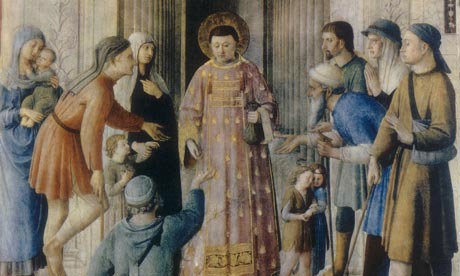
St Lawrence distributing alms by Fra Angelico

St Lawrence distributing alms: fresco by Fra Angelico (1447-1449) Photograph: /Corbis

Kindness was mankind's "greatest delight", the Roman philosopher-emperor Marcus Aurelius declared, and thinkers and writers have echoed him down the centuries. But today many people find these pleasures literally incredible, or at least highly suspect. An image of the self has been created that is utterly lacking in natural generosity. Most people appear to believe that deep down they (and other people) are mad, bad and dangerous to know; that as a species - apparently unlike other species of animal - we are deeply and fundamentally antagonistic to each other, that our motives are utterly self-seeking and that our sympathies are forms of self-protectiveness.

On Kindness
by Adam Philips & Barbara Taylor
Hamish Hamilton, £14.99
Kindness - not sexuality, not violence, not money - has become our forbidden pleasure. In one sense kindness is always hazardous because it is based on a susceptibility to others, a capacity to identify with their pleasures and sufferings. Putting oneself in someone else's shoes, as the saying goes, can be very uncomfortable. But if the pleasures of kindness - like all the greatest human pleasures - are inherently perilous, they are none the less some of the most satisfying we possess.

In 1741 the Scottish philosopher David Hume, confronted by a school of philosophy that held mankind to be irredeemably selfish, lost patience. Any person foolish enough to deny the existence of human kindness had simply lost touch with emotional reality, Hume insisted: "He has forgotten the movements of his heart."

For nearly all of human history - up to and beyond Hume's day, the so-called dawn of modernity - people have perceived themselves as naturally kind. In giving up on kindness - and especially our own acts of kindness - we deprive ourselves of a pleasure that is fundamental to our sense of well-being.

Kindness's original meaning of kinship or sameness has stretched over time to encompass sentiments that today go by a wide variety of names - sympathy, generosity, altruism, benevolence, humanity, compassion, pity, empathy - and that in the past were known by other terms as well, notably philanthropia (love of mankind) and caritas (neighbourly or brotherly love). The precise meanings of these words vary, but basically they all denote what the Victorians called "open-heartedness", the sympathetic expansiveness linking self to other. "No less indiscriminate and general than the alienation between people is the desire to breach it," the German critic Theodor Adorno once wrote, suggesting that even though our alienation, our distance from other people, may make us feel safe it also makes us sorry, as though loneliness is the inevitable cost of looking after ourselves. History shows us the manifold expressions of humanity's desire to connect, from classical celebrations of friendship, to Christian teachings on love and charity, to 20th-century philosophies of social welfare. It also shows us the degree of human alienation, how our capacity to care for each other is inhibited by fears and rivalries with pedigrees as long as kindness itself.

For most of western history the dominant tradition of kindness has been Christianity, which sacralises people's generous instincts and makes them the basis of a universalist faith. For centuries, Christian caritas functioned as a cultural cement, binding individuals into society. But from the 16th century the Christian rule "love thy neighbour as thyself" came under increasing attack from competitive individualism. Thomas Hobbes's Leviathan (1651) - the ur-text of the new individualism - dismissed Christian kindness as a psychological absurdity. Men, Hobbes insisted, were selfish beasts who cared for nothing but their own well-being; human existence was a "warre of alle against alle". His arguments were slow to gain ground, but by the end of the 18th century - despite the best efforts of Hume and others - they were becoming orthodoxy. Two centuries later it seems we are all Hobbesians, convinced that self-interest is our ruling principle. (The French psychoanalyst Lacan suggested that the Christian injunction "love thy neighbour as thyself" must be ironic because people hate themselves.) Kindly behaviour is looked upon with suspicion; public espousals of kindness are dismissed as moralistic and sentimental. Kindness is seen either as a cover story or as a failure of nerve. Popular icons of kindness - Princess Diana, Nelson Mandela, Mother Teresa - are either worshipped as saints or gleefully unmasked as self-serving hypocrites. Prioritising the needs of others may be praiseworthy, we think, but it is certainly not normal.

Today it is only between parents and children that kindness is expected, sanctioned and indeed obligatory. Kindness - that is, the ability to bear the vulnerability of others, and therefore of oneself - has become a sign of weakness (except of course among saintly people, in whom it is a sign of their exceptionality). No one yet says parents should stop being kind to their children. None the less, we have become phobic of kindness in our societies, avoiding obvious acts of kindness and producing, as we do with phobias, endless rationalisations to justify our avoidance.

All compassion is self-pity, DH Lawrence remarked, and this usefully formulates the widespread modern suspicion of kindness: that it is either a higher form of selfishness (the kind that is morally triumphant and secretly exploitative) or the lowest form of weakness (kindness is the way the weak control the strong, the kind are kind only because they haven't got the guts to be anything else). If we think of humans as essentially competitive, and therefore triumphalist by inclination, as we are encouraged to do, then kindness looks distinctly old-fashioned, indeed nostalgic, a vestige from a time when we could recognise ourselves in each other, and feel sympathetic because of our kindness - if such a time ever existed. And what, after all, can kindness help us win, except moral approval; or possibly not even that, in a society where "respect" for personal status has become a leading value.

Most people, as they grow up now, secretly believe that kindness is a virtue of losers. But agreeing to talk about winners and losers is part and parcel of the phobic avoidance, the contemporary terror, of kindness. Because one of the things the enemies of kindness never ask themselves - and this is now an enemy within all of us - is why we feel it at all. Why are we ever, in any way, moved to be kind to other people, not to mention to ourselves? Why does kindness matter to us? It is, perhaps, one of the distinctive things about kindness - unlike an abstract moral ideal such as justice - that in the end we know exactly what it is, in most everyday situations; and yet our knowing what the kind act is makes it easier to avoid. We usually know what the kind thing to do is - and when a kindness is done to us, and when it is not. We usually have the wherewithal to do it (kindness is not an expert skill); and it gives us pleasure. And yet we are extremely disturbed by it. There is nothing we feel more consistently deprived of than kindness; the unkindness of others has become our contemporary complaint. Kindness consistently preoccupies us, and yet most of us are unable to live a life guided by it.

"A sign of health in the mind", Donald Winnicott wrote in 1970, "is the ability of one individual to enter imaginatively and accurately into the thoughts and feelings and hopes and fears of another person; also to allow the other person to do the same to us." To live well, we must be able to identify imaginatively with other people, and allow them to identify with us. Unkindness involves a failure of the imagination so acute that it threatens not just our happiness but our sanity. Caring about others, as Jean-Jacques Rousseau argued, is what makes us fully human. We depend on each other not just for our survival but for our very being. The self without sympathetic attachments is either a fiction or a lunatic.

Modern western society resists this fundamental truth, valuing independence above all things. Needing others is perceived as a weakness. Only small children, the sick and the very elderly are permitted dependence on others; for everyone else, self-sufficiency and autonomy are cardinal virtues. Dependence is scorned even in intimate relationships, as though dependence were incompatible with self-reliance rather than the only thing that makes it possible. The ideal lover or spouse is a freewheeling agent for whom the giving and taking of love is a disposable lifestyle option; neediness, even in this arena of intense desires and longings, is ultimately contemptible.

But we are all dependent creatures, right to the core. For most of western history this has been widely acknowledged. Even the Stoics - those avatars of self-reliance - recognised man's innate need for other people as purveyors and objects of kindness. "Individualism" is a very recent phenomenon. The Enlightenment, generally perceived as the origin of western individualism, promoted "social affections" against "private interests". Victorianism, individualism's so-called golden age, witnessed a fierce clash between champions and critics of commercial individualism. In the early 1880s the historian and Christian activist Arnold Toynbee, in a series of lectures to working men on the English industrial revolution, tore into the egoistic vision of man preached by prophets of free-enterprise capitalism. The "world of gold-seeking animals, stripped of every human affection" envisaged by free marketeers was "less real than the island of Lilliput", Toynbee snorted. American transcendentalists of the same period attacked the spirit of "selfish competition", and established communities of "brotherly cooperation". Even Charles Darwin, that darling of modern individualists, strongly rejected the view of mankind as primarily selfish, arguing for the existence of other-regarding instincts as powerful as self-regarding ones. Sympathy and cooperation were innate to man, Darwin argued in the The Descent of Man (1871), and a key factor behind humanity's evolutionary success.

Darwin championed kindness on scientific rather than religious grounds. For most Victorians, however, Christian caritas remained the epitome of kindness. Serving God meant serving one's fellows, through the vast array of philanthropic agencies sponsored by the churches. Secular individuals and organisations absorbed this ethos, with professional bodies emphasising the altruistic motives of their members while politicians paraded their public-spiritedness. In Britain, self-sacrifice and social duty became keynotes of the "imperial mission", attracting hordes of high-minded men and women prepared to shoulder the "white man's burden". Meanwhile, across the Atlantic, an army of philanthropists descended on poor Americans, determined to elevate their morals while alleviating their hardships. Power suffused with kindly purpose became a militant practical force, moulding social relations domestically and globally.

Today Victorian kindness is condemned for its moral self-righteousness, its class biases, its racial-imperial mentality. Nietzsche's sneer at 19th-century philanthropists as persons of "bad conscience" is widely endorsed. Nor did these good Samaritans lack critics at the time - from Oscar Wilde, with his well-publicised loathing of the "sickly cant of Duty", to radicals and socialists determined to replace charity with justice, elite kindness with universal rights. The horrors of the first world war exposed the hollowness of imperial-sacrificial rhetoric, while the erosion of traditional social hierarchies following the war undermined the service ideal. Women who had long touted self-forgetfulness and dedication to others as "female duty" began to contemplate the benefits of equality instead. Perhaps women were not always bound to care for others more than themselves? "Poor-peopling", as Florence Nightingale dubbed women's philanthropic labours in slum neighbourhoods, began to fall from fashion, and many welcomed its passing, looking instead to trade unions and government to eradicate poverty rather than softening it. By the early 20th century, "good works" had lost their moral glow.

Kindness aligned to power degenerates easily into moralistic bullying - as many recipients of present-day welfare services know to their cost. William Beveridge, the architect of the British welfare state, was acutely aware of this danger. Entering public life in the twilight years of Victorian philanthropy, Beveridge repudiated what he described as the "doing things for other people" spirit of organised charity, announcing his intention to approach social problems scientifically rather than sentimentally. "I utterly distrust the saving power of culture and missions and isolated good feelings ..." All human action was ultimately selfish, he declared. However, this was not a viewpoint that Beveridge - passionately committed to the relief of suffering - could maintain for long. His 1942 report, laying out the principles of cradle-to-grave welfare provision, was hailed by admirers as "practical benevolence". He began political life as a Liberal, and ended it as a socialist committed to the altruistic values he had earlier dismissed, eulogising the "spirit of social conscience" as the foundation stone of a good society. "The happiness or unhappiness of the society in which we live depends upon ourselves as citizens."

The kindness that Beveridge favoured was determinedly modern and demotic, caritas without the condescending coerciveness of Victorian philanthropy. For his friend and brother-in-law, the Christian socialist Richard Tawney, kindness of this order required equality. Inequalities - of wealth, privilege, opportunity - were inimical to fellow feeling. The "religion of inequality" worshipped in Britain, Tawney wrote in 1931, "vulgarised" and "depressed" all human relations. His sentiments strongly influenced the labour movement, undermining free-market ideology and bolstering support for welfare principles.

The present-day NHS is in many respects an archaism, a dinosaur of public altruism that stubbornly refuses to lie down and die. Strenuous attempts by succeeding governments to commercialise it have done much damage, yet the caring ethos survives, testimony to what Richard Titmuss, one of the NHS's most influential champions, described as the universal human impulse to "help strangers". Why should anyone care whether a person entirely unknown to them gets the healthcare he or she needs? On the Hobbesian model of human nature this makes no sense at all; yet the evidence that people do care, Titmuss believed, is overwhelming.

Margaret Thatcher's 1979 electoral victory marked the defeat in Britain of the Beveridge/Tawney/Titmuss vision of a kindly society, while the rise of Reaganism in 80s America saw a similar erosion of welfare values there. Kindness was downgraded into a minority motivation, suitable only for parents (especially mothers), "care professionals" and assorted sandal-wearing do-gooders. The "caring, sharing" 90s proclaimed a return to community values, but this proved to be rhetorical flimflam as Thatcher and Reagan's children came of age, steeped in free-market ideology and with barely a folk memory of the mid-century welfare vision. With the 1997 triumph of New Labour in Britain, and George W Bush's election to the American presidency in 2000, competitive individualism became the ruling consensus. The taboo surrounding "dependency" became even stronger, as politicians, employers and a motley array of well-fed moralists harangued the poor and vulnerable on the virtues of self-reliance. Tony Blair called for "compassion with a hard edge" to replace the softening variety advocated by his predecessors. "The new welfare state must encourage work, not dependency," he declared, as a plague of cost-cutting managers chomped away at Britain's social services.

Capitalism is no system for the kind-hearted. Even its devotees acknowledge this while insisting that, however tawdry capitalist motives may be, the results are socially beneficial. Untrammelled free enterprise generates wealth and happiness for all. Like all utopian faiths, this is largely delusory. Free markets erode the societies that harbour them. The great paradox of modern capitalism, the ex-Thatcherite John Gray has pointed out (False Dawn, 1998), is that it undermines the very social institutions on which it once relied - family, career, community. For increasing numbers of Britons and Americans, the "enterprise culture" means a life of overwork, anxiety and isolation. Competition reigns supreme, with even small children forced to compete against each other and falling ill as a result. A competitive society, one that divides people into winners and losers, breeds unkindness. Kindness comes naturally to us, but so too do cruelty and aggression. People placed under unremitting pressure become estranged from each other. Like the bullied child who bullies others in turn, individuals coerced by circumstances become coercers. Sympathies contract as open-heartedness begins to feel too exposed. Paranoia blossoms as people seek scapegoats for their unhappiness. Such scapegoating is a self-betrayal because it involves sacrificing our kindness. But this is a price many pay when tribal loyalties, sometimes vicious in their expression, replace wider communal bonds. A culture of "hardness" and cynicism grows, fed by envious admiration of those who seem to thrive - the rich and famous, our modern priesthood - in this tooth-and-claw environment.

What is to be done?

Read the rest of the review.


Tuesday, January 06, 2009

Big Think - Does America Have a Sex Addiction?

Author Rachel Resnick explains the ways repression can lead to dangerous addictions. She makes good arguments, I think, and I only see it getting worse. My girlfriend sees this all day where she works, especially the comorbidity of love and sex addictions (love junkies become sex addicts because the two are equated for many people).


The Nature-Nurture Debate, Redux (The Chroncile Review)


This article from The Chronicle Review (Chronicle of Higher Education) takes a look at the influence (finally) of genetics on sociology, which moves everything a little closer to integral (small, glacial increments, but things are shifting). It's all interconnected.

Of course, the risk is that genetics will do to sociology what neuroscience is doing to psychology - remove the human component and make it all about flatland, objective science.

The Nature-Nurture Debate, Redux

Genetic research finally makes its way into the thinking of sociologists

If sociologists ignore genes, will other academics — and the wider world — ignore sociology?

Some in the discipline are telling their peers just that. With study after study finding that all sorts of personal characteristics are heritable — along with behaviors shaped by those characteristics — a see-no-gene perspective is obsolete.

Nor, these scholars argue, is it reasonable to concede that genes play some role but then to loftily assert that geneticists and the media overstate that role and to go on conducting studies as if genes did not exist. How, exactly, do genes shape human lives, interact with environmental forces, or get overpowered by those forces? "We do ourselves a disservice if we don't engage in those arguments," says Jason Schnittker, an associate professor of sociology at the University of Pennsylvania. "If we stay on the ropes, people from a different perspective, with a more extreme view, will be making them."

Schnittker is among the contributors to a special issue of the American Journal of Sociology, the field's flagship publication, devoted to "Genetics and Social Structure" — evidence that at least some sociologists are attempting to reckon with the genetic revolution. And not just in the AJS. Other top sociology journals, too, are publishing work incorporating genetic perspectives: The American Sociological Review in August published a much-discussed article on genes and delinquency by Guang Guo, of the University of North Carolina. (A couple of years ago, in an early foray on this front, Guo co-edited a special section of another top journal, Social Forces, titled "The Linking of Sociology and Biology.")

It is even possible to identify sociology departments in which gene-environment interactions amount to a subfield: Chapel Hill, for one. Its department boasts at least five tenured scholars who write on the subject, and it offers a graduate seminar on genes and society.

The idea for the special issue of AJS was hatched a couple of years ago at Columbia University, under the aegis of that campus's Robert Wood Johnson Health and Society Scholars Program. Its fellows are encouraged to reach across disciplinary lines, and Peter Bearman, who co-directs the Columbia program, found that he and two young visiting fellows, Brandeis's Sara Shostak and Penn State's Molly Martin, shared an interest in responding to the flood of new information about heredity. The three sociologists ended up editing the special issue.

"There was a sense," Bearman says, "that there were two modes of thoughts about genetics and health. One was, 'Genetics causes everything.' Another was a refusal to think that anything related to genetic expression was worth studying.

"My view then, and my view now is that the embrace of genetic explanation and fear of genetic explanation were really the same phenomenon: an overemphasis on the role of genetics in shaping health outcomes." In short, sociologists may shun genes because they secretly fear that genes are more powerful than they actually are.

To concede that some people are genetically encoded to have shorter fuses than others or are more likely to gain weight if granted unlimited access to Oreos is hardly to embrace a view of humans as lumbering robots ruled by genes, contributors to the AJS issue argue. Admitting as much is just the first step in a rich inquiry into the biological and social forces shaping human lives — an inquiry that sociologists, like few others, are equipped to make.

But even the most gung-ho genetically minded sociologists will say that their first baby steps toward consilience, E.O. Wilson's term for the uniting of the biological and social sciences, don't match that lofty rhetoric. In general the genetic sociological work is highly statistical, often involving relatively new multivariable techniques. It is devoid of the narrative description that sociologists who immerse themselves in their subjects' lives can offer.

What has the work uncovered? In the AJS special issue, Schnittker rebuts the "set point" theory of happiness that has been espoused by some psychologists: the notion that there's not much we can do about our innate levels of jubilance or melancholy. He makes use of a data set of people ages 25 to 75, including fraternal twins, identical twins, and nontwin siblings (looking at twins and nontwins helps isolate heritable characteristics), and finds that the environment does, in fact, matter — but in unpredictable ways. Marriage, he finds, has almost no effect on adult contentment once other factors have been accounted for. Friendships, on the other hand, matter a great deal — a reversal of sociologists' usual ordering of these two sources of support. The explanation may be that we marry people who are much like us, while friendships are more random and labile, and thus more likely to bump us out of our habitual moods.

North Carolina's Guo looks at a gene that has been tied to levels of dopamine, a neurotransmitter linked to aggressiveness and sexual energy. One variant of the gene, which may tamp down dopamine levels, has a "robust protective effect" against early first-time sex among teenagers, he finds. The protective effect vanishes, however, when teenagers with that genotype find themselves in schools where early sex is the norm. Meanwhile, Bernice Pescosolido, of Indiana University at Bloomington — who, like Guo, has several co-authors — finds that a version of the gene Gabra2, implicated by other researchers in an increased risk for alcoholism, has no effect on women. Even among men, those with the risky version have no increased risk for alcoholism provided they have strong family bonds.

The idea that social theorists must account for genes sounds commonsensical. But those doing the work, of course, labor under some dark shadows. Social science has a history of misguided, or worse, attempts to link genes to crime, or to deviance, or to IQ; racial differences have often been either a subtext of this work or the researchers' main interest. Take your pick of flare-ups over the past 30 years: the reception of Crime and Human Nature (1985), written by the UCLA political scientist James Q. Wilson and the late Harvard psychologist Richard Herrnstein; comments, in 1992, by a National Institutes of Health official comparing inner cities to jungles and arguing that the breakdown of "social controls" in ghettos allowed genetic impulses to run free; a conference on crime and genes scheduled for 1992 and canceled after an uproar. (It was finally held in 1995.) Then, of course, there was the furor over The Bell Curve, in which Herrnstein and the political scientist Charles A. Murray, of the American Enterprise Institute, attributed social problems among racial minorities in part to low intelligence.

Sociologists spoke up during those controversies, but they have also criticized less obviously combustible genetic studies. Just two years ago, in his presidential address to the American Sociological Association, Troy Duster, an eminent sociologist at New York University, went so far as to suggest that any sociologist who embraced genetic approaches was a traitor to the discipline. Two of the biggest problems facing sociology, he argued, were the "increasing authority of reductionist science" and "the attendant expansion of databases on markers and processes 'inside the body.'" If anything defined sociology, Duster said, it was its role as "century-long counterpoint" to such efforts to connect the roots of social problems to biology.

Duster recalled sitting on various governmental review boards and watching as what he considered an inordinate amount of money flowed toward geneticists and other scientists who studied maladies like alcoholism. Why spend millions searching for a predisposition to alcoholism among Native Americans, he asked, when their mistreatment and oppression offered explanation enough?

In an interview, Duster mostly affirms those remarks. "While in theory, one should embrace this theory of environmental-genetic research," he says, "in actual practice, unless one is very, very sensitive to the stratification of the sciences, the table will be tilted in favor of genetics."

Jeremy Freese, of Northwestern University, frames his contribution to the AJS special issue as a direct rebuttal of Duster. An oppositional stance makes sense "for some highly charged areas," Freese grants, but it can't be the whole agenda. He brandishes a list of 52 characteristics that have been found to be partially heritable: cognitive ability, extroversion, aggressiveness, likeliness to marry, age at first sexual intercourse, support for the death penalty, and on and on. Indeed, by now one should assume that "genetic differences are partial causes of the overwhelming majority of outcomes" that sociologists study. Nevertheless, he says, social scientists still engage in "tacit collusion" to ignore the role of genetic differences.

Nothing makes it easier on "imperializing" fields that already disrespect sociology, Freese writes — he mentions economics and behavioral genetics — "than an incisive, significant, and easily explained flaw shared by an entire literature."

Ouch. Well, not an entire literature, not anymore. What has led to the new genetic turn in sociology, at least among a minority? In part it has to do with the availability of important new data sets. The National Longitudinal Study of Adolescent Health, aka Add Health, for example, at Chapel Hill, was designed from the start to incorporate both sociological and genetic information. It was begun, in 1994, by Bearman, J. Richard Udry, and Kathleen Mullan Harris. The idea was to capture as much information as possible about the social circumstances, friendship networks, and family conditions of 21,000 teenagers in 132 schools, from grades 7 through 12. The survey included a disproportionate number of twins, both fraternal and identical, full- and half-siblings, and adopted kids, allowing preliminary analyses of the heritability of traits. Follow-up interviews were conducted a year later.

Read the rest of the article.