Showing posts with label movies. Show all posts

Monday, July 21, 2014

Humans Already Use Way, Way More Than 10 Percent of Their Brains


From The Atlantic, Sam McDougle dispels the silly myth that we only use 10% of our brains. Oddly, the first time I saw this myth debunked was in Omni Magazine back in the 1980s.

The impetus for this new debunking of the myth is the new Luc Besson - Scarlett Johansson film, Lucy (trailer below), which begins with a neuroscientist (Morgan Freeman) delivering the following lines in a lecture:
“It is estimated most human beings only use 10 percent of the brain’s capacity. Imagine if we could access 100 percent. Interesting things begin to happen.”
We can and so access 100% of our brains (barring organic damage), and still, very few people are doing interesting things.

Humans Already Use Way, Way More Than 10 Percent of Their Brains

It’s a complex, constantly multi-tasking network of tissue—but the myth persists.

Sam McDougle | Jul 16 2014


Chris Helgren/Reuters

By now, perhaps you’ve seen the trailer for the new sci-fi thriller Lucy. It starts with a flurry of stylized special effects and Scarlett Johansson serving up a barrage of bad-guy beatings. Then comes Morgan Freeman, playing a professorial neuroscientist with the obligatory brown blazer, to deliver the film’s familiar premise to a full lecture hall: “It is estimated most human beings only use 10 percent of the brain’s capacity. Imagine if we could access 100 percent. Interesting things begin to happen.”

Johansson as Lucy, who has been kidnapped and implanted with mysterious drugs, becomes a test case for those interesting things, which seem to include even more impressive beatings and apparently some kind of Matrix-esque time-warping skills.

Of course, the idea that “you only use 10 percent of your brain” is, indeed, 100 hundred percent bogus. Why has this myth persisted for so long, and when is it finally going to die?


Unfortunately, not any time soon. A survey last year by The Michael J. Fox Foundation for Parkinson's Research found that 65 percent of Americans believe the myth is true, 5 percent more than those who believe in evolution. Even Mythbusters, which declared the statistic a myth a few years ago, further muddied the waters: The show merely increased the erroneous 10 percent figure and implied, incorrectly, that people use 35 percent of their brains. The idea that swaths of the brain are stagnant pudding while one section does all the work is silly.

Like most legends, the origin of this fiction is unclear, though there are some clues. According to Sam Wang, a neuroscientist at Princeton and the author of Welcome to Your Brain, the catalyst may have been the self-help industry. In the early 1900s, William James, one of the most influential thinkers in modern psychology, famously said that humans have unused mental potential. This completely reasonable assertion was later revived, in mangled form, by the writer Lowell Thomas in his foreword to the 1936 self-help bible How To Win Friends And Influence People. “Professor William James of Harvard used to say that the average person develops only 10 percent of his latent mental ability,” Thomas wrote. It appears that he, or perhaps someone else in his day, simply plucked the golden number out of the sky.

The 10 percent claim is demonstrably false on a number of levels. First, the entire brain is active all the time. The brain is an organ. Its living neurons, and the cells that support them, are always doing something. (Where’s the “you only use 10 percent of your spleen” myth?) Joe LeDoux, a professor of neuroscience and psychology at NYU, thinks that people today may be thrown off by the “blobs”—the dispersed markers of high brain activity—seen in functional magnetic resonance imaging (fMRI) of the human brain. These blobs are often what people are talking about when they refer to the brain “lighting up.”

Say you’re watching a movie in an fMRI scanner. Certain areas of your brain—the auditory and visual cortices, for instance—will be significantly more active than others; and that activity will show up as colored splotches when the fMRI images are later analyzed. These blobs of significant activity usually cover small portions of the brain image, often less than 10 percent, which could make it seem, to the casual observer, that the rest of the brain is idling. But, as LeDoux put it to me in an email, “the brain could be one hundred percent active during a task with only a small percentage of brain activity unique to the task.” This kind of imaging highlights big differences in regional brain activity, not everything the brain is doing. And that’s why the 10-percent myth, compared with other fantasies, is especially pernicious.

In fact, the entire premise of only “using” a certain proportion of your brain is misguided. When your brain works on a problem—turning light that hits your retina into an image, or preparing to reach for a pint of beer, or solving an algebra problem—its effectiveness is as much a question of “where” and “when” as it is of “how much.” Certain regions of the brain are more specialized than others to deal with certain tasks, and most behavior depends on tight temporal coordination between those regions. Your visual system helps you locate that pint of beer, and your motor system gets your hand around it. The idea that swaths of the brain are stagnant pudding while one section does all the work is silly. The brain is a complex, constantly multi-tasking network of tissue.

Still, the appeal of the myth is clear. If we only use 10 percent of our brains, imagine how totally great life would be if we could use more. You could dazzle Grandma and her nursing-home crew during Jeopardy. Or, like Lucy, you could learn Chinese calligraphy in an hour. The 10-percent myth presses the same buttons as any self-help scheme that promises to make us better, faster. As Wang told me, it’s “like the 4-hour workweek guy.”

And that’s why the 10-percent myth, compared with other fantasies, is especially pernicious. It has a distinct air of scientific plausibility—it’s a zippy one-liner with a nice round number, a virus with obvious vectors in pop-psychology books, easy to repeat at cocktail parties. The myth is also part of a larger way of thinking about the brain that is characterized by misleading simplifications—like the notion that the right side of the brain is creative and the left side rational. “Those kinds of ideas self-perpetuate,” LeDoux told me. “It's like saying dopamine is responsible for pleasure and the amygdala makes fear. Both are wrong.”

Neuroscience is still in its adolescence, but it is all too often served to the public as a more mature field. As psychologist Gary Marcus recently argued, biology—including neuroscience—is not like physics, where scientists build on a bedrock of established formal laws. As of yet, neuroscience has no such foundation, which may increase the likelihood that sweeping myths about the brain endure. Neuroscience and psychology are the rare scientific fields that, for many, have tangible personal value—there is no self-help industry based on the therapeutic effects of the Higgs boson—which means slow, careful progress in research often gets juiced up by opportunist, or at least over-eager, non-scientists.

I’m still going to see Lucy, if only because it’s directed by Luc Besson and The Fifth Element blew my 10-year-old mind when it came out. But here’s to hoping for Hollywood sci-fi movies that lean more on the weird and imaginative and less on the widely believed and dead wrong.

Wednesday, July 31, 2013

Martin Scorsese and Stanley Kubrick Pick Their 10 Favorite Films

From Open Culture, here are two "top ten" lists from two of America's most important filmmakers of the last 50 years. First up is Stanley Kubrick, who made his list in 1963. It would be interesting to see how that might have changed if he had done it in the last decade of his life.

The other list comes from one of my favorite directors, Martin Scorsese, who made his list earlier this year. Scorsese includes Kubrick's 2001: A Space Odyssey on his list - I wonder if Kubrick in his later years would have included Taxi Driver or Raging Bull or Mean Streets?

Stanley Kubrick’s List of Top 10 Films (The First and Only List He Ever Created)


July 30th, 2013


When, over the past weekend, I noticed the words “Stanley Kubrick” had risen into Twitter’s trending-topics list, I got excited. I figured someone had discovered, in the back of a long-neglected studio vault, the last extant print of a Kubrick masterpiece we’d somehow all forgotten. No suck luck, of course; Kubrick scholars, given how much they still talk about even the auteur’s never-realized projects like Napoleon, surely wouldn’t let an entire movie slip into obscurity. The burst of tweets actually came in honor of Kubrick’s 85th birthday, and hey, any chance to celebrate a director whose filmography includes the likes of Dr. Strangelove, The Shining, and 2001: A Space Odyssey, I’ll seize. The British Film Institute marked the occasion by posting a little-seen list of Kubrick’s top ten films.

“The first and only (as far as we know) Top 10 list Kubrick submitted to anyone was in 1963 to a fledgling American magazine named Cinema (which had been founded the previous year and ceased publication in 1976),” writes the BFI’s Nick Wrigley. It runs as follows:

1. I Vitelloni (Fellini, 1953)
2. Wild Strawberries (Bergman, 1957)
3. Citizen Kane (Welles, 1941)
4. The Treasure of the Sierra Madre (Huston, 1948)
5. City Lights (Chaplin, 1931)
6. Henry V (Olivier, 1944)
7. La notte (Antonioni, 1961)
8. The Bank Dick (Fields, 1940—above)
9. Roxie Hart (Wellman, 1942)
10. Hell’s Angels (Hughes, 1930)

But seeing as Kubrick still had 36 years to live and watch movies after making the list, it naturally provides something less than the final word on his preferences. Wrigley quotes Kubrick confidant Jan Harlan as saying that “Stanley would have seriously revised this 1963 list in later years, though Wild Strawberries, Citizen Kane and City Lights would remain, but he liked Kenneth Branagh’s Henry V much better than the old and old-fashioned Olivier version.” He also quotes Kubrick himself as calling Max Ophuls the “highest of all” and “possessed of every possible quality,” calling Elia Kazan “without question the best director we have in America,” and praising heartily David Lean, Vittorio de Sica, and François Truffaut. This all comes in handy for true cinephiles, who can never find satisfaction watching only the filmmakers they admire; they must also watch the filmmakers the filmmakers they admire admire.

Related Content:

* * * * * * *

Martin Scorsese Reveals His 10 Favorite Movies (and Writes a New Essay on Film Preservation)


July 31st, 2013


Cinema as we’ve almost always known it — “Edison, the Lumière brothers, Méliès, Porter, all the way through Griffith and on to Kubrick” — has “really almost gone.” So writes Martin Scorsese in his recent essay for the New York Review of Books, “The Persisting Vision: Reading the Language of Cinema.” He argues that traditional film forms have “been overwhelmed by moving images coming at us all the time and absolutely everywhere, even faster than the visions coming at the astronaut” in Kubrick’s 2001: A Space Odyssey. “We have no choice but to treat all these moving images coming at us as a language. We need to be able to understand what we’re seeing and find the tools to sort it all out.” Only natural that Scorsese, as one of the best-known, highest-profile auteurs alive, would reference Kubrick, his generational predecessor in the untiring furtherance of cinematic vision and craft.

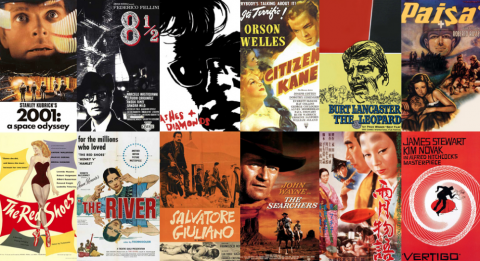
We just yesterday featured a post about Kubrick’s 1963 list of ten favorite films. Scorsese, for his part, has impressed many as one of the most enthusiastically cinephilic directors working in America today: his essays about and appearances on the DVDs of his favorite movies stand as evidence for the surprising breadth of his appreciation. Today, why not have a look at Scorsese’s list, which he put together for Sight and Sound magazine, and which begins with the Kubrick selection you might expect:

2001: A Space Odyssey (1968) – Stanley Kubrick
8½ (1963) – Federico Fellini
Ashes and Diamonds (1958) – Andrzej Wajda
Citizen Kane (1941) – Orson Welles
The Leopard (1963) – Luchino Visconti
Paisan (1946) – Roberto Rossellini
The Red Shoes (1948) – Michael Powell/Emeric Pressburger
The River (1951) – Jean Renoir
Salvatore Giuliano (1962) – Francesco Rosi
The Searchers (1956) – John Ford
Ugetsu Monogatari (1953) – Mizoguchi Kenji
Vertigo (1958) – Alfred Hitchcock

In “The Persisting Vision,” he champions comprehensive film preservation, citing the case of Hitchcock’s Vertigo, the final entry on his list, now named the greatest film of all time by Sight and Sound‘s critics poll. “When the film came out some people liked it, some didn’t, and then it just went away.” When, after decades of obscurity, Vertigo came back into circulation, the color was completely wrong,” and “the elements — the original picture and sound negatives — needed serious attention.” A restoration of the “decaying and severely damaged” film eventually happened, and “more and more people saw Vertigo and came to appreciate its hypnotic beauty and very strange, obsessive focus.” I, personally, couldn’t imagine the world of cinema without it — nor without any of the other pictures Scorsese calls his favorites.

Related Content:

~ Colin Marshall hosts and produces Notebook on Cities and Culture and writes essays on literature, film, cities, Asia, and aesthetics. He’s at work on a book about Los Angeles, A Los Angeles Primer. Follow him on Twitter at @colinmarshall.

Monday, February 25, 2013

85th Annual Academy Awards Winners


I did not see the show last night (we went out to dinner with a friend instead) - besides, I find these things unbearable to watch. So, if you, like me, missed the show, but like to know who won (these movies get added to my must-see list), here is the list of winners, (with snarky commentary) courtesy of I Watch Stuff. Winners are in red text.

It seems they spread the wealth this year - no one film dominated the major categories. As an aside, based on what I have heard from friends, Wreck-It Ralph should have been nominated for Best Picture, and therefore was robbed in not winning the Best Animated Feature category.

Your 85th Annual Academy Awards Winners

February 24, 2013


argo-ben-affleck.jpg

Hollywood's biggest night of listing things is at last over, the Academy of Motion Picture Arts and Sciences last night giving Argo the year's highest honor, The Best Film Ben Affleck Made Since at Least The Town, in Sunday night's 85th Annual Oscars. Meanwhile, Daniel Day-Lewis won Best Actor for his portrayal of historic Linkin Park frontman Abraham Linkin; Jennifer Lawrence can feel good about herself for besting both child and the elderly; and Spielberg went home thinking he should have just made fucking Schindler's Other List, if everyone's going to be like this. Here are the full results:

BEST PICTURE
Amour
Argo
Beasts of the Southern Wild
Django Unchained
Les Misérables
Life of Pi
Lincoln
Silver Linings Playbook
Zero Dark Thirty

BEST ACTOR
Bradley Cooper, Silver Linings Playbook
Daniel Day-Lewis, Lincoln
Denzel Washington, Flight
Hugh Jackman, Les Misérables
Joaquin Phoenix, The Master

BEST ACTRESS
Emmanuelle Riva, Amour
Jennifer Lawrence, Silver Linings Playbook
Jessica Chastain, Zero Dark Thirty
Naomi Watts, The Impossible
Quvenzhane Wallis, Beasts of the Southern Wild

BEST SUPPORTING ACTRESS
Amy Adams, The Master
Anne Hathaway, Les Misérables
Sally Field, Lincoln
Helen Hunt, The Sessions
Jacki Weaver, Silver Linings Playbook

BEST SUPPORTING ACTOR
Alan Arkin, Argo
Christoph Waltz, Django Unchained
Philip Seymour Hoffman, The Master
Robert De Niro, Silver Linings Playbook
Tommy Lee Jones, Lincoln

BEST DIRECTOR
Ang Lee, Life of Pi
David O. Russell, Silver Linings Playbook
Benh Zeitlin, Beast of the Southern Wild
Michael Haneke, Amour
Steven Spielberg, Lincoln

BEST ORIGINAL SCREENPLAY
Amour
Django Unchained
Flight
Moonrise Kingdom
Zero Dark Thirty

BEST ADAPTED SCREENPLAY
Argo
Beasts of the Southern Wild
Life of Pi
Lincoln
Silver Linings Playbook

BEST ANIMATED FEATURE
Brave
Frankenweenie
ParaNorman
The Pirates! Band of Misfits
Wreck-It Ralph

BEST FOREIGN LANGUAGE FILM
Amour
A Royal Affair
No
Kon-Tiki
War Witch

BEST CINEMATOGRAPHY
Anna Karenina
Django Unchained
Life of Pi
Lincoln
Skyfall

BEST COSTUME DESIGN
Anna Karenina
Les Misérables
Lincoln
Mirror Mirror
Snow White and the Huntsman

BEST DOCUMENTARY FEATURE
5 Broken Cameras
The Gatekeepers
How to Survive a Plague
The Invisible War
Searching for Sugar Man

BEST DOCUMENTARY SHORT
Inocente
Kings Point
Mondays at Racine
Open Heart
Redemption

BEST FILM EDITING
Argo
Life of Pi
Lincoln
Silver Linings Playbook
Zero Dark Thirty

BEST MAKEUP AND HAIRSTYLING
Hitchcock
The Hobbit: An Unexpected Journey
Les Misérables

BEST ORIGINAL SCORE
Anna Karenina
Argo
Life of Pi
Lincoln
Skyfall

BEST ORIGINAL SONG
"Before My Time" from Chasing Ice
"Everybody Needs a Best Friend" from Ted
"Pi's Lullaby" from Life of Pi
"Skyfall" from Skyfall
"Suddenly"from Les Misérables

BEST PRODUCTION DESIGN
Anna Karenina
The Hobbit: An Unexpected Journey
Les Misérables
Life of Pi
Lincoln

BEST ANIMATED SHORT
Adam and Dog
Fresh Guacamole
Head Over Heels
Maggie Simpson in 'The Longest Daycare'
Paperman

BEST LIVE ACTION SHORT
Asad
Buzkashi Boys
Curfew
Death of a Shadow (Dood van een Schaduw)
Henry

BEST SOUND EDITING
Argo
Django Unchained
Life of Pi
Skyfall
Zero Dark Thirty
(A G.D. tie! Apparently that's allowed?)

BEST SOUND MIXING
Argo
Les Misérables
Life of Pi
Lincoln
Skyfall

BEST VISUAL EFFECTS
The Hobbit: An Unexpected Journey
Life of Pi
The Avengers
Prometheus
Snow White and the Huntsman

Friday, October 05, 2012

Film Junk - Tarantino, Scorsese and Other Directors Reveal Their Top 10 Movies of All Time

Very interesting selections by these directors - with only a handful of titles showing more than once or twice, including Raging Bull (Scorsese), The Apartment (Wilder), and 8 1/2 (Fellini).

I'm sharing the directors who I admire - a few of them I have never heard of or seen before. See all of the selections at the link below.

Tarantino, Scorsese and Other Directors Reveal Their Top 10 Movies of All Time

Posted by Sean on August 6th, 2012


There was plenty of discussion across the movie blogosphere following last week’s announcement that Vertigo had dethroned Citizen Kane as the greatest film of all time according to Sight & Sound’s decennial poll. In addition to revealing the top 50 as determined by critics, they also provided a top 10 based on a separate poll for directors only. In the print version of the magazine, they have taken it a step further by reprinting some of the individual top 10 lists from the filmmakers who participated, and we now have some of them here for your perusal.

Among them, we have lists from legends like Martin Scorsese, Francis Ford Coppola and Quentin Tarantino, but there are also some unexpected newcomers who took part including Richard Ayoade (Submarine), Miranda July (Me and You and Everyone We Know) and Sean Durkin (Martha Marcy May Marlene). Some of these lists aren’t all that surprising (both Quentin Tarantino and Edgar Wright have given versions of their top 10s before), but hey, who knew that Michael Mann liked both Avatar and Biutiful so much? There’s plenty to chew on here, so check out the lists after the jump and then tell us who is on point and who is simply off their rocker.


Woody Allen

  • Bicycle Thieves (1948, dir. Vittorio De Sica)
  • The Seventh Seal (1957, dir. Ingmar Bergman)
  • Citizen Kane (1941, dir. Orson Welles)
  • Amarcord (1973, dir. Federico Fellini)
  • 8 1/2 (1963, dir. Federico Fellini)
  • The 400 Blows (1959, dir. Francois Truffaut)
  • Rashomon (1950, dir. Akira Kurosawa)
  • La Grande Illusion (1937, dir. Jean Renoir)
  • The Discreet Charm of the Bourgeoisie (1972, dir. Luis Bunuel)
  • Paths of Glory (1957, dir. Stanley Kubrick) 

Bong Joon-Ho

  • A City of Sadness (1989, dir. Hou Hsiao-hsien)
  • Cure (1997, dir. Kiyoshi Kurosawa)
  • The Housemaid (1960, dir. Kim Ki-young)
  • Fargo (1996, dir. the Coen Brothers)
  • Psycho (1960, dir. Alfred Hitchcock)
  • Raging Bull (1980, dir. Martin Scorsese)
  • Touch of Evil (1958, dir. Orson Welles)
  • Vengeance Is Mine (1973, dir. Shohei Imamura)
  • The Wages of Fear (1953, dir. Henri-Georges Clouzot)
  • Zodiac (2007, dir. David Fincher)

Francis Ford Coppola

  • Ashes and Diamonds (1958, dir. Andrzej Wajda)
  • The Best Years of Our Lives (1946, dir William Wyler)
  • I Vitteloni (1953, dir. Federico Fellini)
  • The Bad Sleep Well (1960, dir. Akira Kurosawa)
  • Yojimbo (1961, dir. Akira Kurosawa)
  • Singin’ in the Rain (1952, dir. Stanley Donen and Gene Kelly)
  • The King of Comedy (1983, dir Martin Scorsese)
  • Raging Bull (1980, dir. Martin Scorsese)
  • The Apartment (1960s, dir. Billy Wilder)
  • Sunrise (1927, dir. F.W. Murnau)

Guillermo Del Toro

  • Frankenstein (1931, dir. James Whale)
  • Freaks (1932, dir. Todd Browning)
  • Shadow of a Doubt (1943, dir. Alfred Hitchcock)
  • Greed (1925, dir. Erich Von Stroheim)
  • Modern Times (1936, dir. Charlie Chaplin)
  • La Belle Et La Bete (1946, dir. Jean Cocteau)
  • Goodfellas (1990, dir. Martin Scorsese)
  • Los Olvidados (1950, dir. Luis Bunuel)
  • Nosferatu (1922, dir. F.W. Murnau)
  • 8 1/2 (1963, dir. Federico Fellini)

Miranda July (Me and You and Everyone We Know)

  • Blind (1987, dir. Frederick Wiseman)
  • Smooth Talk (1985, dir. Joyce Chopra)
  • Vertigo (1958, dir. Alfred Hitchcock)
  • After Life (1998, dir. Hirokazu Koreeda)
  • Somewhere in Time (1980, dir. Jeannot Szwarc)
  • Cheese (2007, dir. Mika Rottenberg)
  • Punch Drunk Love (2002, dir. Paul Thomas Anderson)
  • The Red Balloon (1956, dir. Albert Lamorisse)
  • A Room With a View (1985, dir. James Ivory)
  • Fish Tank (2009, dir. Andrea Arnold)

Mike Leigh

  • American Madness (1932, dir. Frank Capra)
  • Andrei Rublev (1966, dir. Andrei Tarkovsky)
  • I Am Cuba (1964, dir. Mikhai Kalatozov)
  • The Emigrants (1971, dir. Jan Troell)
  • How a Mosquito Operates (1912, dir. Winsor McCay)
  • Jules Et Jim (1962, dir. Francois Truffaut)
  • Radio Days (1987, dir. Woody Allen)
  • Songs From the Second Floor (2000, dir. Roy Andersson)
  • Tokyo Story (1953, dir. Yasujiro Ozu)

Michael Mann

  • Apocalypse Now (1979, dir. Francis Ford Coppola)
  • Battleship Potemkin (1925, dir. Sergei Eisenstein)
  • Citizen Kane (1941, dir. Orson Welles)
  • Avatar (2009, dir. James Cameron)
  • Dr. Strangelove (1964, dir. Stanley Kubrick)
  • Biutiful (2010, dir. Alejandro Gonzalez Inarritu)
  • My Darling Clementine (1946, dir. John Ford)
  • The Passion of Joan of Arc (1928, dir. Carl theodor Dreyer)
  • Raging Bull (1980, dir. Martin Scorsese)
  • The Wild Bunch (1969, dir. Sam Peckinpah)

Steve McQueen (Shame)

  • The Battle of Algiers (1966, dir. Gillo Pontecorvo)
  • Zero de Conduite (1933, dir. Jean Vigo)
  • La Regle du Jeu (1939, dir. Jean Renoir)
  • Tokyo Story (1953, dir. Yasujiro Ozu)
  • Couch (1964, dir. Andy Warhol)
  • Le Mepris (1963, dir. Jean-Luc Godard)
  • Beau Travail (1998, dir. Claire Denis)
  • Once Upon a Time in America (1984, dir. Sergio Leone)
  • The Wages of Fear (1953, dir. Henri-Georges Clouzot)
  • Do the Right Thing (1989, dir. Spike Lee)

Jeff Nichols (Take Shelter)

  • Cool Hand Luke (1967, dir. Stuart Rosenberg)
  • Badlands (1973, dir. Terrence Malick)
  • Hud (1963, dir. Martin Ritt)
  • The Hustler (1961, dir. Robert Rossen)
  • Lawrence of Arabia (1962, dir. David Lean)
  • Butch Cassidy and the Sundance Kid (1969, dir. George Roy Hill)
  • Jaws (1975, dir. Steven Spielberg)
  • North By Northwest (1959, dir. Alfred Hitchcock)
  • Stagecoach (1939, dir. John Ford)
  • Fletch (1985, dir. Michael Ritchie)

Saturday, September 01, 2012

Troma Movies Releases 150 Movies on YouTube


Troma Movies has released 150 films from it's nearly 40 year history on YouTube. Troma is known for their low-budget independent movies that play on 1950s horror with tongue firmly implanted in cheek - and even better, many of their films contain social commentary.

A little history from Wikipedia:
Troma films are B-movies known for their surrealistic or automatistic nature, along with their use of shocking imagery; some would categorize them as "shock exploitation films". They typically contain overt sexuality, nudity, and intentionally sadistic, gory, and blatant graphic violence, so much that the term "Troma film" has become synonymous with these characteristics. Troma's slogan is Movies of the Future. Troma reuses the same props, actors, and scenes repeatedly, sometimes to save money. At a certain point, however, this became another hallmark of Troma. Examples include a severed leg, a penis monster, and the flipping and exploding car filmed for the movie Sgt. Kabukiman, NYPD, which is used in place of any other car that needs to crash and explode.

Troma produced or acquired early films featuring several rising talents, such as Carmen Electra (The Chosen One), Billy Bob Thornton (Chopper Chicks in Zombietown), Vanna White (Graduation Day), Kevin Costner (Sizzle Beach, U.S.A.), Samuel L. Jackson (Def by Temptation), Marisa Tomei (The Toxic Avenger), Vincent D'Onofrio (The First Turn-On!), David Boreanaz (Macabre Pair of Shorts), Paul Sorvino (Cry Uncle!), James Gunn (Tromeo and Juliet), Trey Parker and Matt Stone (Cannibal! The Musical), before they were discovered. Another Academy Award winning director, Oliver Stone, made his debut as an actor in The Battle of Love's Return.

Their latest production, Poultrygeist: Night of the Chicken Dead, was released in late 2006.[2]
These are some classic titles from their catalog: