Wednesday, March 26, 2014

A Review of Cognitive Function in First-Episode Psychosis: Childhood Trauma, Stress, and Inflammation


A topic close to my heart these days . . . from the open access journal Frontiers in Psychiatry: Schizophrenia. The researchers conclude the cognitive dysfunction in first-episode psychosis is the result of an interplay of factors, including genetics and early life adversity (neglect and/or abuse in various forms). 

I'm biased, of course, but in the copious research I've examined lately, psychosis (especially auditory hallucinations) is intimately related to adverse childhood experiences. There are many studies showing a genetic factor, but my guess is that many people with the gene who grow up in healthy, secure attachment relationships with a primary caregiver do not ever experience anything close to a psychosis.


Full Citation: 
Aas M, Dazzan P, Mondelli V, Melle I, Murray RM and Pariante CM. (2014, Jan 8). A systematic review of cognitive function in first-episode psychosis, including a discussion on childhood trauma, stress, and inflammation. Frontiers in Psychiatry: Schizophrenia; 4:182. doi: 10.3389/fpsyt.2013.00182 

A systematic review of cognitive function in first-episode psychosis, including a discussion on childhood trauma, stress, and inflammation


Monica Aas [1,2], Paola Dazzan [3,4], Valeria Mondelli [5], Ingrid Melle [1,2], Robin M. Murray [3,4] and Carmine M. Pariante [4,5]
1. Division of Mental Health and Addiction, Institute of Clinical Medicine, University of Oslo, Oslo, Norway
2. NORMENT, K.G. Jebsen Psychosis Research Unit, Division of Mental Health and Addiction, Oslo University Hospital, Oslo, Norway
3. Department of Psychosis Studies, Institute of Psychiatry, King’s College London, London, UK
4. NIHR Biomedical Research Centre for Mental Health, South London and Maudsley NHS Foundation Trust and Institute of Psychiatry, King’s College London, London, UK
5. Department of Psychological Medicine, Institute of Psychiatry, King’s College London, London, UK

Abstract


Objective: To carry out a systematic review of the literature addressing cognitive functions in first-episode psychosis (FEP), divided into domains. Although this is not a full “cognitive-genetics-in-schizophrenia review,” we will also include putative ideas of mechanism(s) behind these impairments, focusing on how early stress, and genetic vulnerability may moderate cognitive function in psychosis.

Method: Relevant studies were identified via computer literature searches for research published up to and including January 2013, only case-control studies were included for the neurocognitive meta-analysis.

Results: Patients with FEP present global cognitive impairment compared to healthy controls. The largest effect size was observed for verbal memory (Cohen’s d effect size = 2.10), followed by executive function (effect size = 1.86), and general IQ (effect size = 1.71). However, effect sizes varied between studies.

Conclusion: Cognitive impairment across domains, up to severe level based on Cohen’s effect size, is present already in FEP studies. However, differences in levels of impairment are observed between studies, as well as within domains, indicating that further consolidation of cognitive impairment over the course of illness may be present. Cognitive abnormalities may be linked to a neurodevelopmental model including increased sensitivity to the negative effect of stress, as well as genetic vulnerability. More research on this field is needed.


Introduction


With an increased awareness of the extent of cognitive impairments present in schizophrenia, cognitive dysfunction is now viewed by many as a core abnormality of the disorder (1, 2). The majority of patients with schizophrenia function at a cognitive level of at least one standard deviation below that of healthy comparison groups (3, 4). Together with a global impairment in cognitive function, specific domains show greater dysfunction, such as episodic memory, working memory, and executive function (5, 6). There are also patients with schizophrenia with cognitive scores in the normal or above-normal range, varying in different studies from 15 to 45% (610). Nevertheless, in the high cognitive function subgroup, 64% still have abnormal scores on at least one cognitive domain, compared to 35% of healthy controls (7). Here a profile is considered abnormal if at least two functions are more than two SDs below the normative mean, or if only a single function is extremely impaired [i.e., >3 SDs below the normative mean (6)]. Therefore, most of the high functional group demonstrates some kind of cognitive deficit compared to healthy controls.

Investigating cognitive performance in patients at the early stages of the illness has the advantage of identifying cognitive deficits more likely to reflect the neurodysfunction that underlies schizophrenia rather than possible illness or treatment related processes following the chronic course of the illness. Of course, it is still possible that prodromal symptoms, or even very short periods of psychotic symptoms, lead to cognitive changes, but investigating patients at illness onset can give new insight into the disorder, when compared to the large amount of research that has been conducted in long-term ill patients. Moreover, these studies can also help elucidate whether or not some of the cognitive changes are a consequence of long-term pharmacological treatment. In considering studies in patients with first-episode psychosis (FEP), it is important to note that some have included not just patients with schizophrenia, but also those with other psychoses. This is relevant since during this early phase diagnosis may change (11), and not including such cases would mean losing potential schizophrenia cases. It can also elicit different cognitive profiles based on the heterogeneity of the first-episode group. For example, affective psychosis may have better cognitive profile than a non-affective schizophrenia (12).

Two recent articles have reviewed cognitive function during the course of schizophrenia and other psychosis (prodromal, first-episode, and chronic illness) (13, 14). However these have a very broad scope. Instead, we decided to carry out a systematic review of cognitive function in FEP; by focusing our review we were able to go into greater depth to elicit patterns of sub area of impairment measured by effect sizes. Compared to the review article by Mesholam-Gately et al. (15), effect sizes were calculated based on controls performance from the same catchment area as the patients, thus avoiding differences in possible sample group biases independent of psychosis. This is the first review article to present in detail effect sizes comparing (subtypes) of FEP and controls on cognitive performance, divided into domains. We will also include putative mechanisms behind these impairments, and both environmental and genetic factors will be discussed.

Only case-control studies were included for the neurocognitive meta-analysis.

Further, we have included all types of FEP, not only schizophrenia (15), giving the possibility to compare “first-episode schizophrenia” versus “other psychosis” on cognitive profile at start of their first-episode of psychosis. We will also investigate if underlying cognitive factors are driving the overall cognitive performance. Finally, we will discuss possible etiological aspects, specifically genetic and environmental factors, and how they interact.

Thus, the aim of this literature review is to present in detail effect sizes comparing FEP and controls from the same catchment area on cognitive performance divided into cognitive domains; 1) investigate and discuss if specific underlying cognitive factors are driving the overall cognitive function, as well as links to disease progression; 2) discuss putative mechanisms behind our findings including sensitivity to stress, and gene environmental interactions.


Methods


Cognitive Function in First-Episode Psychosis

A systematic review of the literature on cognition in FEP was conducted. Medline (PubMed) and PsycINFO bibliographic databases were used to search for articles reviewed. The search strategies involved the following keywords: “cognition and schizophrenia,” “cognitive function and schizophrenia,” cognitive function in FEP,” and “cognition in first- episode psychosis,” up to and including published papers June 2013. Criteria for inclusion were FEP, with cognitive measures (data on mean ± SD) for both patients and controls. Twenty-four articles fulfilled these criteria’s. The qualifying studies are presented in Tables 15, which include, for each cognitive domain area, the bibliographic reference, the cognitive tests used, and the degree of the impairment identified. Effect sizes were computed using Cohen’s d (16). According to Rosenthal and Rosnow (17), effect sizes were considered small for values between 0.20 and 0.50, moderate for values between 0.50 and 0.80, and large for values greater than 0.80. The effect sizes reflect those reported in the original published studies. For papers that did not report the effect size, the effect size was calculated on the basis of the mean and SD in the patient and the control groups.
TABLE 1
http://www.frontiersin.org/files/Articles/65931/fpsyt-04-00182-HTML/image_m/fpsyt-04-00182-t001.jpg

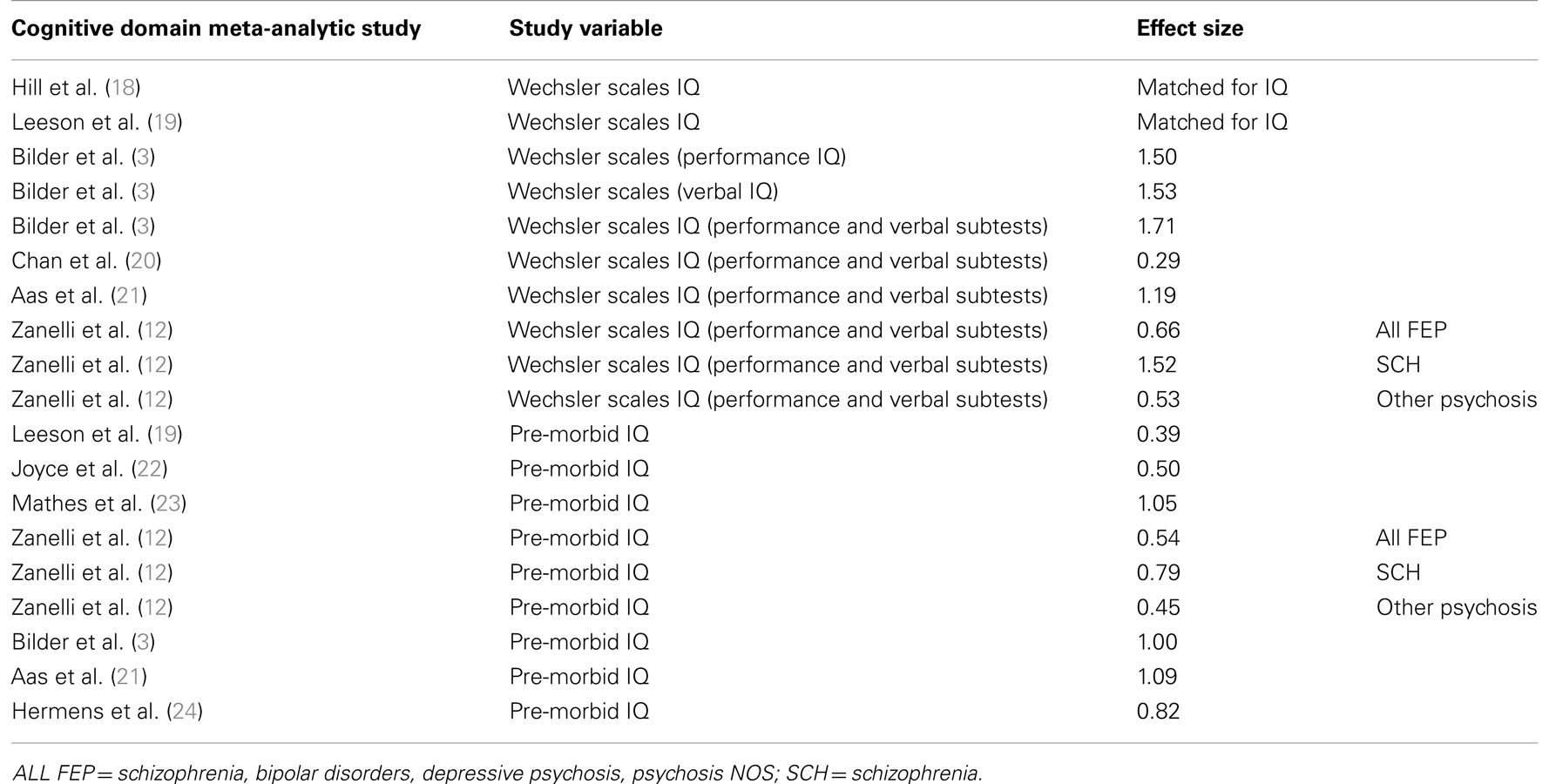
Table 1. Studies comparing patients with first-episode psychosis and healthy controls on general cognitive ability. 

General Intellectual Function

General cognition is usually assessed in two ways. Firstly, general cognitive ability is measured by a set of multiple cognitive tests such as the Wechsler Adult Intelligence scale (WAIS). The WAIS is based on multiple performance and verbal cognitive tests, which together are believed to reflect general cognitive function. Secondly, general cognition is assessed with a single reading test, such as the National reading test (NART) (3) or the Wechsler Test of Adult Reading test (WTAR). The NART and the WTAR are reading tests which both estimate cognitive ability by reading a list of words, with the IQ level estimated on the basis of mistakes made in the pronunciation of the words listed (38). In the literature on FEP studies, the NART or the WTAR (or equivalent schedules) are normally used to assess pre-morbid intelligence, an estimate of intelligence level achieved before illness onset, while the WAIS is usually used as an estimate of current IQ (12).

Executive Function, Attention, and Working Memory

The term “executive functioning” is often used as a synonym for frontal lobe functioning, and to indicate higher cognitive functioning of the prefrontal cortex (2, 38). Executive function consists of loosely related higher-order cognitive processes, including: problem solving, planning, initiation, hypothesis generation, cognitive flexibility, decision making, regulation, and judgment and working memory (38). Working memory is conceived as a limited capacity storage for retaining information over a short time (1–2 min), and performing mental operations of the content during this period (38). Moreover, the context of the working memory may originate from both sensory inputs as well as from stored long-term memory (38). Attention can be defined as the gateway for information flow to the brain. Attention is a complex system that allows the individual to filter relevant and irrelevant information in the context of internal drives and intentions, hold and manipulate mental processes, and monitor responses to stimuli (38).

Memory

Memory is a complex process by which an individual registers retains and retrieves information (38). Memory is divided into non-verbal and verbal memory, with verbal memory including declarative memory and non-declarative memory. Declarative memory includes both episodic memory (memory for events) and semantic memory (memory for facts). Declarative memory includes an understanding of something being learned, while non-declarative memory can take place without conscious awareness (38).

Several tests are used to assess memory, and the Wechsler Memory Scale (WMS) Logical memory test has been widely used to assess declarative memory in psychosis. In the logical memory task, the participant is asked to recall a short story, immediately after hearing the story, and again after a delay of 30 min (38). Other widely used verbal memory tasks in psychosis research are the Rey Auditory Verbal Learning Test (RAVLT) and the California Verbal Learning Test (CVLT), assessing memory functioning through the use of a word-list learning paradigm, which includes an immediate and delayed component similar to the Logical memory (38). Non-verbal memory is assessed by tests evaluating the ability to recall a specific visual design, including an immediate and delayed aspect, with Visual Reproduction and the Rey–Osterrieth Complex Figure Test being the most frequent tests used in the literature (38).

Processing Speed

Processing speed refers to the speed at which different cognitive tasks are completed. It normally involves a simple task, which is timed on completion. The importance of processing speed lies in its relevance to many higher cognitive operations, such as perceptual processes, encoding, and retrieval (38).

Motor Speed

Deficits in motor performance are seen in many neurological disturbances. The most frequently used motor tests in FEP are grooved pegboard and finger tapping. The grooved pegboard contains twenty-five holes with randomly positioned slots and pegs which have a key along one side. Pegs must be rotated to match the hole before they can be inserted as quickly as possible. For the finger tapping task the examinee is instructed to tap as rapidly as possible using index finger for a specific amount of time. For both grooved pegboard and finger tapping performance with the preferred hand usually demonstrates best performance (38).


Results


General Intellectual Function

Overall, patients with FEP scored significantly worse on current IQ assessed by the WAIS battery compared to controls (see Table 1). The largest effect size across FEP studies was observed for the WAIS full scale IQ (based on performance and verbal tasks from the WAIS), with an effect size of 1.71 (3). Significant differences between patients and controls have also been replicated in studies using NART or WTAR scores to measure pre-morbid IQ. Thus in our own work (21), we found a significant difference between NART scores in patients and controls, with an effect size of 1.09. Significant differences between patients and controls NART scores are also shown in other studies, with effect sizes varying between 0.39 and 1.05.

Executive Function, Attention, and Working Memory

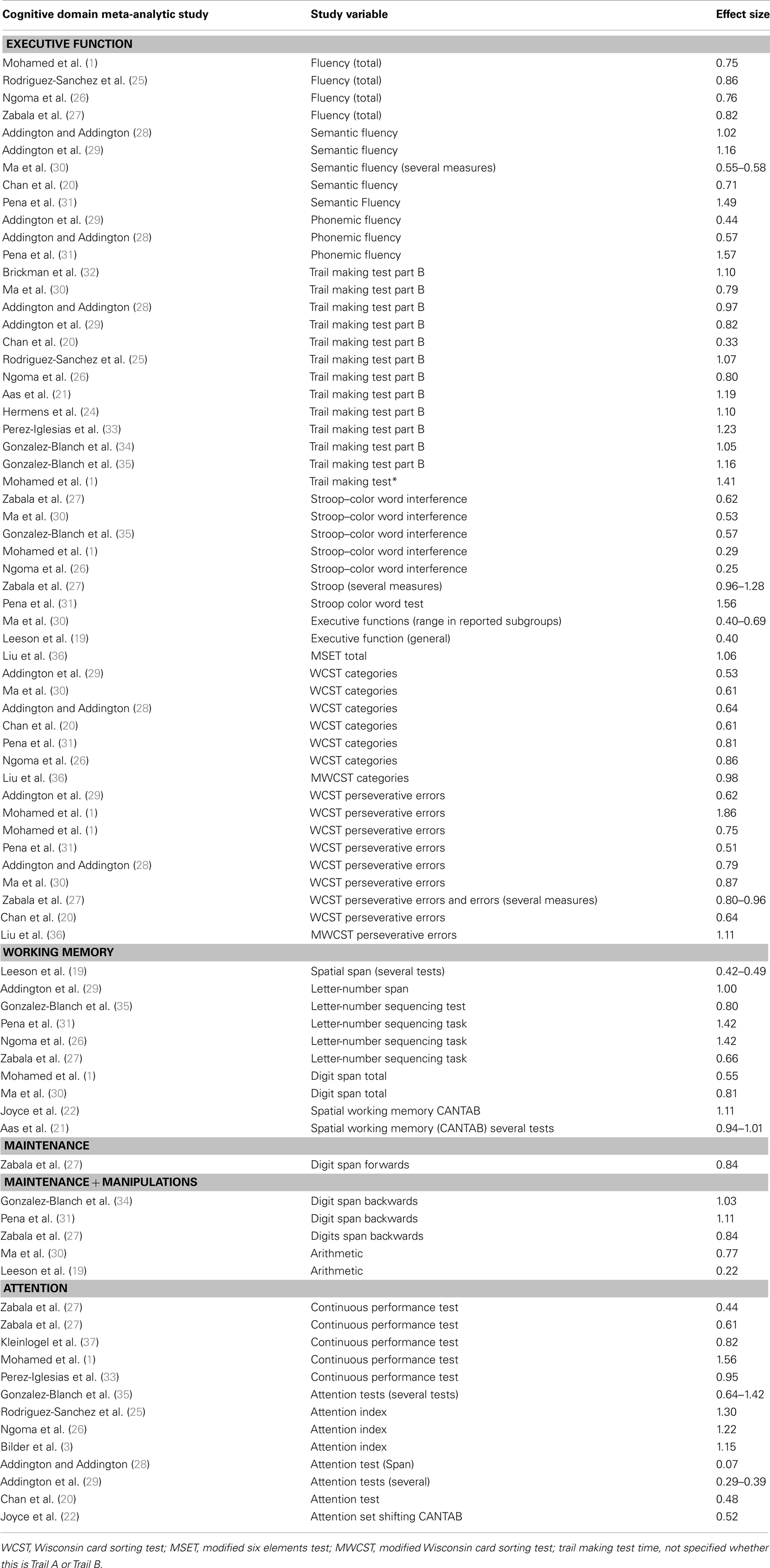
Patients with FEP show impairment in executive performance, with effect sizes ranging from 0.25 to 1.86, with the most profound deficits observed Mohamed et al. (1) on Wisconsin Card Sorting Test (WCST) perseverative errors, with an effect size of 1.86 (see Table 2). Working memory follows with an effect size up to 1.42, followed by attention (effect size up to 1.30).
TABLE 2
http://www.frontiersin.org/files/Articles/65931/fpsyt-04-00182-HTML/image_m/fpsyt-04-00182-t002.jpg

Table 2. Studies comparing patients with first-episode psychosis and healthy controls on executive function, attention and working memory. 

Memory

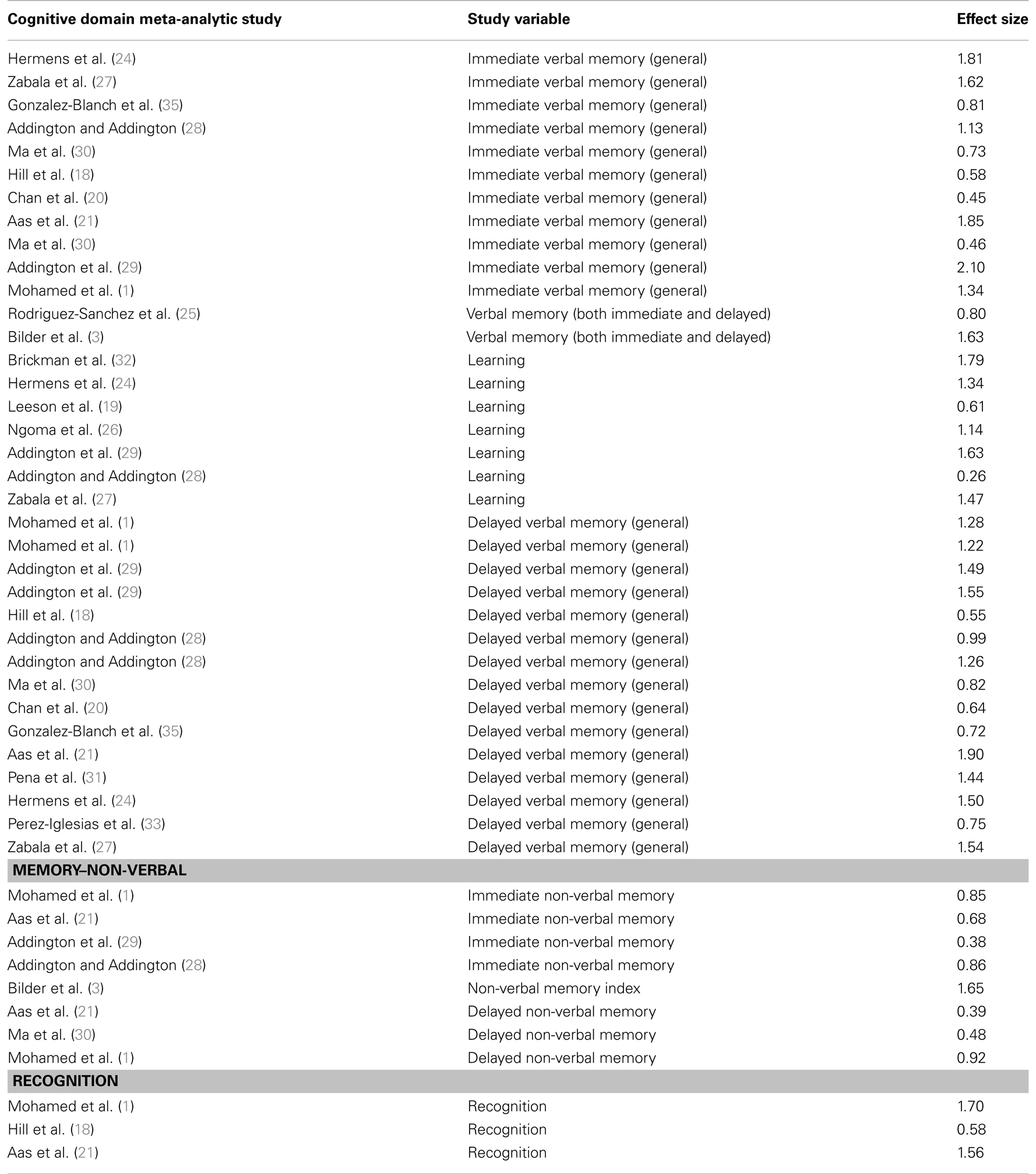
Several studies in FEP have shown significant impairments in memory, particularly in verbal declarative episodic memory (see Table 3). The effect sizes of verbal episodic memory deficits vary from 0.26 to 2.10, and the effect sizes for non-verbal memory vary from 0.38 to 1.65. As shown by the high effect size reported from studies on FEP, memory impairment is the most, or one of the most, impaired cognitive domains already at illness onset.
TABLE 3
http://www.frontiersin.org/files/Articles/65931/fpsyt-04-00182-HTML/image_m/fpsyt-04-00182-t003.jpg

Table 3. Studies comparing patients with first-episode psychosis and healthy controls on memory function. 

Processing Speed

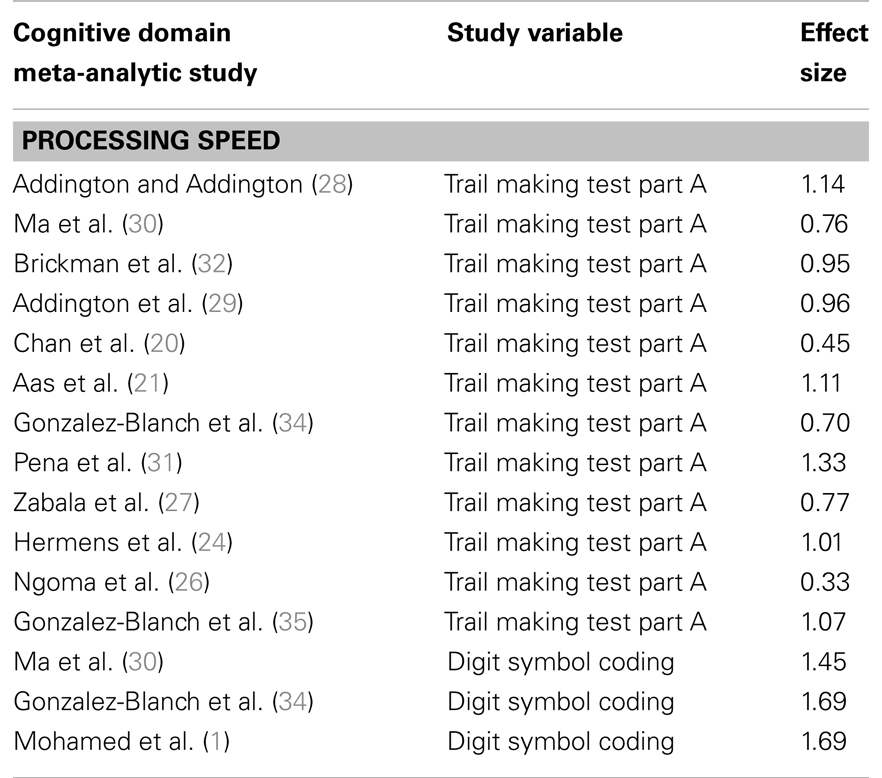
Studies of patients with FEP have shown reduced processing speed in these patients when compared to controls, with effect sizes ranging from 0.33 to 1.69 (see Table 4).
TABLE 4
http://www.frontiersin.org/files/Articles/65931/fpsyt-04-00182-HTML/image_m/fpsyt-04-00182-t004.jpg

Table 4. Studies comparing patients with first-episode psychosis and healthy controls on processing speed
Motor Speed

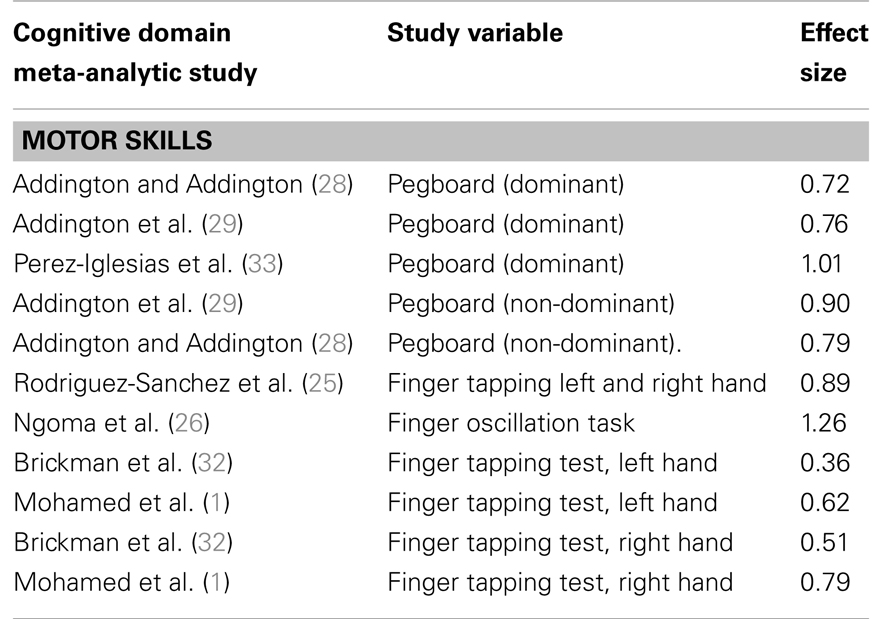
Patients with FEP show impairments on motor speed (with effect sizes varying from 0.36 to 1.26; see Table 5).
TABLE 5
http://www.frontiersin.org/files/Articles/65931/fpsyt-04-00182-HTML/image_m/fpsyt-04-00182-t005.jpg

Table 5. Studies comparing patients with first-episode psychosis and healthy controls on motor speed.

Discussion


Reviewing the literature on cognitive function in FEP, we found significant impairment (Cohen’s d effect size above 0.8 (17) in all cognitive domains investigated; see Tables 15. The largest effect size was observed for verbal memory (Cohen’s d effect size = 2.10), followed by executive function (effect size = 1.86), and general IQ (effect size = 1.71). Our systematic review focused on FEP and included studies published up to 2013, thus covering studies not included previously in the review by Bozikas and Andreou (13) (included studies up to January 2010); or Lewandowski et al. (14) (included studies up to 31st of March 2010). Moreover, the study by Bozikas and Andreou (13) included only articles with longitudinal data, excluding studies presenting FEP only. Also the study by Lewandowski et al. (14) included articles on cognitive function in chronic schizophrenia and other psychosis. Our study therefore complements these articles, focusing in-depth on the first-episode only. We have also calculated effect sizes based on Cohen’s d, providing information about the severity of the impairment, which is not included in the previous reviews described above. Similar to the study of Bozikas and Andreou (13) and Lewandowski et al. (14) we found that already at illness onset patients with FEP are characterized by cognitive impairments across domains. Moreover, our results support different cognitive pattern for schizophrenia and affective psychosis (schizophrenia patients showing the greatest effect size differences in cognitive performance compared to controls). Further, we found more variation in the effect sizes comparing patients and controls on cognitive tests than the study by Reichenberg et al. (2) in chronic schizophrenia, indicating a further consolidation of cognitive impairment over time may be present. These results are similar to Bozikas and Andreou (13) and Lewandowski et al. (14) showing the main reduction in cognition around illness onset, or pre-morbid period, with a relatively stable course, which may become even more pronounced after some years.

Our findings in FEP demonstrate that already at illness onset patients have reduced IQ scores compared to controls. Both current IQ and estimated pre-morbid IQ were significantly lower than those of controls, with the greatest impairment in current IQ scores. Indeed, the discrepancy between current IQ and pre-morbid scores is believed to reflect the deterioration in current IQ at or around illness onset. The study by Zanelli et al. (12) show that when we examine schizophrenia versus other psychosis (psychosis NOS and affective psychosis), patients with schizophrenia have larger effect size differences in current IQ, as well as pre-morbid IQ (schizophrenia current IQ effect size = 1.52; pre-morbid IQ effect size = 0.79), compared to other psychosis (current IQ effect size = 0.53; pre-morbid IQ effect size = 0.45). This indicates worse cognitive function in the schizophrenia group both at illness onset and prior to illness onset, compared to patients with other psychosis. Patients in the schizophrenia group also present the greatest deterioration (measured by effect size) comparing current IQ to pre-morbid IQ [schizophrenia effect size current IQ (1.52) minus effect size pre-morbid IQ (0.79) = 0.73, compared to other psychosis: effect size current IQ (0.53) minus effect size pre-morbid IQ (0.45) = 0.08]. A worse cognitive profile in patients with schizophrenia was also found in the study by Hill et al. (39) showing that patients with FEP who developed schizophrenia demonstrated more impaired cognitive performance across domains, compared to patients with affective psychosis. Similar findings are also observed in chronic psychosis (14).

Several studies conducted in FEP have matched patients and controls on general cognition, in order to investigate specific deficits believed to be particularly marked in psychosis. It should be mentioned that matching subgroups on IQ aiming to measure specific cognitive areas believed to be impaired in psychosis may be challenging due to that such a comparison would be contaminated by regression toward the mean (Lord’s Paradox) (40).

Executive Function, Attention, and Working Memory

Although a strong correlation has been found between general intellectual function and other specific cognitive subareas, such as memory and executive functioning, research has also shown impairment of executive functions, such as planning, flexibility and judgment, without any major change in general intellectual status (38). Is the impairment in executive and working memory observed in patients with psychosis a consequence of general cognitive decline, or is executive impairment in psychosis independent from overall cognitive performance? Chan et al. (20) aimed to answer this question in a study of 78 patients with first-episode medication-naïve schizophrenia and 60 controls; they showed that patients with first-episode medication-naïve schizophrenia exhibit specific types of executive dysfunction independently of general cognitive decline. However, Table 2 shows that there is a great discrepancy across studies in terms of effect sizes observed; for example the effect size 0.22 was found for “Arithmetic” in the study by Leeson et al. (19), compared to an effect size of 0.77 in the study by Ma et al. (30). One difference between these two studies was that the study by Leeson et al. (19) had matched the patients and controls for general IQ, while the study by Ma et al. (30) had not. It is therefore important to have in mind whether general IQ has been taken into account in the analysis when interpreting effect sizes for different cognitive subtests.

Memory

It has been suggested that episodic memory tests could be used to elicit diagnostic differences in a psychosis sample. For example, in the study by Fitzgerald et al. (41) consisting of 83 patients with FEP, decreased performance on verbal memory was reported in patients with schizophrenia compared to patients with affective psychosis, implying diagnostic differences in performance on this specific memory task. Prospective studies also show worse cognitive profile in patients with FEP who later develop schizophrenia across cognitive domains, compared to patients with affective psychosis (12, 39).

Processing Speed

The study by Leeson et al. (19), comparing FEP and healthy controls (matched for general cognition) reported that processing speed was the cognitive domain most impaired in FEP. Leeson et al. (19) also found a relationship between processing speed performance and performance on executive and memory tasks, two known impaired cognitive domains in psychosis, as discussed earlier. This indicates the importance of measuring processing speed when studying patients with psychosis. As processing speed is important for the performance of higher cognitive operations, such as executive functions and memory, it has been suggested that impaired processing speed underlies the abnormalities in these areas (42). On the other hand, to complicate this further, a reduction of processing speed has also been found associated with antipsychotic medication (43).

Below are hypothesis about putative mechanism(s) of the cognitive reduction in FEP, investigating the role of early stress, inflammation and genetic vulnerability.

Stress and Cognition in Psychosis

Some previous studies in chronic patients with psychosis, and in healthy controls, report a negative correlation between childhood trauma and cognitive function, particularly decreased scores on general cognitive abilities, memory, and executive function (4448). This is interesting as similar cognitive areas are found to be most reduced in FEP, comparing patients to controls performance (see Result). The deleterious effect of stress and glucocorticoid on the brain (particularly on hippocampus) is well known in the literature (49, 50), and indeed disorders characterized by increased stress exposure such as depression, post-traumatic stress disorder, chronic fatigue disorder, show cognitive impairment, particularly in memory and in executive function (5153). Moreover, psychosis is a disorder characterized by high level of stressful events (54), including recent stressful events (55), the inability to cope with life events (56, 57), and childhood trauma (58, 59). It is therefore possible that some of the cognitive impairment in FEP is due to an increased exposure, or vulnerability toward the negative effect of particularly childhood trauma. We will now review the literature supporting this putative mechanism.

Cortisol Level and Cognitive Function and Psychosis

Over two decades have past since the first study investigating Hypothalamic-Pituitary-Adrenal (HPA) axis and cognitive abnormalities in schizophrenia were published (60) and suggested a link between hypercortisolism and cognitive impairment. Since then, several studies have investigated HPA axis and cognitive function in long-term chronic schizophrenic patients. The first study by Saffer et al. (60) consisted of 11 patients with type II schizophrenia (mainly negative symptoms), 34 controls, 30 patients with schizophrenia with type 1 (mainly positive symptoms), and 9 patients with mixed type I and type II schizophrenia (both negative and positive symptoms). This study found a strong negative correlation between dexamethasone abnormalities (dexamethasone non-suppressors) and cognitive performance in type II schizophrenics, implying a relationship between HPA axis hyperactivity and cognitive impairment. Furthermore, Walder et al. (61), evaluating 18 patients with chronic psychosis, 7 patients without psychosis, and 19 healthy controls, found that, in the entire sample, cortisol levels were negatively correlated with performance on memory and executive tasks.

Also in FEP an abnormal HPA axis has been demonstrated (55) showing higher cortisol levels during the day in the patients compared to the controls. An interesting closed-loop model, first hypothesized by Lupien (62), gives a possible explanation for the relationship between cortisol level and cognition in schizophrenia. The closed-loop model works in the following manner: basal cortisol level increases symptoms severity, which again impacts on the encoding of incoming information into long-term memory store; this leads to difficulties discriminating between relevant (threat) and irrelevant (non-threat) information, which again further increases the reactivity to stress.

In our recent paper on patients with FEP (21), we found that patients performed significantly worse on all cognitive domains compared to controls. In patients only, a blunted cortisol awakening response (that is, more abnormal) was associated with a more severe deficit in verbal memory and processing speed, supporting a role for the HPA axis, as measured by cortisol awakening response, in modulating cognitive function in patients with psychosis.

Childhood Trauma and Cognitive Function in Psychosis

Six studies in the literature have investigated cognition and early trauma in people with psychosis, four in individuals including chronic illness phase. The first study by Lysaker et al. (45) was conducted in males with schizophrenia spectrum disorder, and no comparison control group was used. The authors found that male patients with childhood trauma (sexual abuse) had impaired processing speed, working memory, and executive function compared with patients without abuse (45). The second study by Schenkel et al. (47) included 15 female and 25 males with schizophrenia spectrum disorder, with no comparison control group. The authors found that patients with schizophrenia or schizoaffective disorder with a history of childhood trauma showed a decreased score on learning and visual context processing compared to non-abused patients. Similar findings were found in the study by Shannon et al. (48) in a sample of 85 patients (67 males and 18 females) with chronic schizophrenia; here patients with childhood trauma scored significantly lower on working memory as well as verbal memory tasks, even after controlling for pre-morbid IQ and depressive symptoms. Similar findings were observed in our own examination of the large AESOP study of FEP which comprised of 138 patients (73 males and 65 females) and 138 controls (64 males and 74 females), showing an association between childhood trauma and reduced performance on attention, concentration and mental speed, language, and verbal intelligence; however this was mainly driven by male patients with affective psychosis (44), whilst in controls only one subtest (performance intelligence) was reduced in the group with high exposure of childhood trauma, and in males only. Also in an independent study including 406 patients with a mean duration of illness of 3 years showed a strong negative correlation between cognitive function and a history of childhood trauma; here childhood trauma was associated with a reduction in cognitive function across cognitive domains in patients with schizophrenia spectrum- and bipolar disorders, in particular working memory and executive function, as well as general cognition. Moreover, these dysfunctions were driven by underlying deficits in general cognitive tasks as measured by the Wechsler Abbreviated Scale of Intelligence (WASI) (63). Only two studies have found negative, or inconclusive, findings between cognitive function and early trauma in FEP (21, 64), with the latter and largest study showing an effect of childhood trauma on cognitive function in controls, but not in patients (64).

Potential Biological Mechanisms

Since patients with psychotic disorders – in addition to being more exposed to trauma – also demonstrate abnormalities in the HPA axis (55), immunological disturbances (65, 66), together with cognitive and brain structure abnormalities (6, 12, 21, 67), it is of interest to investigate the link between stress exposure and biological stress parameters to cognitive abnormalities in psychosis. Based on the findings outlined above, it is particularly intriguing to investigate to what extent patients with psychotic disorders also have a genetic vulnerability toward abnormal stress response that may add to – or interact with the effects of early trauma, and cognitive impairments.

There are several indications of an abnormal HPA axis in patients with psychotic disorders irrespective of early trauma. This includes findings of an increased pituitary volume in patients with FEP compared to controls (68, 69). There are also signs of an altered or increased systemic cortisol metabolism (7072) with links to genetic markers in psychosis (71), which might interact with the effect of stressful life event. The idea of a genetic predisposition to an abnormal stress response is supported by indications that not only patients with psychosis have abnormal stress responses, but also their relatives (73). Moreover, increased cortisol levels correlate with smaller hippocampal volume in psychosis (74). There is also an interaction between glucocorticoids and serotonin in the central nervous system (CNS) as glucocorticoids regulate both tryptophan hydroxylase and the expression of several serotonin receptors (75). In addition, the functional polymorphism in the promoter region of the serotonin transporter gene (5-HTTLPR) has been linked to altered stress response, as carriers of the short (s-) allele have increased negative psychological reactions and stress hormone release compared with carriers of the long (l-) allele (76). Indeed, our study Aas et al. (76) demonstrated that patients with an early psychotic illness who were carriers of the short (s-) allele of the serotonin transporter gene (5-HTTLPR), exposed to high levels of childhood trauma (physical neglect and abuse) had significantly poorer cognitive functioning, than all other groups. Patients with psychosis also show reduced brain-derived neurotropic factor (BDNF) levels both in the brain (77), and in serum and plasma (7779), which may be related to their cognitive performance (80). The BDNF gene has at least one functional variant, the SNP (rs 6265) resulting in a Valine (val) to Methionine (met) substitution at codon 66 of the proBDNF. The low active met allele is here related to reductions in BDNF release (81). Recent research in FEP have found associations between reduced BDNF gene expression levels, childhood trauma, increased inflammation, and smaller hippocampal volume (82). Reduced BDNF levels are also observed in bipolar patients exposed to childhood trauma (83), as well as linked to cognition in animals (84). It is well known that patients with psychosis show brain structural abnormalities compared to healthy controls (67, 85, 86). A recent meta-analyses in healthy individuals indicate hippocampus volume reductions in met carriers compared to homozygotic val carriers (87); this is an area of the brain important for memory. In psychosis, met carriers usually demonstrate larger ventricles, more CSF, and reduced frontal gray matter volume (88, 89), even if there are inconsistent results (90). While the study by Mondelli et al. (82) did not genotype, their study support the role of BDNF on brain structures, as well as a relationship between childhood trauma and BDNF levels. Childhood trauma may thus represent a significant factor influencing cognitive function in psychosis, mediated through an effect on BDNF. Indeed our recent study in patients with a psychotic illness (80) support this hypothesis, showing that BDNF val66met-met carriers reporting high levels of childhood trauma demonstrate significantly reduced executive function/working memory as well as smaller hippocampal volume, compared to all other groups.

Several lines of evidence have implicated the immune system in the development of severe psychiatric disorders, and increased inflammation is found in depression (9193), as well as in psychosis (65, 66, 94). Recent GWAS studies clearly indicate immune genes as susceptibility genes for schizophrenia (92, 95). Increased inflammation is also found to be associated with cognitive impairments in animals (96). Pilot data from a small sample of patients with FEP and healthy controls show a relationship between increased inflammation parameters (IL-8 and IL-6) and cognitive impairments across both groups (97), indicating that immune markers may be related to cognitive function in psychosis. More studies should investigate this further, aiming to understand the cognitive reduction seen in FEP compared to healthy controls.

Epigenetic Research Related to Schizophrenia Risk and Cognitive Function

Recent epigenetic research related to schizophrenia risk, links early stress (hypoxia and perinatal stress) to methylation and altered gene expression associated with behavior and cognitive changes (98). Perinatal stress has also been found to be related to reduction of Brain-derived neurotrophic factor (BDNF) in the brain of adult rats (84). Riva et al. (84) also show that perinatal stress in male rats is related to reduced performance on the object recognition test in the adult rat. Riva linked the above to epigenetic changes, explaining that perinatal stress increases methylation, which again is related to a reduced transcript of BDNF, and cognitive changes. Riva et al. (84) has also demonstrated that perinatal stress is associated with reduced upregulation of BDNF on the forced swim test in adult rats, linking this to impaired ability to cope under stressful situations in rats exposed to perinatal stress. Finally, Riva et al. (84) also found that epigenetic changes in response to stress are seen across genes: methylome analysis in the prefrontal cortex of rats exposed to perinatal stress showed that a large number of genes (3,386 genes) were methylated differently from controls. These included genes linked to bipolar disorders and schizophrenia, such as CACNA1C and DISC1, as well as the COMT gene. Further research should therefore investigate links between early stress, and epigenetic changes of relevant genes across genome, aiming to understand mechanisms behind cognitive abnormalities in patients with FEP.

Limitations

This study has several limitations which should be acknowledged: we decided to focus on only some aspects which may influence cognitive function (i.e., stress, and interactions between stress and genetic factors, as well as inflammation), and we did not have the possibility to go into depth on other important aspects, such as time of illness onset (early illness related to worse cognitive function), possible gender differences (males lower performance), the influence of antipsychotics and medication, and the duration of treatment. Although all these patients are FEP, the exact level of treatment varied between the studies (see Supplementary Material for an overview of recruitment in the different papers discussed). Moreover other environmental factors such as cannabis have both been associated with increased risk of the illness, as well as influencing cognitive function, however due to space and focus of the paper, we focused on the role of stress and inflammation and genetics related to these factors as possible explanation model. Only the Cohen’s d and not the confidence intervals for the Cohen’s d are included in this study. However, we have included in the Supplementary Material a detailed overview of the studies included aiming to facilitate interpretations of the findings. As already mentioned matching subgroups on IQ aiming to measure specific cognitive areas believed to be impaired in psychosis may also be challenging due to that such a comparison may be influenced by regression toward the mean (Lord’s Paradox) (40).


Summary


We have demonstrated that cognitive impairment across domains (up to and above severe level based on Cohen’s d effect size) is present already at illness onset, as shown in FEP studies. However, differences in levels of impairment are observed between studies, as well as within domains, indicating that compared to chronic schizophrenia (2), a further consolidation of cognitive impairment over time may be present.

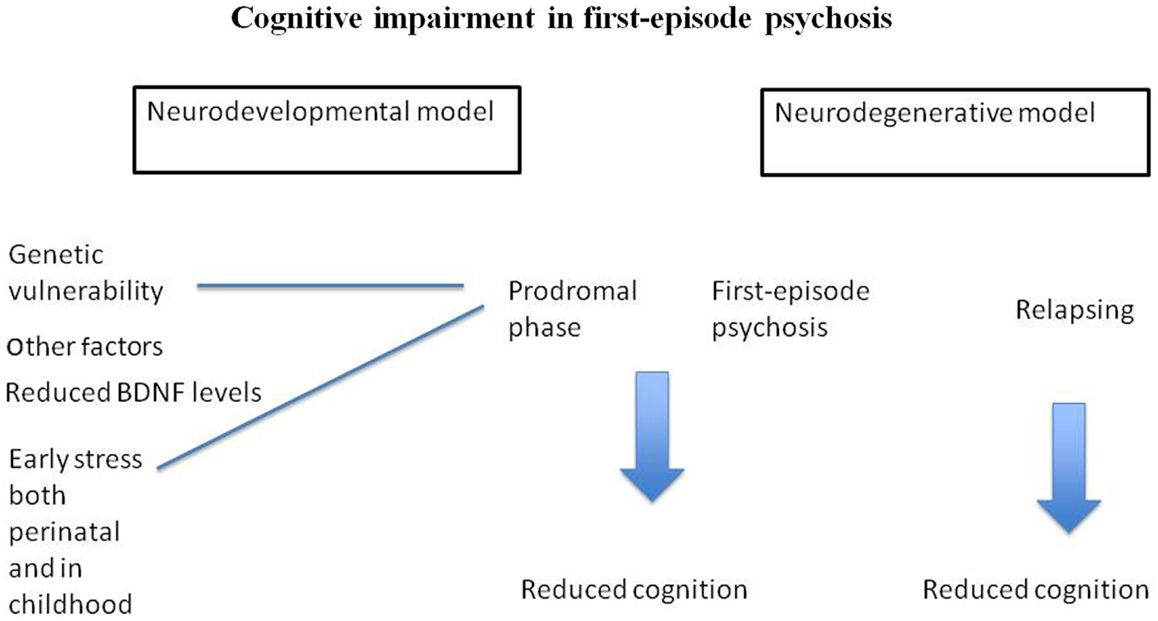
The research into trauma, stress, and HPA axis disturbances (including gene interactions) is one of the areas where we have some knowledge about how specific environment and genetic factors influence cognition (Figure 1). Indeed, early stress may have long-lasting changes on cognitive function by affecting expression of relevant genes. This is the start of a new line of research aimed at further understanding the complex etiology behind cognitive abnormalities in psychosis. Based on published biological studies, we propose that some of these impairments may be due to these subjects’ increased sensitivity to the negative effect of stress, and genetic vulnerability, affecting the HPA axis, the immune function, and neuroplasticity. More studies are needed aiming to understand the complex etiology of cognitive impairments in psychosis.
FIGURE 1
http://www.frontiersin.org/files/Articles/65931/fpsyt-04-00182-HTML/image_m/fpsyt-04-00182-g001.jpg

Figure 1. Suggests that cognitive impairment in FEP is related to neurodevelopmental abnormalities. Figure 1 also postulate that stress, as well as genetic vulnerability may be part of the complex etiology behind cognitive impairment in psychosis.

Conflict of Interest Statement

The authors declare that the research was conducted in the absence of any commercial or financial relationships that could be construed as a potential conflict of interest.

Acknowledgments

Some of the work leading to this review has been funded by the British Academy and by the South London and Maudsley NHS Foundation Trust & Institute of Psychiatry NIHR Biomedical Research Centre for Mental Health. This study was also funded by grants from the University of Oslo, South-Eastern Norway Health Authority (#2004123, #2006258) and the Research Council of Norway (#167153/V50, #163070/V50, #190311/V50).

Supplementary Material

The Supplementary Material for this article can be found online at http://www.frontiersin.org/Journal/10.3389/fpsyt.2013.00182/abstract
 
References available at the Frontiers site.

Abuse Alters Hormones in Kids, Hikes Risk of Metabolic Disorders

We have known for quite a while that children who experience abuse and/or neglect in childhood are more likely to have metabolic disorders as adults (i.e., be overweight, have type-II diabetes, high blood pressure, and so on). The mechanisms of action have not been clear, other than an awareness that it involves inflammation.

The researchers looked at the weight-regulating hormones leptin, adiponectin, and irisin (as well as the inflammatory marker C-reactive protein) in the blood of adults who endured physical, emotional, or sexual abuse or neglect as children. They found that early-life adversity is directly associated with elevated circulating leptin and irisin, and indirectly associated with elevated CRP and decreased adiponectin.


Abuse Alters Hormones in Kids, Hikes Risk of Metabolic Disorders

By Rick Nauert PhD Senior News Editor
Reviewed by John M. Grohol, Psy.D. on March 21, 2014


A new endocrinology investigation suggests childhood abuse or neglect can lead to long-term hormone impairment that raises the risk of developing obesity, diabetes, or other metabolic disorders in adulthood.

The study is published in the Endocrine Society’s Journal of Clinical Endocrinology & Metabolism (JCEM).

For the study, researchers examined levels of the weight-regulating hormones leptin, adiponectin, and irisin in the blood of adults who endured physical, emotional, or sexual abuse or neglect as children.

Leptin is involved in regulating appetite and is linked to body-mass index (BMI) and fat mass. The hormone irisin is involved in energy metabolism. Adiponectin reduces inflammation in the body, and obese people tend to have lower levels of the hormone.

Researchers found that these important hormones were out of balance in people who had been abused or neglected as children.

“This study helps illuminate why people who have dealt with childhood adversity face a higher risk of developing excess belly fat and related health conditions,” said one of the study’s authors, Christos S. Mantzoros, M.D., D.Sc., Ph.D.

“The data suggest that childhood adversity places stress on the endocrine system, leading to impairment of important hormones that can contribute to abdominal obesity well into adulthood.”

The cross-sectional study examined hormone levels in the blood of 95 adults ages 35 to 65. Using questionnaires and interviews, each participant was assigned a score based on the severity of the abuse or neglect experienced during childhood.

Researchers divided the participants into three groups and compared hormone levels in people with the highest adversity scores to the other two-thirds of the participants.

Participants with the highest adversity scores tended to have higher levels of leptin, irisin, and the inflammatory marker C-reactive protein in their blood. All of these markers are linked to obesity.

In addition, the group of people who suffered the most adversity tended to have lower levels of adiponectin, another risk factor for obesity.

Even after researchers adjusted for differences in diet, exercise, and demographic variables among the participants, high levels of leptin and irisin continued to be associated with childhood adversity.

“What we are seeing is a direct correlation between childhood adversity and hormone impairment, over and above the impact abuse or neglect may have on lifestyle factors such as diet and education,” Mantzoros said.

“Understanding these mechanisms could help health care providers develop new and better interventions to address this population’s elevated risk of abdominal obesity and cardiometabolic risk later in life.”

Source:
The Endocrine Society

* * * * *


Early-life adversity, defined as physical, emotional, or sexual abuse and neglect before 18 years of age, is associated with metabolic syndrome, obesity, and type 2 diabetes mellitus in adult life. However, the underlying mechanism is not fully understood, and whether adipomyokines are associated with early-life adversity independent of other factors such as body mass index, psychosocial risks, and health behaviors is not known.

The objective of the study was to evaluate the association between early-life adversity and circulating the levels of the adipomyokines such as leptin, adiponectin, and irisin and the inflammatory marker, C-reactive protein (CRP).

This study was a cross-sectional study of 95 adults at a university-based research center. We collected venous blood from participants and analyzed serum for leptin, adiponectin, irisin, and CRP.

Circulating leptin, irisin, and CRP levels were significantly higher in the highest adversity tertile group compared with low and middle tertile groups (P < .001 for leptin, P = .01 for irisin, and P = .02 for CRP). Adiponectin levels were lower in the highest tertile group compared with the low and middle tertile groups (P = .03). After adjusting for demographic variables, physical activity, diet, current mental health, and body mass index, the associations between early-life adversity leptin, irisin, and did not change. However, adiponectin and CRP levels were no longer significantly related to early life adversity.

Early-life adversity is directly associated with elevated circulating leptin and irisin, and indirectly associated with elevated CRP and decreased adiponectin. These findings suggest that these adipomyokines may play a role in the pathogenesis of metabolic abnormality in a population with significant early life adversity.

Tuesday, March 25, 2014

The Toxins That Threaten Our Brains (The Atlantic)

This is some seriously disturbing stuff - a lot of the chemicals generally assumed safe by our lovely government regulations are still known neurotoxins.

This comes from The Atlantic.

The Toxins That Threaten Our Brains

http://cdn.theatlantic.com/assets/media/img/2014/03/17/opener.jpg

Leading scientists recently identified a dozen chemicals as being responsible for widespread behavioral and cognitive problems. But the scope of the chemical dangers in our environment is likely even greater. Why children and the poor are most susceptible to neurotoxic exposure that may be costing the U.S. billions of dollars and immeasurable peace of mind.  

James Hamblin
Illustrations by Jackie Lay March 18, 2014

Forty-one million IQ points. That’s what Dr. David Bellinger determined Americans have collectively forfeited as a result of exposure to lead, mercury, and organophosphate pesticides. In a 2012 paper published by the National Institutes of Health, Bellinger, a professor of neurology at Harvard Medical School, compared intelligence quotients among children whose mothers had been exposed to these neurotoxins while pregnant to those who had not. Bellinger calculates a total loss of 16.9 million IQ points due to exposure to organophosphates, the most common pesticides used in agriculture.

Last month, more research brought concerns about chemical exposure and brain health to a heightened pitch. Philippe Grandjean, Bellinger’s Harvard colleague, and Philip Landrigan, dean for global health at Mount Sinai School of Medicine in Manhattan, announced to some controversy in the pages of a prestigious medical journal that a “silent pandemic” of toxins has been damaging the brains of unborn children. The experts named 12 chemicals—substances found in both the environment and everyday items like furniture and clothing—that they believed to be causing not just lower IQs but ADHD and autism spectrum disorder. Pesticides were among the toxins they identified.


“So you recommend that pregnant women eat organic produce?” I asked Grandjean, a Danish-born researcher who travels around the world studying delayed effects of chemical exposure on children.

“That’s what I advise people who ask me, yes. It’s the best way of preventing exposure to pesticides.” Grandjean estimates that there are about 45 organophosphate pesticides on the market, and “most have the potential to damage a developing nervous system.”

Landrigan had issued that same warning, unprompted, when I spoke to him the week before. “I advise pregnant women to try to eat organic because it reduces their exposure by 80 or 90 percent,” he told me. “These are the chemicals I really worry about in terms of American kids, the organophosphate pesticides like chlorpyrifos.”

For decades, chlorpyrifos, marketed by Dow Chemical beginning in 1965, was the most widely used insect killer in American homes. Then, in 1995, Dow was fined $732,000 by the EPA for concealing more than 200 reports of poisoning related to chlorpyrifos. It paid the fine and, in 2000, withdrew chlorpyrifos from household products. Today, chlorpyrifos is classified as “very highly toxic” to birds and freshwater fish, and “moderately toxic” to mammals, but it is still used widely in agriculture on food and non-food crops, in greenhouses and plant nurseries, on wood products and golf courses.

Landrigan has the credentials of some superhero vigilante Doctor America: a Harvard-educated pediatrician, a decorated retired captain of the U.S. Naval Reserve, and a leading physician-advocate for children's health as it relates to the environment. After September 11, he made news when he testified before Congress in disagreement with the EPA’s assessment that asbestos particles stirred into clouds of debris were too small to pose any real threat. Landrigan cited research from mining townships (including Asbestos, Quebec) and argued that even the smallest airborne asbestos fibers could penetrate deeply into a child’s lungs.

Chlorpyrifos is just one of 12 toxic chemicals Landrigan and Grandjean say are having grim effects on fetal brain development. Their new study is similar to a review the two researchers published in 2006, in the same journal, identifying six developmental neurotoxins. Only now they describe twice the danger: The number of chemicals that they deemed to be developmental neurotoxins had doubled over the past seven years. Six had become 12. Their sense of urgency now approached panic. “Our very great concern,” Grandjean and Landrigan wrote, “is that children worldwide are being exposed to unrecognized toxic chemicals that are silently eroding intelligence, disrupting behaviors, truncating future achievements and damaging societies.”


The chemicals they called out as developmental neurotoxins in 2006 were methylmercury, polychlorinated biphenyls, ethanol, lead, arsenic, and toluene. The additional chemicals they’ve since found to be toxins to the developing brains of fetuses—and I hope you’ll trust me that these all are indeed words—are manganese, fluoride, chlorpyrifos, tetrachloroethylene, polybrominated diphenyl ethers, and dichlorodiphenyltrichloroethane.

Grandjean and Landrigan note in their research that rates of diagnosis of autism spectrum disorder and ADHD are increasing, and that neurobehavioral development disorders currently affect 10 to 15 percent of births. They add that “subclinical decrements in brain function”—problems with thinking that aren’t quite a diagnosis in themselves—“are even more common than these neurobehavioral development disorders.”

In perhaps their most salient paragraph, the researchers say that genetic factors account for no more than 30 to 40 percent of all cases of brain development disorders:
Thus, non-genetic, environmental exposures are involved in causation, in some cases probably by interacting with genetically inherited predispositions. Strong evidence exists that industrial chemicals widely disseminated in the environment are important contributors to what we have called the global, silent pandemic of neurodevelopmental toxicity. 
Silent pandemic. When public health experts use that phrase—a relative and subjective one, to be deployed with discretion—they mean for it to echo.

When their paper went to press in the journal The Lancet Neurology, the media responded with understandable alarm:
“A ‘Silent Pandemic’ of Toxic Chemicals Is Damaging Our Children’s Brains, Experts Claim” - Minneapolis Post, 2/17/14

“Researchers Warn of Chemical Impacts on Children,” - USA Today, 2/14/14

“Study Finds Toxic Chemicals Linked to Autism, ADHD” - Sydney Morning Herald, 2/16/14
When I first saw these headlines, I was skeptical. It wasn’t news that many of the chemicals on this list (arsenic, DDT, lead) are toxic. With each of these substances, the question is just how much exposure does it take to cause real damage. For instance, organophosphates aren’t something that anyone would categorically consider safe, in that they are poison. They kill insects by the same mechanism that sarin gas kills people, causing nerves to fire uncontrollably. But like asbestos, they are still legally used in U.S. commerce, with the idea that small amounts of exposure are safe. The adage “the dose makes the poison” may be the most basic premise of toxicology. And hadn’t we already taken care of lead? Didn’t we already know that alcohol is bad for fetuses? Wasn’t fluoride good for teeth?

I found that the real issue was not this particular group of 12 chemicals. Most of them are already being heavily restricted. This dozen is meant to illuminate something bigger: a broken system that allows industrial chemicals to be used without any significant testing for safety. The greater concern lies in what we’re exposed to and don’t yet know to be toxic. Federal health officials, prominent academics, and even many leaders in the chemical industry agree that the U.S. chemical safety testing system is in dire need of modernization. Yet parties on various sides cannot agree on the specifics of how to change the system, and two bills to modernize testing requirements are languishing in Congress. Landrigan and Grandjean’s real message is big, and it involves billion-dollar corporations and Capitol Hill, but it begins and ends with the human brain in its earliest, most vulnerable stages.

How Toxins Destroy Brains

About a quarter of your body’s metabolism goes toward operating and maintaining your brain. In order to process even basic information, billions of chemical signals are constantly being carried between neurons. The undertaking is so onerous that even though your brain is not moving (like, say, the powerful muscles in your legs), it uses around 10 times more calories per pound than the rest of you.

Most of that industrious brain and its 86 billion neurons were created in a matter of months. During the first few weeks of gestation, when your mother knew you only as morning sickness and you were a layer of cells huddled in one corner of her uterus, those cells lined up, formed a groove, and then closed to form a tube. One end of that tube eventually became your tiny spinal cord. The rest expanded to form the beginnings of your brain.


For a brain to develop properly, neurons must move to precise places in a precise sequence. They do so under the direction of hormones and chemical neurotransmitters like acetylcholine. The process is an intricate, fast-paced dance on a very tiny scale. Each nerve cell is about one hundredth of a millimeter wide, so it has to travel its own width 25,000 times just to move an inch—which some neurons in the cortex must. At any point, that cell can be knocked off course. Some of the neurotoxins Grandjean and Landrigan discuss have the potential to disrupt this journey, in a slight or serious fashion.

By the third trimester, the surface of the brain begins folding itself into wrinkled peaks and valleys, the gyri and sulci that make a brain look like a brain. Specific areas of that cortex learn to process specific aspects of sensation, movement, and thought, and that starts in the uterus. As Grandjean explains this process in his 2013 book Only One Chance, “Usage promotes function and structure, as the connectivity of the brain cells is shaped by responses to environmental stimuli.” That is, the fetal brain starts having experiences that form the basis for learning and memory. The nature-nurture duality begins at conception.

By age two, almost all of the billions of brain cells that you will ever have are in their places. Except in the hippocampus and one or two other tiny regions, the brain does not grow new brain cells throughout your life. When brain cells die, they are gone. So its initial months of formation, when the brain is most vulnerable, are critical. “During these sensitive life stages,” Grandjean and Landrigan write, exposure “can cause permanent brain injury at low levels that would have little or no adverse effect in an adult.”

Federal health officials are aware of this risk. The National Institutes of Health, as Landrigan puts it, “finally woke up in the late 1990s to the fact that children are much more sensitive and vulnerable to chemicals than adults are.” Over the past decade, the federal government has invested substantially more money in looking at just how pregnant women and children have been affected by industrial chemicals. The EPA has awarded millions of dollars in related research grants, and the NIH started funding a network of what it calls Centers for Children’s Environmental Health and Disease Prevention Research. There is one at Mount Sinai and another at Harvard (the respective homes of Landrigan and Grandjean), and there are others at Columbia, UC Berkeley, and elsewhere.

Those centers have established strong research programs called prospective birth-cohort studies. Scientists enroll pregnant female subjects and carefully record objective measures of environmental exposure, using things like blood samples, urine samples, and maybe even dust and air samples from their homes. After the babies are born, the researchers follow up with them at various points in their childhoods. These studies are expensive and take a long time, but they’re incomparably good at connecting prenatal exposures with lost IQ points, shortened attention span, or emergence of ADHD.


Functional MRI reveals the effect of prenatal methylmercury exposure in three adolescents. Subjectes were asked to tap the fingers of their left hands. In the control group (row B), only the right side of the brain was activated. In the subjects who had been exposed to methylmercury (row A), an abnormal activation pattern shows that both sides are involved. (The Lancet Neurology)
“That’s the big breakthrough,” Landrigan says. "The scientific community has mastered the technique of doing these studies, and they’ve been running long enough that they’re beginning to put out some spectacularly good results.” At Columbia, for instance, the children’s center is investigating whether children exposed in the womb to BPA and polycyclic aromatic hydrocarbons (PAHs)—byproducts from burning fossil fuels—are more likely to develop learning and behavior disorders than children not exposed. They have also shown that high prenatal exposure to air pollutants like PAHs are associated with attention problems, anxiety, and depression at ages 5 to 7 years. It was this center, together with the UC Berkeley and Mount Sinai children’s centers, that first identified the detrimental impact of chlorpyrifos on IQ and brain development. The researchers even used MRI testing to show that these chemicals appear to change children’s brain structure, causing thinning of the cortex. Other children’s centers are looking at the extent to which these and other chemicals—including arsenic from well water, brominated flame retardants, and the anti-corrosion agent manganese—are to blame for a range of possible neurologic disorders.

Impressive as all this research investment is, the larger question remains: Why are we looking at these hazards now—instead of before we introduced these chemicals into the world?

The Insidious Rise of Lead

The problem with toxic substances is that their effects can be insidious. Take the example of lead—a chemical that lingered in gasoline, house paints, and children's toys for decades before scientists realized the true extent of the damage.

Several years ago, a four-year-old boy in Oregon began complaining of stomach pain and vomiting. Doctors reassured his parents that it was likely a viral illness, but his symptoms worsened, and he became completely unable to eat. He also had a badly swollen cheek. The doctors determined that the boy had bitten himself, so severely that it must have been during a seizure. Blood tests showed that he was anemic, and subsequent tests found that he had extremely high levels of lead (123 micrograms per deciliter of blood).

The doctors began treating the boy with medication to help clear the lead. They also set out to find out where the lead was coming from. An investigation of the boy’s home, which was built in the 1990s, found no lead paint. Despite treatment, though, the boy’s lead tests remained abnormally high. So the doctors did an x-ray.

Inside the boy’s stomach was a one-inch metal medallion, which appeared bright white on the x-ray image. His parents recognized it as a toy necklace they had purchased from a vending machine approximately three weeks earlier. The state environmental quality lab later found that the medallion contained 38.8 percent lead. The manufacturer later did a voluntary recall of 1.4 million of the metal toy necklaces.


A late 19th-century advertisement for lead paint (Boston Public Library)
By that time, manufacturers had been using the toxic substance for centuries, despite clearly dangerous effects. In 1786, Benjamin Franklin wrote to a friend about the first time he heard of lead poisoning. When he was a boy, he recounted, there had been “a complaint from North Carolina against New England Rum, that it poisoned their people, giving them the dry bellyache, with a loss of the use of their limbs. The distilleries being examined on the occasion, it was found that several of them used leaden still-heads and worms, and the physicians were of the opinion that the mischief was occasioned by that use of lead.” Franklin went on to describe his observations of similar symptoms in patients at a Paris hospital. When he inquired about their occupations, he discovered that these men were plumbers, glaziers, and painters.

In 1921, General Motors began adding tetraethyl lead to gasoline. Lead gave gasoline a higher octane rating, which meant it could handle more compression without combusting. In practical terms, that meant more powerful engines, faster warplanes, and better industrial transport. The Ethyl Corporation that produced leaded gasoline was a joint venture between GM, Standard Oil, and DuPont. One of its executives, Frank Howard, called leaded gasoline “an apparent gift of God,” even as the plant where tetraethyl lead was synthesized became known as “the Houses of Butterflies,” because it was not uncommon for workers to experience hallucinations of insects on their skin.

Americans in the 1950s and ’60s were still widely exposed to unregulated leaded gasoline and paint, as well as piping, batteries, cosmetics, ceramics, and glass. Around that time, studies began to reveal the widespread existence of “subclinical” lead poisoning—damage that was not severe enough to meet diagnostic criteria for a neurologic disease, but would prevent the child from ever achieving optimal intellectual functioning. By 1969, microbiologist and Pulitzer-Prize-winning writer René Dubos said that the problem of lead exposure was “so well-defined, so neatly packaged, with both causes and cures known, that if we don't eliminate this social crime, our society deserves all the disasters that have been forecast for it.”


Four-year-old Tanya Brinson is tested for lead paint poisoning at Boston City Hall in June 1975. (Peter Bregg/AP)
By the mid 1970s, the average U.S. preschool child had 15 micrograms of lead per deciliter of blood. Eighty-eight percent of children had a level exceeding 10 μg/dL—which is twice what the CDC currently considers toxic. Among poor black children, the average level was markedly higher: 23 μg/dL.

Instead of making sweeping policy changes, experts largely accused low-income parents—especially mothers—of inadequate supervision and fostering pathological behaviors that led children to eat paint. With parental ineptitude to blame, and poor, minority children bearing the brunt of the problem, a systematic approach to eliminating lead was a low national priority. Bellinger recounted this in the Journal of Clinical Investigation, writing that children were essentially sentinels, used to identify the presence of lead hazards. “As long as the ranks of the lead poisoned consisted primarily of the children of politically and economically disenfranchised parents,” he wrote, “it was hard to interest politicians in the problem. Little political capital could be accumulated by tackling the problem.”

Finally in 1975, the EPA required a gradual phasing of lead out of gasoline. Two years later, the Consumer Product Safety Commission said that residential paint could contain no more than 0.06 percent lead.


Jackie Lay, adapted from Bellinger, Journal of Clinical Investigation
Meanwhile there is still disagreement as to what constitutes a safe level of lead exposure—and if there even is such a thing. As more and more evidence came out over the years showing that low levels are in fact toxic to developing brains, the CDC incrementally lowered that threshold—from 60 micrograms per deciliter of blood in 1970 to 40 in 1971, 30 in 1975, 25 in 1985, 10 in 1991, and finally to just five in 2012.

By 2009 the average lead concentration in the blood Americans was about 1.2 μg/dL for young children—just 8 percent what it was in 1980. But Bellinger notes that even this relatively low level is still “substantially elevated from an evolutionary perspective”—many times higher than before our ancestors “began to disturb the natural distribution of lead in the earth's crust.”

“Are the blood lead levels of contemporary humans generally below the threshold of toxicity?” Bellinger wrote. “Let us hope so, but the conclusion that they are is based more on faith than on evidence.”

The Toothless Law and the New Test

It's surprising to learn how little evidence there is for the safety of chemicals all around us, in our walls and furniture, in our water and air. Many consumers assume there is a rigorous testing process before a new chemical is allowed to be a part of a consumer product. Or at least some process.

“We still don’t have any kind of decent law on the books that requires that chemicals be tested for safety before they come to market,” Landrigan said.

The law we do have is the Toxic Substances Control Act (TSCA, pronounced toss-ka among those in the know). Passed in 1976 under President Gerald Ford, it is still today the primary U.S. law regulating chemicals used in everyday products. On its face intended to protect people and the environment from dangerous chemical exposure, it is widely acknowledged to have fallen short of its magnanimous goal. It only requires testing for a small percentage of chemicals, those deemed an “unreasonable risk.”

“It’s just an obsolete, toothless, broken piece of legislation,” said Landrigan. “For example, in the early 1990s, EPA was unable to ban asbestos under TSCA.” This was after the National Toxicology Program had classified asbestos as a known cancer-causing agent, and the World Health Organization had called for a global ban. The EPA did briefly succeed in banning asbestos in the U.S. in 1989, but a court of appeals overturned the ban in 1991. Asbestos is still used in consumer products in the U.S., including building materials like shingles and pipe wrap, and auto parts like brake pads.

Landrigan also calls it “a particularly egregious lapse” that when TSCA was enacted, the 62,000 chemicals already on the market were grandfathered in, such that no toxicity testing was required of them. These chemicals were, as Landrigan puts it, “simply presumed safe” and allowed to remain in commerce until a substantial health concern came to public attention.


In the nearly 40 years since the law’s passage, more than 20,000 new chemicals have entered the market. “Only five have been removed,” Landrigan says. He notes that the CDC has picked up measurable levels of hundreds of these chemicals in the blood and urine of “virtually all Americans.” Yet, unlike food and drugs, they enter commerce largely untested.

Landrigan and Grandjean’s purpose in declaring a silent pandemic was less about the 12 named substances and more about using them as cautionary tales. They named in their list a few chemicals that still appear be imminent threats, but they also include some that have been highly restricted in their use for a long time. And at least one of them, fluoride, has proven beneficial in small doses.

“Fluoride is very much a two-edged sword,” Landrigan said. “There’s no question that, at low doses, it’s beneficial.” Flouride has been shown to prevent dental cavities and aid skeletal growth. At higher levels, though, it causes tooth and bone lesions. The epidemiologic studies cited by Grandjean and Landrigan, which came from China, imply that high fluoride exposure has negative effects on brain growth.

“Are the exposure levels in China comparable to what we have in our drinking water and toothpaste?” I asked.

“No, they’re probably higher,” Landrigan said. “In some places in China, there are naturally high levels of fluoride in the groundwater, which picks it up because it’s water-soluble.”

“So your advice isn’t to take it out of our toothpaste?”

“Not at all,” Landrigan said. “I think it’s very good to have in toothpaste.”

He’s more concerned about flame-retardants—a group of compounds known as polybrominated diphenyl ethers (PBDEs). These chemicals came into vogue after their predecessors, called PCBs (polychlorinated biphenyl ethers), were banned in 1979. By the time it became clear that PCBs caused cancer—and a variety of other adverse health effects on the immune, reproductive, nervous, and endocrine systems—they’d been put into hundreds of industrial and commercial uses like plastics and rubber products. So manufacturers switched to PBDEs and advertised PCB-free products, assuming—or, at least, implying—that PBDEs wouldn’t cause problems of their own.

“California, at the urging of the chemical industry several years ago, put the highest standard in the world on the levels of PBDEs that needed to be included in them,” Landrigan explained. “The result is that people in California have the highest levels of brominated flame retardants in their bodies.”

The state finally banned PDBEs in 2006, after studies from Columbia showed high quantities of the compound in women’s breast milk and linked it to IQ losses and shortening of attention span. Between 2008 and 2012, PDBE levels in the blood of California residents decreased by two-thirds.

Landrigan and Grandjean argue that stronger chemical safety legislation could have made all of this back-peddling damage control unnecessary. They don’t expect every chemical to go through long-term, randomized control studies prior to its release. Rather, they want to see industrial chemicals screened through a simple cell-based test. If that test were to come out positive—if the cells in the petri dish showed any kind of toxic reaction—then the chemical would be tested further.

A next step from there might be an animal testing model. The drawbacks there, Grandjean told me, are that “those programs are expensive, they take time, you have to kill hundreds and thousands of mice and rats.” However, he adds, “if a company has developed a very useful substance, and it turns out to be toxic to nerve cells in petri dishes, then maybe animal testing is the next step.”

“I don’t think that that should necessarily be a requirement,” Grandjean said. “But I can see if a company has developed a very useful substance, and it turns out to be toxic to nerve cells in petri dishes, then maybe that is the next step.”

Landrigan and Grandjean both mentioned something they called Tox21, the Toxicology in the Twenty-First Century program program, which is laying groundwork for a new kind of accelerated, large-scale testing. “TSCA reform really falls under EPA’s jurisdiction,” Landrigan said. “At the NIH and National Institute of Environmental Health Sciences, though, that’s where the latest research on this is.”


When I heard that this Tox21 program is teaching a very large yellow robot to do large-scale rapid chemical testing, I had to learn more. Dr. Linda Birnbaum is the director of the National Institute of Environmental Health Sciences and the National Toxicology Program in North Carolina’s Research Triangle. Birnbaum oversees federal funding for research to discover how the environment influences health and disease, including Tox21.

“If you want to do the full battery of current tests that we have on a chemical, you’re looking at least five years and about $5 million,” Birnbaum told me. “We’re not going to be able to do that on large numbers of chemicals.” The robot is being trained to scan thousands of chemicals at a time and recognize threats inexpensively and quickly—before people get sick. It’s also using alternative testing models—looking at not just isolated cells, but also simple organisms like the roundworm C. elegans or zebrafish—to answer certain basic questions.

The program is also looking at how a single chemical might affect a wide range of people. “We’re looking at 1,000 different human genomes from nine different ethnic groups on five continents,” Birnbaum told me.

Like Landrigan, Birnbaum raised the specter of the tens of thousands of chemicals grandfathered in 1976 that underwent no testing, as well as the commonly cited data that less than 20 percent of the 80,000 chemicals in commerce have had any testing at all. She spoke wistfully of the European Union’s chemical testing protocol, a model Grandjean had told me was “very reasonable.” It’s called REACH (Registration, Evaluation, Authorization, and Restriction of Chemicals), and it involves a tiered approach to regulation: If a compound is produced in small amounts, only some cursory information is required. If greater amounts are produced or imported, the EU requires more in-depth testing, such as animal experiments and two-generation studies.

“We’ve learned a heck of a lot in the last 30 to 40 years about the safety of chemicals and what can cause problems,” Birnbaum said, “and it would be really nice if our regulations required us to use some of the newer science to answer the questions of safety.”

Don’t Panic?

“When you use the word pandemic, that’s a scare word,” said Laura Plunkett. “And that’s my problem. There’s a more responsible way to express it. I understand that they want to bring it to attention, but when you bring it to attention, you can still do it in what I would say is a scientifically defensible manner.”

Plunkett has a Ph.D. in pharmacology and toxicology. Reviewing articles written in the wake of the publicity around The Lancet Neurology paper, I was struck by the definitive title of her blog post on a site called Science 20: “There Is No Pandemic of Chemicals Causing Brain Disorders in Children.” Plunkett has been a diplomat for the American Board of Toxicology since 1984. She taught for a while and did research at NIH, but she is now an independent consultant running her own company, Integrative Biostrategies. 


One of her clients is the American Chemistry Council. She also has clients in the food, pesticide, and chemical business—“industry ties,” as they say. With that in mind, I sought her out as an established scientist who has worked on the side of the chemical-producing companies. Her blog post about the Lancet article was the only response I found telling people not to panic.

“What [Landrigan and Grandjean] are doing with the data is missing the key component, which is the dose,” Plunkett explained. “Many of the chemicals they talk about are well established to be neurodevelopmental toxicants in children—but it’s all about how much they’re exposed to. Just like anything else. If you don’t give people enough, or if you don’t take enough in your water or food or the air you breathe, you’re not going to have an effect.”

Plunkett insists that, unlike lead, some of the chemicals on the Lancet Neurology list are only developmental toxicants at very high levels—the sort, she says, “that nobody would be exposed to on a daily basis.”

Plunkett says she has no problem with a call to ensure that chemical testing is as thorough as possible. “But then to say, and by the way, if you look at the data, ‘We’ve been poisoning people for the last 10 years’? That’s a whole other step that isn’t supported by the data they point to.”

I asked her how concerned American parents should be about certain individual chemicals on Grandjean and Landrigan’s list. “I mean, we knew lead was a problem 30 years ago,” she said, “and that’s why we removed it from gasoline, and that’s why we don’t let it in solder and cans, and we’ve taken lead-based paint off the market.”

“If you really look at the data on fluoride,” she continued, “trying to link an IQ deficit in a population with that chemical is almost impossible to do. Even though statistically, randomly they may have found a relationship, that doesn’t prove anything—it identifies a hazard but doesn’t prove there’s a cause and effect between the two things.” 


What about the chemical that most concerned Landrigan, the pesticide chlorpyrifos?

“No, because the organophosphate pesticides are one of the most highly regulated groups of chemicals that are out there. The EPA regulates those such that if they’re used in agriculture, people are exposed to very, very low levels.”

Pesticides are indeed more regulated than other industrial chemicals. Before manufacturers can sell pesticides in the U.S., the EPA must ensure that they meet federal standards to protect human health and the environment. Only then will the EPA grant a "registration" or license that permits a pesticide's distribution, sale, and use. The EPA also sets maximum levels for the residue that remains in or on foods once they’re sold. 

An EPA spokesperson told me that a company introducing a new pesticide must “demonstrate more than 100 different scientific studies and tests from applicants.” The EPA also said that since 1996’s Food Quality Protection Act, it has added “an additional safety factor to account for developmental risks and incomplete data when considering a pesticide’s effect on infants and children, and any special sensitivity and exposure to pesticide chemicals that infants and children may have.” Landrigan and Grandjean don’t believe that’s always sufficient; the dose may make the poison, but not everyone believes the EPA’s limits are right for everyone.

When I asked Plunkett whether new industrial chemicals were being screened rigorously enough, even she cited the need to strengthen the Toxic Substances Control Act of 1976. “I’m a very strong proponent of fixing the holes we have,” she said, “and we do have some holes under the old system, under TSCA, and those are what the new improvements are going to take care of. They’re going to allow us to look at the chemicals out there we don’t have a lot of data on—and really those are the ones I’m more concerned about.” 

The High Price of Lost IQ

Everyone I spoke to for this story agreed that TSCA needs to be fixed. But every attempt has met with bitter opposition. All parties want it to happen; they just want it to happen on their own terms. Unless it does, they don’t want it to happen at all.

Last May, a bipartisan group of 22 senators, led by Frank Lautenberg and David Vitter, introducing the Chemical Safety Improvement Act of 2013. Lautenberg, then 89 years old, was the last surviving World War II veteran in the Senate and a longtime champion of environmental safety. (Among other things, he wrote the bill that banned smoking on commercial airlines.) A month after he introduced his TSCA reform bill, Lautenberg died of pneumonia.

After Lautenberg’s death, Senator Barbara Boxer told reporters the bill “would not have a chance” of passing without major changes. “I will be honest with you,” said Boxer, who chairs the Committee on Environment and Public Works, “this is the most opposition I’ve ever seen to any bill introduced in this committee.” Some of the resistance came from environmental and health advocates who felt the bill would actually make it harder for states to regulate the chemicals that were grandfathered in by TSCA. Their fears intensified in January, after 10,000 gallons of a coal-processing substance poured into West Virginia’s Elk River, contaminating a nearby water treatment plant. (The Wall Street Journal reported, “Little is known about the chemical's long-term health effects on people, although it isn't believed to be highly toxic.”)


In February, with Lautenberg’s bill stalled in the Senate committee, Republican Representative John Shimkus seized the opportunity to introduce another reform option called the Chemicals in Commerce Act. The chemical industry applauded Shimkus’ bill—it won support from the American Chemistry Council, American Cleaning Institute, and the Society of Chemical Manufacturers and Affiliates. Earlier this month at the GlobalChem conference in Baltimore, Dow Chemical’s Director of Products Sustainability and Compliance Connie Deford said that TCSA reform was in the interests of the chemical sector, acknowledging that consumer confidence in the industry is at an all-time low.

Yet the Chemicals in Commerce Act has provoked strong criticism from groups like the Center for Environmental Health and the Natural Resources Defense Council. A senior scientist with the Environmental Defense Fund called the bill “even more onerous and paralyzing” than the present law, and Representative Henry Waxman, ranking member of the House Energy and Commerce Committee, said the bill “would weaken current law and endanger public health.”

I asked the EPA to comment on Landrigan and Grandjean’s claim that we are in the midst of a “silent pandemic” and inquired what, if anything, is being done about it. The agency responded by sending me a statement: “EPA has taken action on a number of the chemicals highlighted in this report which have and are resulting in reduced exposures, better understanding, and more informed decisions.” The agency included a list of the actions it has already taken to reduce exposure to the chemicals identified in the report. (See sidebar.) And it emphasized a 2012 “Work Plan,” which includes plans to assess more than 80 industrial chemicals in the coming years.

When I emailed the statement to Landrigan, he replied, “Many of the items that they list here are things that I helped to put in place.” (In 1997, he spent a sabbatical year setting up EPA’s Office of Children’s Health Protection.) He agreed that the EPA is doing a lot to protect children from environmental threats. “But the problem is that the good people within EPA are absolutely hamstrung by the lack of strong legislation,” he wrote. “They can set up research centers to study chemicals and outreach and education programs, but without strong and enforceable chemical safety legislation, they cannot require industry to test new chemicals before they come to market, and they cannot do recalls of bad chemicals that are already on the market.”

Meanwhile, researchers like David Bellinger, who calculated IQ losses, are highlighting the financial cost to society of widespread cognitive decline. Economist Elise Gould has calculated that a loss of one IQ point corresponds to a loss of $17,815 in lifetime earnings. Based on that figure, she estimates that for the population that was six years old or younger in 2006, lead exposure will result in a total income loss of between $165 and $233 billion. The combined current levels of pesticides, mercury, and lead cause IQ losses amounting to around $120 billion annually—or about three percent of the annual budget of the U.S. government.

Low-income families are hit the hardest. No parent can avoid these toxins—they’re in our couches and in our air. They can’t be sweated out through hot yoga classes or cleansed with a juice fast. But to whatever extent these things can be avoided without better regulations, it costs money. Low-income parents might not have access to organic produce or be able to guarantee their children a low-lead household. When it comes to brain development, this puts low-income kids at even greater disadvantages—in their education, in their earnings, in their lifelong health and well-being.

Grandjean compares the problem to climate change. “We don’t have the luxury to sit back and wait until science figures out what’s really going on, what the mechanisms are, what the doses are, and that sort of thing. We’ve seen with lead and mercury and other poisons that it takes decades. And during that time we are essentially exposing the next generation to exactly the kind of chemicals that we want to protect them from.”

The EPA Responds

The agency says it has taken the following actions to reduce exposure to the chemicals mentioned in Grandjean and Landrigan's report:

Chlorpyrifos: Banned all uses in and around homes

Polybrominated diphenyl ethers: Reviewing all new uses, following a voluntary phase out by U.S. manufacturers

Lead: Numerous federal regulations over the past few decades, leading to dramatically reduced childhood blood lead levels

Methylmercury: Significant efforts to reduce exposure, including 2011 standards that reduce pollution from coal and oil-fired power plants

Polychlorinated biphenyls: TSCA banned the manufacture and import of PCBs, and EPA is reassessing the largest remaining uses

Arsenic: Banned some types of arsenic, restricted others

Fluoride: Established safe drinking water standards and currently considering other revisions

Toluene: Included in the 2012 Work Plan, with assessment to begin by 2017

Manganese: Included in the 2012 Work Plan, with assessment to begin by 2017

Tetrachloroethylene: Included in the 2012 Work Plan, with assessment to begin by 2017


James Hamblin, MD, is a senior editor at The Atlantic.