A great song from one of my favorite performers.
Technorati Tags: Peter Gabriel, Video, Games Without Frontiers, Music
Monday, May 29, 2006


Morning Meditation

[image source]
Imagine a pool of turbid, stirred up and muddied water. Then, a man with a vision might stand upon the bank. He could not see the oysters, the shells, the pebbles and gravel on the bottom or the fish moving about. And why? Because of the turbid state of the water.I consider the presence of this verse in my RSS feeds this morning a kind of synchronicity. I've been thinking about how I want to conduct myself in the world, and by extension, in this blog. I don't want to create a turbid, muddy pool of water in this space, nor in the rest of my life.
In the same way, it is impossible for one with a turbid mind to understand either his own benefit or the benefit of others, or to realize higher states. And why? Because of the turbid state of the mind. Now, imagine a pool of clear, tranquil and unstirred water. A man with vision might stand on the bank. He could see the oysters, the shells, the pebbles and gravel on the bottom, and the fish that move about. And why? Because of the untroubled state of the water.
In the same way, it is possible for one with a tranquil mind to understand his own benefit and the benefit of others, and to realize higher states. And why? Because of the untroubled state of his mind.
~ Dhammapada, Verse 149
Over at Zaadz, Jay recently suggested a quick meditation/dedication that he wants to employ before posting something. I like that idea. Here is what he wrote:
I'm commiting myself to the following exercise for at least the next week. Every time I blog, I'll start with a short one-minute meditation, then recite to myself:If I had done this meditation and dedication, I would not have entered into the recent dust up about Zaadz, or at least not in the way that I did. I regret that post not because I think I was wrong in the facts, but because I didn't enter into it from a place of compassion of loving-kindness. It was ego-driven, and therefore, it could do nothing but muddy the waters.May this post emanate from loving kindness and compassion for all who suffer. May every word I write come from the highest, most embracing wisdom available to me at the moment.
It is so easy to allow ego to run the show when something we value is under attack, or when we feel someone is misrepresenting the truth. The natural instinct of the mammal mind is to fight.
What is more difficult is to remain centered in our own clarity and to try to see the other person's point-of-view through his/her own reality lens. This is the true test -- to be able hold our own place and still take the other's position, to hold two divergent positions in our minds at the same time.
I didn't do that. As a result, I have felt sad about the way things played out in that discussion (though much of it was beyond my control). If I had entered into the discussion with a clear mind, and with compassion in my heart, things might have played out differently.
So I am going to employ Jay's suggested dedication, or some variant that feels right for me. I want this blog to be a clear lake of reason, compassion, and kindness, not a muddy pool of confusion, bitterness, and animosity.
I will still take on things that I feel are wrong or hurtful, but I want to do it from a clearer perspective and in the absence of anger or bitterness.
I've borrowed this from Nancy, with slight modifications:
May this blog strive to be in perfect alignment with Spirit, and for whatever flows forward to be a co-creation between me and the Eros of the Kosmos.Peace.
Technorati Tags: Buddhism, Dhammapada, Buddha, Compassion, Loving-Kindness, Clear Mind, Blogging
poem: liminality

[image source]
liminality
walking across the bridge, his mind
surrenders to the flow of water far below,
to the flow of things, the tumble and turns
requiring the strength of bone, the stature
of granite, a fierce solidity that seems so
out of reach, muffled by the thunder of each
footfall on wood, each step carrying him
away from land, suspended above the ravine,
neither here nor there, suspended between
breaths, waiting for the shadow to rise
from the slight pause, but it doesn't, so
there is only the waiting, and the walking,
and the distant thunder of water, one foot
after the other, breath after breath, and
the fear, a sound, as though a flute were played
by a tornado, the horrible screech, scratching
the interior of his skull, fear that tastes bitter,
the not knowing, suspended between each breath,
footfall after footfall, breathing the river's liquid
mystery, then it's over, the bridge is crossed,
both feet on solid ground, a deep breath, a sigh,
a slight shiver, and the cruel bliss of forgetting
This was another effort at Jay's exercise. It came out all in one big block of text, but it felt like it needed to be broken into lines. Not sure it quite works as a poem but I liked it.
Technorati Tags: Poem, Liminality, Bridge, Vertigo, River, Fear
Sunday, May 28, 2006
Gratitude

Today I am grateful that I finally figured out how to paste pictures into my Zaadz blog posts. So in honor of that wonderful development, I thought I'd post this beautiful KALACHAKRA MANDALA.
I am also grateful for a relaxing Sunday with Kira. We had planned to do a day trip to a small town south of here, but it didn't work out and it was fine that we just hung out today.
I am also grateful that we will probably go see Momix and Pilobolus in the next few months. Ah, culture! I have missed having a cultural life since I left Seattle. There isn't a lot to do here that appeals to us, and what does look like fun is often priced for only the rich retirees.
What are you grateful for on this day?
Technorati Tags: Culture, Gratitude, Sunday, Kalachakra mandala, Momix, Pilobolus
Going Gently Into that Good Night
My thoughts and prayers are with Jay and his family on the passing of his grandmother into the bardo realms. From what he wrote, it seems as though she went gently and quietly into the next stage of her evolution. May she have a peaceful and joyful rebirth.
James Gardner: The Selfish Biocosm
.jpg)
There is a great interview with James Gardner in the new issue of What Is Enlightenment? In the interview, he touches on his new work, which is nothing less than revolutionary for a hard scientist. He is proposing a "Selfish Biocosm" theory, an approach that he describes as follows:
[The "Selfish Biocosm" provides] the foundation for a scientifically plausible version of the "strong anthropic principle"—the notion that the physical laws and constants of nature are cunningly structured in such a way as to coax the emergence of life and intelligence from inanimate matter.The theory is oultined in his book, Biocosm: The New Scientific Theory of Evolution: Intelligent Life is the Architect of the Universe.
He explains his basic approach in the Introduction to Biocosm:
The fourth part of the book puts forward my new Selfish Biocosm hypothesis: that the anthropic qualities that our universe exhibits can be explained as incidental consequences of an enormously lengthy cosmic replication cycle in which a cosmologically extended biosphere provides the means by which our cosmos duplicates itself and propagates one or more "baby universes." The hypothesis suggests that the cosmos is "selfish" in the same metaphorical sense that evolutionary theorist and ultra-Darwinist Richard Dawkins proposed that genes are "selfish." Under my theory, the cosmos is "selfishly" focused upon the overarching objective of achieving its own replication. To use the terminology favored by economists, self-reproduction is the hypothesized "utility function" of the universe.Here is a bit from the interview in What Is Enlightenment?
An implication of the Selfish Biocosm hypothesis is that the emergence of life and ever more accomplished forms of intelligence is inextricably linked to the physical birth, evolution, and reproduction of the cosmos. This section also provides a set of falsifiable implications by means of which the new hypothesis may be tested.
So my theory is that the physcial laws and constants have at least two functions. The first is the commonly accepted function, which is to govern the physical movement of bodies and particles and the interplay of those particles with forces like electromagnetism. Understanding and mastering those physical laws are essential if we are going to be able to predict how long it's going to take a rocket to reach Saturn, for example, or how long the process of the radioactive decay of uranium will take.
But my hypothesis goes on to assert something far more controversial, which is that the laws and constants of nature have a second important fucntion -- they also simultaneously encode a kind of developmental program. They function like cosmic DNA. There's a hidden subscript to them, which is like a developmental code, a genetic program. It's like a computer program that is programming the emergence of life and intelligence. It suggests that the emergence of life and intelligence is written into the laws and constants of physics at the most fundamental level. That's my version of the strong anthropic principle. Now that's a radical assertion, but it's becoming less so. I think a number of prominant scientists are really starting to contemplate that possibility seriously -- Martin Reese, Paul Davies, Freeman Dyson, Seth Shostak, and others.
The proposition is that the whole ensamble of physical laws and constants is literally a developmental code in precisely the same sense that DNA is. It prescribes the ontogeny of what is really an organism, and it provides a plan or a blueprint for the replication of that organism.
WIE: By organism do you mean the universe itself in some sense? Are you saying that the development of the "organism" in this case is essentially the evolution of the universe?
Gardner: Exactly. And that yields a whole set of mirror images of some of our familair concepts. For instance, under this worldview, terrestial evolution is really more akin to ontogeny, to the process by which a single organism develops. It's more like the process by which an organism grows from a fertilized egg into a fully mature individual of a particular species. And my hypothesis says that the entire universe is a replicator, in which the laws and constants of physics are not randomly reshuffled with each iteration of the Big Bang. In fact, they are controlled. They are patterned. They are structured in the way that DNA structures the birth and development of a new individual of a particular species.
___
WIE: And you're suggesting that something is developing in the universe--that something is being born.
Gardner: Yes. The universe is essentially coming to life.
Gardner is essentially proposing that intelligence was a necessary evolutionary step in the development of the universe. He suggests that evolution needs intelligence as a kind of feedback loop in the same way that any developing organism requires more than the simple genetic code of DNA to develop. There has to be a feedback loop in which newly developed tissue and structures activate the next step in the development of the organism. Basic developmental biology.
Gardner is extending this same process into the entire universe. He suggests that the basic laws and constants of physics act like DNA, but that for further evolution to occur, the universe needs it own creations to act as a feedback loop to begin the next stage of evolution. Gardner feels that intelligence -- not only human -- acts as this feedback loop.
Here are a couple of other links to Gardner's writing:
Biography at WIE?
The Physical Constants as Biosignature
Biocosm, The New Scientific Theory of Evolution
Biocosm
Technorati Tags: James Gardner, Evolution, Biocosm, What Is Enlightenment?, Cosmic DNA, Selfish Biocosm
Sunday Poet: Anna Akhmatova
Solitude
So many stones have been thrown at me,
That I'm not frightened of them anymore,
And the pit has become a solid tower,
Tall among tall towers.
I thank the builders,
May care and sadness pass them by.
From here I'll see the sunrise earlier,
Here the sun's last ray rejoices.
And into the windows of my room
The northern breezes often fly.
And from my hand a dove eats grains of wheat...
As for my unfinished page,
The Muse's tawny hand, divinely calm
And delicate, will finish it.
Sunbeam
I pray to the sunbeam from the window -
It is pale, thin, straight.
Since morning I have been silent,
And my heart - is split.
The copper on my washstand
Has turned green,
But the sunbeam plays on it
So charmingly.
How innocent it is, and simple,
In the evening calm,
But to me in this deserted temple
It's like a golden celebration,
And a consolation.
I hear the oriole's always-grieving voice
I hear the oriole's always-grieving voice,
And the rich summer's welcome loss I hear
In the sickle's serpentine hiss
Cutting the corn's ear tightly pressed to ear.
And the short skirts of the slim reapers
Fly in the wind like holiday pennants,
The clash of joyful cymbals, and creeping
From under dusty lashes, the long glance.
I don't expect love's tender flatteries,
In premonition of some dark event,
But come, come and see this paradise
Where together we were blessed and innocent.
Anna Ahkmatova is perhaps one of the best, largely unknown poets of the last century. For 25 years her works were unofficially banned by the Russian government, during which time she did not publish openly. Her work was officially banned following WWII. Before the Communist revolution, she was a leading figure in Russian literature. Even after the revolution, she was loved by most Russians and respected for not fleeing the country during the hard times she endured.
Here is some biography:
The poet Anna Akhmatova was born Anna Gorenko in Odessa, in the Ukraine, in 1889; she later changed her name to Akhmtova. In 1910 she married the important Russian poet and theorist Nikolai Gumilyov. Shortly afterwards Akhmatova began publishing her own poetry; together with Gumilyov, she became a central figure in the Acmeist movement. Acmeism -- which had its parallels in the writings of T. E. Hulme in England and the development of Imagism -- stressed clarity and craft as antidotes to the overly loose style and vague language of late nineteenth century poetry in Russia.
The Russian Revolution was to dramatically affect their lives. Although they had recently divorced, Akhmatova was was nevertheless stunned by the execution of her friend and former partner Gumilyev in 1921 by the Bolsheviks, who claimed that he had betrayed the Revolution. In large measure to drive her into silence, their son Lev Gumilyov was imprisoned in 1938, and he remained in prison and prison camps until the death of Stalin and the thaw in the Cold War made his release possible in 1956. Meanwhile, Akhmatova had a second marraige and then a third; her third husband, Nikolai Punin, was imprisoned in 1949 and thereafter died in 1953 in a Siberian prison camp. Her writing was banned, unofficially, from 1925 to 1940, and then was banned again after World War Two was concluded. Unlike many of her literary contemporaries, though, she never considered flight into exile.
Persecuted by the Stalinist government, prevented from publishing, regarded as a dangerous enemy , but at the same time so popular on the basis of her early poetry that even Stalin would not risk attacking her directly, Akhmatova's life was hard. Her greatest poem, "Requiem," recounts the suffering of the Russian people under Stalinism -- specifically, the tribulations of those women with whom Akhmatova stood in line outside the prison walls, women who like her waited patiently, but with a sense of great grief and powerlessness, for the chance to send a loaf of bread or a small message to their husbands, sons, lovers. It was not published in in Russia in its entirety until 1987, though the poem itself was begun about the time of her son's arrest. It was his arrest and imprisonment, and the later arrest of her husband Punin, that provided the occasion for the specific content of the poem, which is sequence of lyric poems about imprisonment and its affect on those whose loveed ones are arrested, sentenced, and incarcerated behing prison walls..
The poet was awarded and honorary doctorate by Oxford University in 1965. Akhmatova died in 1966 in Leningrad.
Many of her poems are dark, even those from before the revolution. Her family life was tough, and her relationship to her husband was tenuous. But there is also a mystical streak in her work, a looking behind the surfaces of things. These are the poems that have spoken to me through the years, since I first discovered her work one rainy Saturday in Seattle when I worked at Open Books.
She favored a style of direct language and expression that mirrors similar movements in the US by poets such as William Carlos Williams and the other imagists (Amy Lowell, Marianne Moore, and Ezra Pound, among others). Like Pound and H.D., Akhmatova eventually turned to longer poems to express the disillusionment she lived with in Communist Russia.
Here are a couple of more poems.
Willow
And I grew up in patterned tranquillity,
In the cool nursery of the young century.
And the voice of man was not dear to me,
But the voice of the wind I could understand.
But best of all the silver willow.
And obligingly, it lived
With me all my life; it's weeping branches
Fanned my insomnia with dreams.
And strange!--I outlived it.
There the stump stands; with strange voices
Other willows are conversing
Under our, under those skies.
And I am silent...As if a brother had died.
Lying in me
Lying in me, as though it were a white
Stone in the depths of a well, is one
Memory that I cannot, will not, fight:
It is happiness, and it is pain.
Anyone looking straight into my eyes
Could not help seeing it, and could not fail
To become thoughtful, more sad and quiet
Than if he were listening to some tragic tale.
I know the gods changed people into things,
Leaving their consciousness alive and free.
To keep alive the wonder of suffering,
You have been metamorphosed into me.
Anna Akhmatova on the web:
The Academy of American Poets: Extensive biography and links.
Poetry Lovers Page: A collection of poems.
AllSpirit: This is the source of the poems in this post.
PoemHunter: 28 poems.
Technorati Tags: Anna Akhmatova, Poetry, Russia, Imagist
Saturday, May 27, 2006
Gratitude

[image source]

I am grateful today that a couple of regular readers liked the fairy tale I posted this morning. I thank them for their comments.
Today's Friday Five in the holy memes and kosmic blog starters pod at Zaadz this week is on gratitude, so I thought I'd post my response to the questions here, too.
Week 4: GratitudeOne last thing today: I want to send blessings to TA.
1) What are the first things that pop into your mind that you are grateful for?
Kira, cashew butter, life, friends, my computer, my health, books, squats, water, rain, Seattle, and so on.
2) What are some not-so-obvious things that you are grateful for?
My screwed up teen years, my father's death, my mother's death, that I have no family, fear, depression, and so on.
3) How have you shown your gratitude in the past 24 hours? Past week? Your life?
Usually by saying thank you. Gratitude posts, telling KiraI love her, saying “thank you” to people who say or do nice things, prayer, offerings, by doing the best that I can with what I have been given.
4) When people show you gratitude, how do they show it to you? How would you like it to be shown?
Usually by saying thank you.
5) Do you have trouble accepting gifts and favors and showing genuine gratitude? Why or why not?
Yes. I have a hard time with people appreciating me. I have a harsh inner critic that constantly undermines my sense of worth. It's very hard for me to accept favors when they are offered.
For what are you grateful?
Technorati Tags: Gratitude, Friday five, Zaadz, Blessings
Tarot as Mirror of the Psyche: Wheel of Fortune
[Please see the Introduction to this series for a brief synopsis of my approach to working with the major trumps of the Tarot. I am hoping to post a new meditation each Saturday. I use meditation here in the philosophical sense of the word, meant to denote an open-ended, free-form exploration of an idea.]
 Last week the Fool had to turn inward to find the inner Hermit, the wise elder who serves as the archetypal representation of the higher self. Now the journey moves from inner contemplation to the grand principles of the Kosmos as we encounter the Wheel of Fortune.
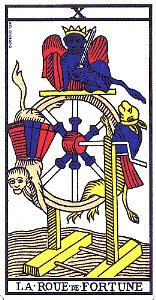
We are faced with a rather strange card here. For the first time none of the figures are recognizably human or natural. We have two odd-looking creatures revolving helplessly on Fortune's enigmatic wheel, while a third creature presides over the whole scene. What are we to make of these strange creatures wearing human clothes?
According to Sallie Nichols (Jung And Tarot):
 Commentators generally think it a good omen in this card that Anubis is rising on the wheel and that Typhon is on his way down. But it is a wheel, after all, and Typhon will be back in the ascension soon enough. Given this truth, what we are dealing with here is the cycle of opposites in the greater scheme of things.
Before we move into deeper interpretation, there is still the matter of the third creature sitting atop the wheel. The winged creature has the body and tail of a lion, while the face is monkey-like. It seems to be naked, though it does wear a gold crown and hold a sword. Strangely enough, this is a sphinx, depicted here in its devouring feminine form (think of Moreau's Oedipus and the Sphinx, at right).
Oedipus succeeded in answering the riddle of the sphinx, but the Gods punished him for his hubris by leaving him at the mercy of his fate as prophesied -- to kill his father and marry his mother. Even though he answered the questions, he failed to reclaim his animal nature, and therefore remained a captive of the feminine realm (owned by his mother, Queen Jocasta).
 This is one of the mythical situations where the hero (our young Fool) may slay the monster or learn its lesson. In this case, our Fool must use the inner strength s/he acquired in the last card to liberate the inner animal energies that populate this card. But, as was true for Oedipus, intellect is not the correct approach here. The Fool cannot free the libido energies associated with creativity through mental agility.
The Fool must confront and integrate those animal energies within. If s/he succeeds, Anubis will be her/his fate. If s/he fails, Typhon will be the fate that awaits him/her. But the Fool must not fall prey to the sphinx's riddles if s/he hopes to pass this test. S/he must look within, as s/he learned in the last card, and find the animal nature at the core of all human beings.
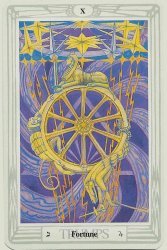
If we step back from the detail of the card, we have a wheel, a mandala of the Kosmos. Jung saw the mandala as a symbol of the unconscious self. One is the macro, and the other is the micro. With this particular mandala, we have motion, the turning wheel of fortune. This suggests the cyclical nature of birth and death, becoming and dying, growth and decay, and as the two mythic creatures in our card suggest, integration and disintegration.
 These forces are always working within our biology (the growth and decay of cells continues throughout our lifetimes -- the body we have now is completely new from the body we had seven years ago); meanwhile, the same forces are at work on the grand scale of stars and galaxies. The bottom line is that change is the single constant in our world.
The Osho Zen Deck calls this card Change, and that seems to be the core meaning of the Wheel of Fortune. Here is some of the interpretation from the Osho site:
One other point needs to be made, although please keep in mind that these are generalizations. In the West, we value diversity of experience and seek unique influences. In the West, we identify with the outer ring of the wheel with its speed and constant exposure to new things. In the East, stillness is valued over activity, and deeper experience is valued over a wider range of experiences. In the East, the hub of the wheel is sought, much in the same way the center of a mandala is the focus of meditation.
 We would do well to integrate these diverse preferences. In the pagan and wiccan traditions, much of the work of ritual is conducted within the circle. This places the individual psyche in the center, the axis mundi, and also creates an experiential boundary with the outer edge of the circle. While remaining centered, the ritualist invites into the circle the forces and experiences s/he seeks. In this way, we are not bombarded by that which we do not seek, but invite that which we seek to come to us.
As the Fool continues his/her journey, being able to accept change as a constant and being able to discern what is valuable to the process and what isn't will be crucial to her/his success. In the next card we'll see if s/he was able to integrate the animal energies of this card successfully.
Technorati Tags: Tarot, Wheel of Fortune, Sallie Nichols, Jung, The Fool, Change, Osho Zen

 Last week the Fool had to turn inward to find the inner Hermit, the wise elder who serves as the archetypal representation of the higher self. Now the journey moves from inner contemplation to the grand principles of the Kosmos as we encounter the Wheel of Fortune.
We are faced with a rather strange card here. For the first time none of the figures are recognizably human or natural. We have two odd-looking creatures revolving helplessly on Fortune's enigmatic wheel, while a third creature presides over the whole scene. What are we to make of these strange creatures wearing human clothes?
According to Sallie Nichols (Jung And Tarot):
The golden creature rising on our right is usually connected with Anubis, the dog-faced god of Egypt who weighed the souls of the dead. He is thought of as a positive, integrative factor. The monkey-like animal on our left is usually associated with Typhon, the god of destruction and disintegration.
Commentators generally think it a good omen in this card that Anubis is rising on the wheel and that Typhon is on his way down. But it is a wheel, after all, and Typhon will be back in the ascension soon enough. Given this truth, what we are dealing with here is the cycle of opposites in the greater scheme of things.Before we move into deeper interpretation, there is still the matter of the third creature sitting atop the wheel. The winged creature has the body and tail of a lion, while the face is monkey-like. It seems to be naked, though it does wear a gold crown and hold a sword. Strangely enough, this is a sphinx, depicted here in its devouring feminine form (think of Moreau's Oedipus and the Sphinx, at right).
Oedipus succeeded in answering the riddle of the sphinx, but the Gods punished him for his hubris by leaving him at the mercy of his fate as prophesied -- to kill his father and marry his mother. Even though he answered the questions, he failed to reclaim his animal nature, and therefore remained a captive of the feminine realm (owned by his mother, Queen Jocasta).
 This is one of the mythical situations where the hero (our young Fool) may slay the monster or learn its lesson. In this case, our Fool must use the inner strength s/he acquired in the last card to liberate the inner animal energies that populate this card. But, as was true for Oedipus, intellect is not the correct approach here. The Fool cannot free the libido energies associated with creativity through mental agility.
The Fool must confront and integrate those animal energies within. If s/he succeeds, Anubis will be her/his fate. If s/he fails, Typhon will be the fate that awaits him/her. But the Fool must not fall prey to the sphinx's riddles if s/he hopes to pass this test. S/he must look within, as s/he learned in the last card, and find the animal nature at the core of all human beings.
If we step back from the detail of the card, we have a wheel, a mandala of the Kosmos. Jung saw the mandala as a symbol of the unconscious self. One is the macro, and the other is the micro. With this particular mandala, we have motion, the turning wheel of fortune. This suggests the cyclical nature of birth and death, becoming and dying, growth and decay, and as the two mythic creatures in our card suggest, integration and disintegration.
These forces are always working within our biology (the growth and decay of cells continues throughout our lifetimes -- the body we have now is completely new from the body we had seven years ago); meanwhile, the same forces are at work on the grand scale of stars and galaxies. The bottom line is that change is the single constant in our world.The Osho Zen Deck calls this card Change, and that seems to be the core meaning of the Wheel of Fortune. Here is some of the interpretation from the Osho site:
Life repeats itself mindlessly - unless you become mindful, it will go on repeating like a wheel. That's why Buddhists call it the wheel of life and death, the wheel of time. It moves like a wheel: birth is followed by death, death is followed by birth; love is followed by hate, hate is followed by love; success is followed by failure, failure is followed by success.This is the cycle of life on a large scale. If we cling to things as they are at any given time, we will be disappointed when they change -- and things will always change. So the practice that must arise with this card is nonattachment.
One other point needs to be made, although please keep in mind that these are generalizations. In the West, we value diversity of experience and seek unique influences. In the West, we identify with the outer ring of the wheel with its speed and constant exposure to new things. In the East, stillness is valued over activity, and deeper experience is valued over a wider range of experiences. In the East, the hub of the wheel is sought, much in the same way the center of a mandala is the focus of meditation.
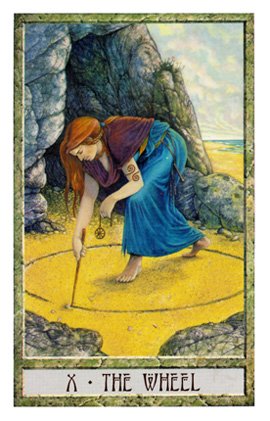 We would do well to integrate these diverse preferences. In the pagan and wiccan traditions, much of the work of ritual is conducted within the circle. This places the individual psyche in the center, the axis mundi, and also creates an experiential boundary with the outer edge of the circle. While remaining centered, the ritualist invites into the circle the forces and experiences s/he seeks. In this way, we are not bombarded by that which we do not seek, but invite that which we seek to come to us.
As the Fool continues his/her journey, being able to accept change as a constant and being able to discern what is valuable to the process and what isn't will be crucial to her/his success. In the next card we'll see if s/he was able to integrate the animal energies of this card successfully.
Technorati Tags: Tarot, Wheel of Fortune, Sallie Nichols, Jung, The Fool, Change, Osho Zen
Kallia and the Dragon
Thursday wasn’t special in any way. Kallia woke up around sunrise, as always, and heard her parents working in the yard. There were cows to be milked, eggs to be collected, and other assorted chores. As days go, this was an ordinary day, except for one thing.
Kallia had dreamed she was to become a great ruler. But first she must find her dragon. She didn’t like this dream too much. After all, only men became rulers, only men could slay dragons, and, besides, she was only twelve years old. She was to be married in four years to a man from the next village, a man whom she did not even know.
As the day wore on and Kallia did her chores, mended her brothers’ clothes, and fed the animals, she kept thinking about the dream. She also wondered what it would mean to find a dragon. “I bet no one would want to marry me,” she thought to herself.
Yet, the truth of the dream stuck in her chest. It felt like a new heartbeat that she couldn’t ignore. For three days, she thought about nothing but the dream. The image of the dragon became the most important thing her world. Her life seemed small when compared to the life she might live if the dream came true.
Her mother noticed that Kallia was not very attentive to her chores. “Where are you, young lady?” her mother asked. “You seem possessed by spirits.”
“I’m just thinking, mother. No reason to be worried.” Kallia tried to act as though everything were normal. She even tried extra hard to get her work done.
Her mother was still worried. “Well, stop thinking. That’s work for the men.” Kallia heard these words and wondered how her mother could believe them. She wondered why women were not allowed to think or act without permission.
The dream was too strong. She decided she would go in search of a dragon. She could carry a small sword and shield, perhaps the one her father used to train her brothers to fight. No one had seen a dragon in these parts in several generations, but many stories were told of great leaders having slain a dragon to prove their valor. Kallia had no intention of becoming a leader, but she was sure she must find a dragon.
It took nearly a week to work out a plan, but Kallia finally managed to take the weapons and leave the village without being seen. Traveling at night was difficult, but she chose a night when the moon was round and a faint light shone on her path.
Kallia felt her stomach tighten and her breathing become quick and shallow. She had never been out in the woods at night, and had never traveled alone in her young life. As she walked, she realized she had been denied so much because she was a girl. Her brothers had been trained to fight, hunt, and survive alone in the woods for days at a time. She was taught to sew, feed animals, and cook for the men. It was the life her mother was living, and the life she was expected to live.
She had never questioned her life before. But now, having set out on this adventure, she was filled with questions and feelings she had never known. Even though she was scared and every strange noise made her jump, she felt good. She felt free in a new way, like being alive for the first time.
After three long days and nights, Kallia found a giant cave leading into the base of a rather big mountain. She was tired and hadn’t slept much, just a few hours each afternoon. She had been eating berries and other wild plants her mother had taught her to collect for food. But she had also packed a pouch of dried meat, enough for many days.
It was still light out, so Kallia decided to take a short nap. Her long brown hair, tied up with a bit of rope, had collected leaves and twigs during her journey. She kind of liked being dirty, she thought, as she drifted off to sleep.
When Kallia awoke, the sun was setting. She pulled her cloak over her shoulders and settled her back against a tree. “If there is a dragon anywhere in these woods,” she thought, “he will be in this cave.” She stared at the cave for hours, well into the night. She imagined meeting the dragon and being flamed by its breath or swatted by its scaly tail.
During the dark hours of the night, every possible fear raced through Kallia’s mind. She wondered over and over why she was doing this, why she was seeking a dragon that would surely kill her. Dragons had killed many great warriors. Why should she be able to do what they couldn’t?
Kallia had never before thought about dying. She knew all people died but, at twelve years old, that truth seemed unreal to her. However, dying did not scare her; only the thought of pain was frightening. “At dawn,” she decided, “I will go into the cave and find the dragon.”
The more she thought about the dream, the more she felt she must find this dragon. She didn’t remember actually killing the creature in the dream, but that was the only possible choice. Everyone knows dragons must be killed.
Dawn finally came. Kallia took a deep breath, tried to stop her body from shaking with fear, and walked into the cave. Even with the torch she had made from an old piece of cloth, it was dark. As she walked, the cave kept getting bigger and bigger. Soon she was in a massive cavern. She felt the temperature change -- it was warmer now. If she listened very quietly, she could almost hear the sound of snoring. “Maybe a hermit is living here,” she hoped, feeling a bit safer for a moment.
Kallia took a few cautious steps. The snoring was getting louder. Holding the torch up over her head, she saw a large shape in the far corner. Her breath stuck in her throat, and her heart skipped several beats. She knew at once that she had found a dragon, no matter how much she wished it were just a large bear.
She moved closer, feeling fear in her stomach as she wedged her torch into a crevice in the wall. Kallia readied her weapons, deciding to attack while it slept. No need to give it warning by waking it. She raised her shield and sword and ran at the beast, intending to thrust her sword deep into its ribs.
Before she could get close enough, the dragon woke up and saw her coming. Kallia nearly froze in her tracks but decided to keep charging. The dragon yawned, a lazy kind of yawn, and raised its tail. With just a little swat, Kallia was knocked off her feet, landing on her backside.
She raised her shield, fearing the dragon would eat her. She could feel the heat from its breath. But the dragon just sat there, looking vaguely tired. Even dragons need their sleep.
Kallia lowered her shield and took a peek at the dragon. The dragon was just sitting there, half awake. She felt like a failure. The dream must have been all wrong. Tears rose to her eyes.
The dragon yawned, then looked at Kallia sitting on the floor of his cave. “Well, my child, have you learned anything from your adventure?”
Kallia looked up, startled. She did not know that dragons could speak. Words tumble from her mouth. “Uh, yeah, I have learned that little girls are foolish.”
“Try again, child. Being a girl is not your problem. That can’t stand in your way if you follow your dreams.” The dragon, smiling, didn’t seem so scary.
“Do you know about my dream?” Kallia asked.
“I knew you were coming to kill me, but I did not know why,” the dragon said.
“I dreamed that I must find a dragon,” Kallia began. “The dream said that if I do, I will become a great leader. But women are not warriors, and a woman has never ruled our land. I’m afraid I was wrong and that the dream has no truth. I thought all dragons must be killed.” Kallia felt a wave of disappointment move through her body. She felt like a balloon being deflated.
“Killing me is not your lesson, young lady.” The dragon seemed to know an awful lot for a creature that was supposed to be evil and mean.
Kallia felt confused. She just wanted to go home and sleep on her mat. “I don’t know why I had that dream, Dragon. I think I will just go home now, if you’ll let me.”
The dragon laughed, fire flaring out of his nostrils. “Giving up so soon? You haven’t even learned why your dream sent you here.”
Kallia sat down on the dusty floor of the cave. “Uh, so, why am I here? Am I supposed to learn something from you?” Her voice was shaky and thin.
The dragon smiled. “Very good. Whenever you meet a dragon, always ask it what lesson it has to teach you. That is the purpose of dragons. Do you understand?”
Kallia still felt confused. She felt safer, now, but unsure of what was happening.
The dragon continued, “The lesson I wish to teach you is that confronting a dragon -- not killing it -- is the way to become wise and powerful. Do you know how many people are frightened of us?” The dragon laughed again and more flames shot from his snout. “They see a dragon and try to kill it out of fear. Because we must protect ourselves from harm, people never discover the lesson they were supposed to learn.”
Kallia was beginning to understand. “So, you are my friend? If I learn the lesson you offer, you will not eat me?”
“Yes,” the dragon said, “on one condition. You must truly learn the lesson.”
Kallia smiled. “Yes, I will do that. Thank you. To be honest, I thought you were going to eat me.”
When Kallia arrived back at her village, she told her father of her adventures. He was very happy that she had returned safely, but angry that she went into the woods without telling anyone. Kallia explained the dream and what the dragon had taught her.
“Father,” she began cautiously, “I don’t want to be married in four years. I want to learn things and see the world.” Saying those words felt harder than facing a dragon. “I won’t marry that man.”
Having faced a dragon in its lair, she felt like there was no challenge in life that she could not handle.
Technorati Tags: Fiction, Children's story, Dragon, Lessons, Kallia, Fantasy
Kallia had dreamed she was to become a great ruler. But first she must find her dragon. She didn’t like this dream too much. After all, only men became rulers, only men could slay dragons, and, besides, she was only twelve years old. She was to be married in four years to a man from the next village, a man whom she did not even know.
As the day wore on and Kallia did her chores, mended her brothers’ clothes, and fed the animals, she kept thinking about the dream. She also wondered what it would mean to find a dragon. “I bet no one would want to marry me,” she thought to herself.
Yet, the truth of the dream stuck in her chest. It felt like a new heartbeat that she couldn’t ignore. For three days, she thought about nothing but the dream. The image of the dragon became the most important thing her world. Her life seemed small when compared to the life she might live if the dream came true.
Her mother noticed that Kallia was not very attentive to her chores. “Where are you, young lady?” her mother asked. “You seem possessed by spirits.”
“I’m just thinking, mother. No reason to be worried.” Kallia tried to act as though everything were normal. She even tried extra hard to get her work done.
Her mother was still worried. “Well, stop thinking. That’s work for the men.” Kallia heard these words and wondered how her mother could believe them. She wondered why women were not allowed to think or act without permission.
The dream was too strong. She decided she would go in search of a dragon. She could carry a small sword and shield, perhaps the one her father used to train her brothers to fight. No one had seen a dragon in these parts in several generations, but many stories were told of great leaders having slain a dragon to prove their valor. Kallia had no intention of becoming a leader, but she was sure she must find a dragon.
It took nearly a week to work out a plan, but Kallia finally managed to take the weapons and leave the village without being seen. Traveling at night was difficult, but she chose a night when the moon was round and a faint light shone on her path.
Kallia felt her stomach tighten and her breathing become quick and shallow. She had never been out in the woods at night, and had never traveled alone in her young life. As she walked, she realized she had been denied so much because she was a girl. Her brothers had been trained to fight, hunt, and survive alone in the woods for days at a time. She was taught to sew, feed animals, and cook for the men. It was the life her mother was living, and the life she was expected to live.
She had never questioned her life before. But now, having set out on this adventure, she was filled with questions and feelings she had never known. Even though she was scared and every strange noise made her jump, she felt good. She felt free in a new way, like being alive for the first time.
After three long days and nights, Kallia found a giant cave leading into the base of a rather big mountain. She was tired and hadn’t slept much, just a few hours each afternoon. She had been eating berries and other wild plants her mother had taught her to collect for food. But she had also packed a pouch of dried meat, enough for many days.
It was still light out, so Kallia decided to take a short nap. Her long brown hair, tied up with a bit of rope, had collected leaves and twigs during her journey. She kind of liked being dirty, she thought, as she drifted off to sleep.
When Kallia awoke, the sun was setting. She pulled her cloak over her shoulders and settled her back against a tree. “If there is a dragon anywhere in these woods,” she thought, “he will be in this cave.” She stared at the cave for hours, well into the night. She imagined meeting the dragon and being flamed by its breath or swatted by its scaly tail.
During the dark hours of the night, every possible fear raced through Kallia’s mind. She wondered over and over why she was doing this, why she was seeking a dragon that would surely kill her. Dragons had killed many great warriors. Why should she be able to do what they couldn’t?
Kallia had never before thought about dying. She knew all people died but, at twelve years old, that truth seemed unreal to her. However, dying did not scare her; only the thought of pain was frightening. “At dawn,” she decided, “I will go into the cave and find the dragon.”
The more she thought about the dream, the more she felt she must find this dragon. She didn’t remember actually killing the creature in the dream, but that was the only possible choice. Everyone knows dragons must be killed.
Dawn finally came. Kallia took a deep breath, tried to stop her body from shaking with fear, and walked into the cave. Even with the torch she had made from an old piece of cloth, it was dark. As she walked, the cave kept getting bigger and bigger. Soon she was in a massive cavern. She felt the temperature change -- it was warmer now. If she listened very quietly, she could almost hear the sound of snoring. “Maybe a hermit is living here,” she hoped, feeling a bit safer for a moment.
Kallia took a few cautious steps. The snoring was getting louder. Holding the torch up over her head, she saw a large shape in the far corner. Her breath stuck in her throat, and her heart skipped several beats. She knew at once that she had found a dragon, no matter how much she wished it were just a large bear.
She moved closer, feeling fear in her stomach as she wedged her torch into a crevice in the wall. Kallia readied her weapons, deciding to attack while it slept. No need to give it warning by waking it. She raised her shield and sword and ran at the beast, intending to thrust her sword deep into its ribs.
Before she could get close enough, the dragon woke up and saw her coming. Kallia nearly froze in her tracks but decided to keep charging. The dragon yawned, a lazy kind of yawn, and raised its tail. With just a little swat, Kallia was knocked off her feet, landing on her backside.
She raised her shield, fearing the dragon would eat her. She could feel the heat from its breath. But the dragon just sat there, looking vaguely tired. Even dragons need their sleep.
Kallia lowered her shield and took a peek at the dragon. The dragon was just sitting there, half awake. She felt like a failure. The dream must have been all wrong. Tears rose to her eyes.
The dragon yawned, then looked at Kallia sitting on the floor of his cave. “Well, my child, have you learned anything from your adventure?”
Kallia looked up, startled. She did not know that dragons could speak. Words tumble from her mouth. “Uh, yeah, I have learned that little girls are foolish.”
“Try again, child. Being a girl is not your problem. That can’t stand in your way if you follow your dreams.” The dragon, smiling, didn’t seem so scary.
“Do you know about my dream?” Kallia asked.
“I knew you were coming to kill me, but I did not know why,” the dragon said.
“I dreamed that I must find a dragon,” Kallia began. “The dream said that if I do, I will become a great leader. But women are not warriors, and a woman has never ruled our land. I’m afraid I was wrong and that the dream has no truth. I thought all dragons must be killed.” Kallia felt a wave of disappointment move through her body. She felt like a balloon being deflated.
“Killing me is not your lesson, young lady.” The dragon seemed to know an awful lot for a creature that was supposed to be evil and mean.
Kallia felt confused. She just wanted to go home and sleep on her mat. “I don’t know why I had that dream, Dragon. I think I will just go home now, if you’ll let me.”
The dragon laughed, fire flaring out of his nostrils. “Giving up so soon? You haven’t even learned why your dream sent you here.”
Kallia sat down on the dusty floor of the cave. “Uh, so, why am I here? Am I supposed to learn something from you?” Her voice was shaky and thin.
The dragon smiled. “Very good. Whenever you meet a dragon, always ask it what lesson it has to teach you. That is the purpose of dragons. Do you understand?”
Kallia still felt confused. She felt safer, now, but unsure of what was happening.
The dragon continued, “The lesson I wish to teach you is that confronting a dragon -- not killing it -- is the way to become wise and powerful. Do you know how many people are frightened of us?” The dragon laughed again and more flames shot from his snout. “They see a dragon and try to kill it out of fear. Because we must protect ourselves from harm, people never discover the lesson they were supposed to learn.”
Kallia was beginning to understand. “So, you are my friend? If I learn the lesson you offer, you will not eat me?”
“Yes,” the dragon said, “on one condition. You must truly learn the lesson.”
Kallia smiled. “Yes, I will do that. Thank you. To be honest, I thought you were going to eat me.”
When Kallia arrived back at her village, she told her father of her adventures. He was very happy that she had returned safely, but angry that she went into the woods without telling anyone. Kallia explained the dream and what the dragon had taught her.
“Father,” she began cautiously, “I don’t want to be married in four years. I want to learn things and see the world.” Saying those words felt harder than facing a dragon. “I won’t marry that man.”
Having faced a dragon in its lair, she felt like there was no challenge in life that she could not handle.
Technorati Tags: Fiction, Children's story, Dragon, Lessons, Kallia, Fantasy
Earthquake in Java

More than 2,700 people have already been confirmed dead in the aftermath of a quake that measured 6.2 on the Richter scale. The quake was centered near the densely populated city of Yogyakarta in Java. Many thousands more are injured and now homeless.
 The quake is likely releated to the increased volcanic activity in recent weeks at Mount Merapi. There are some concerns that the volcano may become more active.
Let us please send these people our prayers and whatever little bit we can spare to help in the relief efforts. Many of the small villages appear to have been completely destroyed.
And let us never forget how tenuous is our existence in this vast and amazing world.
Images are from CNN.
Technorati Tags: Earthquake, Java, Indonesia, Mount Merapi, Relief, Prayers
Video: Soothing Images and Music
Start your weekend with some soothing music and images of flowers. Very peaceful and meditative.
The Man Behind Zaadz

[image from Brian's page at Zaadz]
The recent post by Tom of Blogmandu on his feelings about Zaadz prompted me to do a little more digging into who Brian Johnson is. I found out that I had been one of his eteamz customers when I lived in Seattle. And I found Think Arete, a site he founded before Zaadz.
Think Arete is philosophy and more. Go have a look around. You'll get a sense of who Brian is and what motivates him. Some people may feel that Zaadz is simply a capitalist venture to make money off of "squishy Lefty" folks, but I think that Brian is not motivated simply by money. He has that, and lots of it.
For those who subscribe to Integral Naked, Brian will be in conversation with Ken Wilber on Monday (not sure when it will air). This will be a good opportunity to see where Johnson's heart-mind is as it relates to an integral worldview. If you want to suggest topics for conversation, stop by Brian's blog and leave a comment (soon).
Technorati Tags: Brian Johnson, Zaadz, Think Arete, Integral Naked, Ken Wilber, Integral Worldview
Subscribe to:
Comments (Atom)