Saturday, January 28, 2006

Preliminary Observations on Integral Relationship, Part Two


["Hieros Gamos" by Joe Xuereb]

Part Two: Toward an Integral Model

[Please see Part One before reading this entry. Thanks to Kai and Kira for their ongoing conversation around this topic. If you haven't been keeping up with the conversation Kira and Kai are having in the comments section, you're missing some great insights, observation, and sharing.]

Disclaimer: As noted in the title, these are preliminary observations toward creating an integral model for relationship. I do not claim to have all the answers. I hope to generate a dialogue that might move more people to consider the implications of integral theory for the realm of intimate relationship.

Relationship has a tendency to mirror the parts of our lives that need attention. In choosing a partner, our psyche often pulls us toward the person who can best help us grow past our limitations. How this happens is a mystery, but it seems to be true more often than not. We discover our limitations through relationship, through intimacy, through making mistakes and experiencing conflicts. Holding this purpose of relationship in our hearts and minds might be the most important first step toward having an integral relationship.

From this vantage point, relationship is an important part of our physical, emotional, intellectual, and spiritual practice. Living an integral relationship requires a shift in consciousness about how we view relationship. For our primary relationship to be integral, it cannot be separate from our connection to our body, our emotional/shadow work, our psyche and its needs, or our spiritual path. All these parts of our lives (and more) are interconnected, and we must live in this awareness.

So what does this mean in terms of integral theory? I propose that at least five lines are necessary (but not sufficient) to having an integral relationship. I would argue that highly developed morals (Kohlberg), affect (emotional intelligence), gender identity, cognition, and empathy are all necessary for an integral relationship. Certainly, the presence of higher development in other lines would also contribute to a more integral model (especially care, creativity, and role-taking). Finally, we must have access to that part of consciousness which is able to observe itself--the observer self, or witness. Without the observer self, none of the rest of this is possible.

In terms of moral development, any relationship benefits from both partners having attained the post-conventional stage. Further, level six (universal human ethics) or level seven (transcendental morality) are the only truly second-tier moralities, and having attained these levels of moral complexity allows for the transcendence of ego needs (which I maintain is the hallmark of an integral relationship).

In an integral relationship, concern for the other's growth, happiness, needs, and safety transcend one's own ego concerns. For the first time, partners place the other's needs above their own. The approach is similar to being of service to Spirit in that we act in service of our partner, who in our eyes manifests Spirit. This does not mean we ignore or reject our own needs but, rather, that we seek ways to transcend purely egoic needs in order to serve a higher purpose (a soul-level relationship, our soul needs, and the soul needs of our partner). Even if we can't live in this elevated moral position every minute of every day, we must be able to access it in times of conflict. The ability to hold a transcendent moral stance in times of conflict is what allows us to place the spirit of the relationship above our own ego needs.

Being able to separate from our ego needs, which are usually tied to emotions, becomes central element of an integrally oriented relationship. Emotional intelligence (affect), as defined by John D. Mayer and Peter Salovey and updated by Daniel Goleman, is crucial to a healthy relationship and, therefore, the foundation of an integral relationship. Goleman outlines five basic competencies:

  1. The ability to identify and name one's emotional states and to understand the link between emotions, thought and action.

  2. The capacity to manage one's emotional states — to control emotions or to shift undesirable emotional states to more adequate ones.

  3. The ability to enter into emotional states (at will) associated with a drive to achieve and be successful.

  4. The capacity to read, be sensitive, and influence other people's emotions.

  5. The ability to enter and sustain satisfactory interpersonal relationships.
All of these skills are important in an integral relationship. I would add to this list the ability to detach from our intense emotional states and take a step back to observe them--this is another place where the observer self plays a crucial role.

We must have access to and an understanding of our own emotions if we are to feel empathy for our partner. Without empathy, we will never be able to reach the moral stages described in the previous paragraphs. Without empathy, we can never experience our partner's point of view in a situation. Without empathy, we can never really transcend ego concerns in our relationships.

As we saw in the first post on this topic, gender identity is essentially fixed until individuals reach the high Orange and Green stages of development. However, I suggest that an integral relationship requires a fluid sense of gender identity. The outward manifestation of this fluidity is in one's ability to assume different gender roles, while the inward manifestation is actually an absence of attachment to any one gender identity, a form of androgyny. In the purest form (causal level), androgyny does not refer to the mixture of masculine and feminine traits, but to the transcendence of specific sexual/gender traits--the androgyne.

This second-tier conception of gender identity allows either partner to assume the masculine or feminine energy in the relationship. Further, it's not a problem if both partners assume male energy or female energy. At higher experiential states (tantra in the traditional sense), the gender energies become archetypal in nature--as ego recedes--and can result in gender union (a kind of hieros gamos). At the highest levels, gender dissolves completely, along with ego.

Cognitive development is essentially a movement through Wilber's fulcrums of basic structures, which combines Piaget's early stages with Aurobindo's transrational stages. As Piaget's stage model ends, Wilber adds a transformation stage (vision-logic) before moving into Aurobindo's conceptions of psychic, subtle, causal, and nondual. Vision-logic corresponds to late Green/early Yellow in the Beck Spiral Dynamics model. The hallmark of this stage is the ability to hold and compare differing perspectives or points of view.

In the language of Spiral Dynamics, one must be able to read the whole Spiral and assume the worldview of any of the first tier vMemes at will to be truly integral or second tier. This is the "necessary but not sufficient" element of integral consciousness. There is more to being second tier than intellectual development, but second tier won't happen without the mental capacity to assume various and conflicting worldviews.

Development of the Self along the Spiral requires an ability to intellectually conceive of new ways of seeing the world. This is not to say that an integral experience is not available as a state of consciousness, because it is, but integral consciousness as the foundation of a worldview must be solidified as a stage and not a simple state, which is available to anyone at any stage of development.

So this brings me to what I think is the most important element to an integral relationship: the ability to access the observer self. The observer self is the part of ourselves that can step back and listen to our minds obsess about finances, or an annoying coworker, or whatever the wind of the mind is blowing into consciousness--to observe our own interior monologue. This part of our consciousness is more of who we really are than the stream of words we call the interior monologue will ever be. The observer self is the first authentic approach to finding the higher Self that resides beyond the realm of ego (Wilber's "witness").

If we meditate or see a good therapist, the observer self is one of the first skills we will develop. It’s that important. Without that part of ourselves, our monologues will keep arguing that their version of reality is the only version, and we will keep believing them, living our lives as though the monologues are the only truth, feeling confused when the world disagrees. Further, the observer self allows us to look at our behaviors and our egoic needs as though from a distance.

This skill is invaluable to a healthy relationship. When we are in the midst of conflict, or bumping up against one of the many times that our intimate relationships will reveal our wounding, we must be able to detach from the shame, guilt, anger, fear, or any other strong emotion that might surface, and to create some space to observe the emotion, its source, and how we might learn from it. As I noted above, relationship often serves the purpose of revealing our flaws and wounding to provide us with an opportunity to work on them. Without an observer self, this is not possible. If we cannot detach from our emotions when we need to, an integral relationship will not be possible.

It must be noted that the observer self is not limited to second tier or integral stage development. Anyone at any stage can learn to access the observer self as a state of consciousness. An exercise to learn this skill is available in a previous post on this site. However, a truly integral-stage person will have access to the observer at will.

These are my preliminary observations on integral relationship. I welcome objections, corrections, and continuing dialogue on this topic. As is my nature, this post has been extremely theoretical and intellectual. So what does an integral relationship, or the attempt to have one, look like from the inside? In my next post, part three, I will try to present some of my personal experience with my attempts to co-create an integral relationship.

Go to Part Three.

Thursday, January 26, 2006

Poem: Su Tung P'o


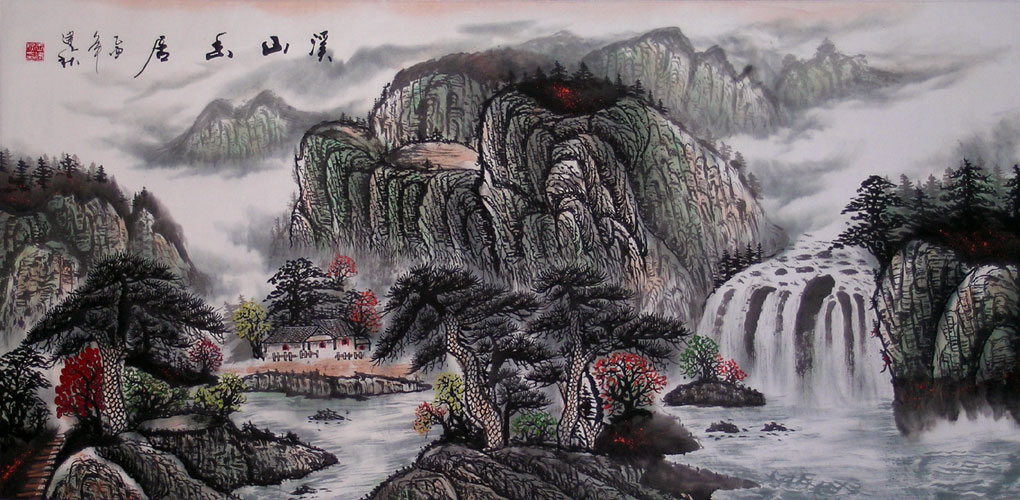
[Secluded Home at Spring Mountain, Wang Jian-Qi]
Moon, Flowers, Man

I raise my cup and invite
The moon to come down from the
Sky. I hope she will accept
Me. I raise my cup and ask
The branches, heavy with flowers,
To drink with me. I wish them
Long life and promise never
To pick them. In company
With the moon and the flowers,
I get drunk, and none of us
Ever worries about good
Or bad. How many people
Can comprehend our joy? I
Have wine and moon and flowers.
Who else do I want for drinking companions?

Translated by Kenneth Rexroth, One Hundred poem from the Chinese

Wednesday, January 25, 2006

Emotions and Equanimity


["Emotions" by Joelle Deroy]

After an emotion has . . . surfaced, there are two ways to deal with it. One is to objectify the emotional response by blaming someone or something for the way you feel. This way reinforces and escalates negative feelings. The other choice is to go directly into the emotion, become it, discover it, feel it thoroughly, and calmly watch its nature. Rather than ask why, observe how the emotion arises. Instead of trying to push the emotion away, befriend it. If you watch carefully, without involvement, you will see this emotion manifest in both body and mind and dissolve into pure energy.

Just by sitting quietly and watching our emotional state without attachment, we become tranquil. No other instruction is necessary. Agitated, restless feelings are like muddy water, which becomes still and transparently clear when left to stand. As our emotional reaction naturally subsides, mind and body become peaceful and balanced.

If we do not allow this change, we will see that we are holding the emotion fixed in the body, breath, and mind. Looking deeply into this emotional tension, we may discover a strange paradox: although we do not want to suffer, we seem unable to give up our unhappiness. We either cannot or will not change. We hold on to emotional responses, even the negative ones, because our emotional needs and attachments are very strong; they form a major part of our identity. Letting go of them can be very frightening and confusing, for without these familiar feelings we may no longer be sure who we are.

Tarthang Tulku, Hidden Mind of Freedom; Dharma Publishing

Although I prefer the Shambhala path of Buddhism, I keep reading Dzogchen books. I am liking what I read in some of them. Tulku is easy to read and clear in his instructions. As I continue with his book, I'll try to post interesting passages or any thoughts I have on the text.

Tuesday, January 24, 2006

Therapy as the Warrior's Path


["Drowning" by Tonmi Lillman]

Conventionally, being fearless means that you are not afraid or that, if someone hits you, you will hit him back. However, we are not talking about that street-fighter level of fearlessness. Real fearlessness is the product of tenderness. It comes from letting the world tickle your heart, your raw and beautiful heart. You are willing to open up, without resistance or shyness, and face the world. You are willing to share your heart with others.

***

In the Shambala tradition, discovering fearlessness comes from working with the softness of the human heart.

( Chögyam Trungpa, Shambala: The Sacred Path of the Warrior)


When I began my weekly talks with Maude, I had no idea what I was getting myself into or how my life would be changed. If I had known, I likely would have continued as I have, but I would have made more space in my days for just being. Some days, I am back at the gym and training my clients within an hour of hanging up the phone. It seems there is little time for reflection, meditation, and thinking up excuses to avoid the next conversation. I really was not well-prepared for the process I was undertaking.

All I knew when I made the first phone call was that I was not happy and that nothing I had tried until that point had worked to ease the discomfort always lurking beneath the surface of my consciousness. I wasn't depressed, or at least not in any way identifiable to most people. In fact, my outward life was working better than it ever had before, yet I was not content. Something was missing.

The one thing I did know when our conversations began was that I had never been a very emotional person. Perhaps it might be more honest to say that I avoid emotions to the point that I often am unaware of what I am feeling. My conservative parents taught me that "boys don't cry" or show any other vulnerable emotion. In fact, I was raised to value intellect over emotion in every conceivable way and in every instance. I learned very early that a powerful intellect garners power and respect, while vulnerable emotions are "weak and sissy." I learned through my father's words--"Stop crying or I'll give you something to really cry about"--not to show vulnerability in any way.

I carried those lessons into adulthood, and in many ways they helped me get to where I am now--both good and bad. However, the lack of vulnerability has been a hindrance to healthy relationships and to living the compassionate life that Buddhism teaches. In fact, it was my life partner who suggested I talk with Maude. She has known Maude for many years and recommended her as someone who might be able to help me find whatever it was that my life seemed to lack.

When I made the first call, I didn't suspect that I would be learning about fearlessness. Nor did I suspect that true fearlessness, as Trungpa suggests, acquires its strength from the tenderness of a human heart.

* * *

The details are unimportant. Suffice it to say that no human heart makes it to the age of 38 without gathering a variety of wounds--some deep and damaging, others less painful but still significant. For most of my life until this point, I thought, "So what--quit whining and get on with your life." I believed we all had wounds but that the strong person was simply better at working around them. As near as I could tell, I was doing a fair job at working around whatever wounds I had accumulated. As long as my life wasn't in crisis, I saw no reason to go digging around in my psyche. All that was ever required, from my point of view, was more knowledge and understanding. No problem seemed so great that I could not think my way through it.

I must have been dropped on my head too many times as an infant. Or maybe it was the copious drug use in my teen years. Whatever the case, my thinking--as educated in psychology as I actually am--has turned out to be less than adequate to the situation. I think it was Einstein who said that a problem can't be solved by the same consciousness that created the problem in the first place. He was correct.

Yet, the consciousness that created the problem was doing exactly what it was designed to do. When a child's psyche is exposed to pain for which it is ill prepared, the psyche devises defenses to deal with the pain. For example, if a young boy is repeatedly told that he should not cry when he feels pain or fear, and is even punished for expressing his vulnerability, his psyche will find ways to stuff that pain away someplace out of reach. The feeling element of his psyche will split off and be disowned. A subpersonality will develop in its place that is tough and unfeeling. The role of that subpersonality is to protect the boy from painful feelings. As the boy grows into a man, he will continue to act with few authentic emotions. Even if he realizes what is going on inside himself, either through meditation, introspection, or relationship with others, his intellect will be insufficient to resolve the problem since it was his mind that created the problem in the first place.

* * *

So, one day I'm feeling a little discontented. The feeling comes and goes for a few weeks, and I am clueless as to why I should not be happy when so much of my life is exactly how I want it. After talking with my partner, who has experienced me as distant and emotionally unavailable, I decide to talk to Maude. Looking back, that decision was the spiritual equivalent of walking out into the ocean and allowing the waves to carry me far from land.

Much of what I assumed to be true--about who I am, about my childhood, about what I want most in life--has been washed away. In many ways, this is good. I have written before about "coming undone," about the ways we can renew ourselves through giving up beliefs that no longer serve our lives. I respect the process of undoing and generally seek ways to jettison elements of my life that no longer serve me. This is different. I am undoing many of the core elements of how I define myself in the world. I am no longer the person I was when I picked up the phone for the first time. Nor am I yet the person I am in the process of becoming.

I am stuck in between. In the study of ritual and initiation, this is what is called liminal space. The word liminal derives from the Latin limen, which means threshold--of or relating to being in an intermediate state, phase, or condition; in between, transitional. In the colloquial, one might say I am neither here nor there. In truth, I no longer even know where here or there are.

Liminal space is uncomfortable. I am often grumpy, short-tempered, moody, impatient, on edge, and generally no fun to be around. Did I mention the moodiness? It's like being a teenager again, but at least there's no acne this time. In fact, I have all the symptoms--low energy, poor sleep, moodiness, a need for isolation, disrupted eating patterns--of someone who is depressed. This isn't the neurochemical imbalance kind of depression that requires pharmaceutical intervention. It's what is known as situational depression and is best treated by examining the situation that has created it. In this case, that would be liminality.

Maude has the unmitigated audacity to tell me, over and over again, that I am exactly where I need to be. If she weren't so damned right, I'd just be really annoyed. In fact, I am annoyed. Yet, despite all the turmoil and chaos swirling around inside my head, I am still capable of taking a step back and looking at the process as though it were someone else's life that was coming unraveled. From that point of view, I know she is right. I am neck-deep in the ocean of my psyche. No matter how foreign it feels, and it feels like being a stranger in my own skin, I know how to swim and I am not going to drown.

* * *

But wait, there's more. Like I said before, I was raised to believe that I can think my way out of any problem. Or rather, that if I work hard enough at something, I can master it and be in control. I thrive on being in control, on mastering problems and being the one who figures thing out. I need to have all the answers, and on the rare occasion that I don't have all the answers, I am convinced that I can find the answers quickly. From this point of view, I should have solved whatever was bothering me after the first couple of phone calls. From this point of view, I should be running the world by now, or at least some multinational corporation. Such is the power of ego.

But ego is insufficient to the task at hand. The more I try to do something to "fix" myself, the more I create distance from feeling. Doing is intellectual and active--it's where I am most comfortable. Feeling is emotional and passive--I avoid feeling as much as possible. So Maude does not give me "homework," and she constantly rebuffs my pleas for some kind of technique or activity that can lessen my discomfort. "Just notice your avoidance as it comes up," she says; or, "Just be aware that you are intellectualizing instead of feeling." Yeah, that's all great, but I want to DO something.

How difficult it is, with such a belief system, to no longer be in control. Liminality does not tolerate an inflated ego. It quickly pokes holes in such a bloated sense of self. The result is that pesky depression I complained about a few paragraphs ago. Which brings me to another of my "issues": my sense of self is either inflated or deflated, but seldom balanced. Neither is real. I am never as "in control" as I try to convince myself that I am; nor am I ever as at the fate of mercy as I sometimes feel. Both viewpoints serve to distance me from my authentic feelings--most often fear or grief.

* * *

The tenderness and sadness Trungpa speaks about is assumed in Buddhism to be the natural state of the heart. For all its wisdom, Buddhism lacks the insight into developmental issues that Western psychology has mastered over the past one hundred years. Buddhism excels at the higher reaches of human development but lacks a solid understanding of how human beings develop from birth to adulthood. The real source of that tenderness and sadness is the wounding we experience as we grow to maturity.

A wise friend once told me that my greatest gifts in life would grow out of my deepest wounding. Although I grasped his point intellectually, I had no idea how much literal truth there was in his words. One of my deepest wounds is the sense that I am separate, unappreciated, unloved by Spirit, Divinity, God--whatever you want to call the creative intelligence that is ground and goal of material reality. I have no idea how that grief will become a gift in my life, but I do know that touching that grief is softening my heart. The more I can touch that tenderness, that sadness, the more fearless I become. This is the path of the warrior that Trungpa writes about.

When I first picked up the phone to talk with Maude, I had no idea I was embarking on the path of the warrior. I knew about warrior spirit from my readings in Buddhism, Native American traditions, and from some New Age authors such as Dan Millman. I never really took much of it seriously. I had no desire to be a warrior--spiritual or otherwise.

Yet here I am, rereading Trunga's book in some ill-guided attempt to intellectually understand what is happening within me. Maude knows I cannot help myself in this area. Still, she makes a point of reminding me that I am exactly where I need to be--even if I have no idea where in the hell I am.

Monday, January 23, 2006

On Samsara


[Bosch: Garden of Earthly Delights, Middle Panel]

When we speak of samsara, it seems to be something bad. What is samsara? What do you point to when you want to identify samsara? Who is samsara? If you're wondering who samsara is, you can point to yourself. Each of us is our own samsara. Is it the same or different from ourselves? It's not be found anywhere else apart from our own existence. We are the ones who experience suffering; we are the ones who experience joy. Moreover, we are the ones who create our own samsara. Is samsara created? Yes, it is, and we're the ones who create it. How does this take place? With such mental afflictions as the three poisons of attachment, hatred, and delusion, we create samsara. The nature of all of these poisons is delusion. That is what creates our samsara.

Gyatrul Rinpoche, "Commentary" on Natural Liberation

Sunday, January 22, 2006

Sunday Poem: Charles Wright

Body and Soul II  

(for Coleman Hawkins)

The structure of landscape is infinitesimal,
Like the structure of music,
                                           seamless, invisible.
Even the rain has larger sutures.
What holds the landscape together, and what holds music together,
Is faith, it appears--faith of the eye, faith of the ear.
Nothing like that in language,
However, clouds chugging from west to east like blossoms
Blown by the wind.
                               April, and anything's possible.

Here is the story of Hsuan Tsang.
A Buddhist monk, he went from Xian to southern India
And back--on horseback, on camel-back, on elephant-back, and on
foot.
Ten thousand miles it took him, from 29 to 645,
Mountains and deserts,
In search of the Truth,
                                    the heart of the heart of Reality,
The Law that would help him escape it,
And all its attendant and inescapable suffering.
                                                                          And he found it.

These days, I look at things, not through them,
And sit down low, as far away from the sky as I can get.
The reef of the weeping cherry flourishes coral,
The neighbor's back porch light bulbs glow like anemones.
Squid-eyed Venus floats forth overhead.
This is the half hour, half-light, half-dark,
                                                when everything starts to shine out,
And aphorisms skulk in the trees,
Their wings folded, their heads bowed.

Every true poem is a spark,
                            and aspires to the condition of the original fire
Arising out of the emptiness.
It is that same emptiness it wants to reignite.
It is that same engendering it wants to be re-engendered by.
Shooting stars.
April's identical,
                          celestial, wordless, burning down.
Its light is the light we commune by.
Its destination's our own, its hope is the hope we live with.

Wang Wei, on the other hand,
Before he was 30 years old bought his famous estate on the Wang River
Just east of the east end of the Southern Mountains,
                                                                          and lived there,
Off and on, for the rest of his life.
He never travelled the landscape, but stayed inside it,
A part of nature himself, he thought.
And who would say no
To someone so bound up in solitude,
                                         in failure, he thought, and suffering.

Afternoon sky the color of Cream of Wheat, a small
Dollop of butter hazily at the western edge.
Getting too old and lazy to write poems,
                                                               I watch the snowfall
From the apple trees.
Landscape, as Wang Wei says, softens the sharp edges of isolation.

Don't just do something, sit there.
And so I have, so I have,
                    the seasons curling around me like smoke,
Gone to the end of the earth and back without a sound.


From A Short History of the Shadow, 2002, Farrar, Straus, and Giroux.  

Commentary on Wright Poem

Due to formatting issues with Blogger, I could not maintain the formatting in the poem and still be able to edit the body text as needed, so they are separate posts.

Here is a little biography on Charles Wright from the Academy of American Poets website:

Charles Wright was born in Pickwick Dam, Tennessee, in 1935 and was educated at Davidson College and the University of Iowa. Chickamauga, his eleventh collection of poems, won the 1996 Lenore Marshall Poetry Prize. His other books include Buffalo Yoga (Farrar, Straus & Giroux, 2004); Negative Blue (2000); Appalachia (1998); Black Zodiac (1997), which won the Pulitzer Prize and the Los Angeles Times Book Prize; The World of the Ten Thousand Things: Poems 1980-1990; Zone Journals (1988); Country Music: Selected Early Poems (1983), which won the National Book Award; Hard Freight (1973), which was nominated for the National Book Award; and two volumes of criticism: Halflife (1988) and Quarter Notes (1995). His translation of Eugenio Montale's The Storm and Other Poems (1978) was awarded the PEN Translation Prize. His many honors include the American Academy of Arts and Letters Award of Merit Medal and the Ruth Lilly Poetry Prize. In 1999 he was elected a Chancellor of The Academy of American Poets. He is Souder Family Professor of English at the University of Virginia in Charlottesville.

Wright's Zone Journals is, for me, one of the finest books of poetry published in the last 50 years. The lines are associative, not narrative, and move with a kind of fluidity that reflects the liquid nature of the mind.

Wright's is a poetry of "luminous moments," as Edward Hirsch says. A reader gets the sense that Wright is painfully aware of his insignificance before the blank face of God. Here are more of Hirsch's thoughts on Wright:

Charles Wright is a poet of lyric impulses, of what Pound termed "gists and piths." His poems are structured associatively rather than narratively, and he has created a poetics of luminous moments, what Wordsworth called "spots of time," Joyce termed "epiphanies," Virginia Woolf labeled "moments of being." Such moments, fleeting and atemporal, rupture narrative and loosen bonds of continuity and consequence. They mark and isolate the self, transporting it to another realm, weakening its boundaries. They are inchoate and asocial--defying language, destroying time. Thus they have to be seized and contained, described and dramatized in words, reintegrated back into temporal experience. The epiphanic mode creates linguistic demands upon the poet, and Wright has responded to these demands conclusively. Over the years his work has become larger and more inclusive, with narrative overtones rather than undertones, though from the beginning he has written a poetry of flashes and jump-starts, of radiance glimpsed and noted down--transcribed, transfigured.

There is a definite Christian influence in Wright's work, but it is balanced by a reverence for the Eastern religions and their focus on being in the present moment. Wright struggles often with staying in the present. His poems become filters through which he remembers things past in order to make sense of the present. The poem posted above ends with a reminder to himself to just sit in the moment. A good lesson for us all.

Charles Wright poems on the web:

After Reading Tu Fu, I Go Outside to the Dwarf Orchard
Early Saturday Afternoon, Early
In the Greenhouse
Last Supper
Words and the Diminution of All Things

Saturday, January 21, 2006

Preliminary Observations on Integral Relationship, Part One

Part One: Foundations

A while back, Joe Perez posted on the idea of polyamory as a post-conventional form of relationship. I suspect there are many who would disagree and see the desire to be in more than one intimate relationship at a time as immoral. I certainly do not think it is immoral, but I am undecided regarding its place as part of an integral model of relationship.

Joe's post also contained a developmental model of relationship based on Lawrence Kohlberg's stages of moral development. This is how Joe described his model:

In the first (pre-conventional) stage, dynamics are characterized by a desire for fluid and polymorphously perverse sexual play with multiple partners, and/or sexual role playing based on power dynamics (fetish, sadomasochistic play, etc.) Non-monogamy is valued; monogamy is derided as something for fuddy duddies and uptight squares.

In the second (
conventional) stage, sexual relationships are characterized by a desire for a balanced relationship with one primary partner, usually in a conventional marriage/domestic partnership. Monogamy is held to be virtuous, and non-monogamous liaisons are forbidden as adulterous or cheating.

In the third (
post-conventional) stage, sexual relationships are characterized by a desire for deep intimacy and passionate sexual aliveness that may be found with one or more partners in either conventional or unconventional relationships. Monogamy and non-monogamy are both recognized as playing important roles in the development of a mature sexuality.

I like these distinctions, but I disagree with a few points in Joe's model.

I would argue (from my perspective) that the pre-conventional stage is not as fun-loving as is presented. At this stage, power and control are more important than anything else. Most of the time, it will be male domination and conquest--one partner will possess the other. At this stage there is no emotional content or concern for the other's well-being. It is a physical act. We see this in the primate world where sex is a form of currency, or in tribal cultures where "wives" are accumulated to ensure the birth of sons. Sexuality at this stage may also be attended by various taboos based on pleasing the Gods, protecting the hunt or the fertility of crops, or preventing birth defects (incest taboo). In modern cultures, this stage may take on some of the traits Joe mentions, but only among those who are consciously participating at a stage below their overall center of gravity.

The conventional stage contains what we think of as traditional relationship forms, especially marriage. Joe nailed this one, aside from perhaps the "balanced" part, which is more appropriate to post-conventional egalitarianism.

I agree for the most part with Joe's post-conventional stage. As I mentioned above, I haven't decided where I come down on the polyamory element that Joe argues is part of the post-conventional stage. My experience tells me that multiple intimate partners is not often tolerated and, even more, seldom works for all involved.

I would like to take the idea of developmental stages for relationship a little deeper using Spiral Dynamics as a model to look at how different worldviews might influence relationship patterns and eventually lead to an integral model of relationship. What I am proposing is a unique "relationship" developmental line that progresses up the Spiral. Of course, a relationship line will be influenced by the moral development line, by emotional development, by intellectual development, and so on, up to and including the spiritual development line.

This exploration is meant to be a first step toward an integral model of relationship. I do not pretend to know how an integral relationship might look, though I have some ideas. I am hoping that this might generate some discussion so that we might work together to create an imprint, an archetype for integral relationship. To my knowledge, this is a new frontier waiting to be explored.


At the animistic/tribal (Purple) stage, most behavior is organized around maintaining safety in an unsafe world. Magic and superstition are primary modes of manipulating the world. Family bonds are important, but families will often have more than one wife per husband. Ancestors are respected and customs, including relationships, are based on how things have always been done. Relationship at this stage is mostly about procreation and commerce (sex for food and safety). There may be recreational sexuality, but there is not likely to be much "sharing" in the sense that we think of it.

As people move into egocentric/exploitive (Red) stage, personal gratification becomes even more central, as do control and domination. Power is the currency of this stage where strength is the key to survival. The world is seen as hostile and dangerous, and each person is on his/her own. Needs gratification is central for men, while women are still looking for safety and status within the group (determined by the man she is with). Rigid rules are not as important here, and individuals might be more open to experimenting with whatever feels good, including same-sex partners, group sexuality, and other previously taboo expressions of relationship.

When the absolutist/traditionalist (Blue) stage emerges, divine authority becomes the central focus of rules and conduct. There is only one right way to do things, including relationships, and all other expressions of relationship are sinful. At this stage, monogamy becomes the preferred form of coupling. Stability and order are seen as necessary for a successful community life, and monogamy fits that model. There is often some form of divinely revealed reason for this model (Adam and Eve for Jews, Christians, and Muslims). At this point in human development, relationship is often seen as solely for the purpose of procreation, but now there is the added element of duty (the father to his wife and children, or a wife to her kids and husband). Sexual taboos are present again, often as a way to limit enjoyment of sexuality so that people will focus more of their attention on serving God (or country, community, church, and so on). For the first time in any large numbers, genuine love can become an element of the relationship.

Eventually, the individual ego will reassert itself and its needs in the materialist/achiever (Orange) stage of development. Rather than subordinate needs and desires to divine authority, individuals begin to seek out what feels good to them. But it's different than it was at the egocentric stage because the individual is entering a post-conventional moral stage where right and wrong are felt from the inside rather than imposed from the outside. Relationships at this stage are built around self-expression and forming alliances. Romantic love is usually the initial magnetism, but a lasting bond will be a partnership of equals who both get their needs met through the relationship. Because self-expression is important, individuals at this stage will experiment more with previously taboo partnerships and modes of relating. Same-sex, role playing, and bondage/fetish expressions are now on the table. Emotion is still not a central element, though feeling "good," desired, sexy, and so on is important to both (or all) partners. This is the stage where I see polyamory being a viable option.

At some point, emotions, equality, and egalitarianism will become central concerns. This stage is known as the relativistic/social (Green) stage, often referred to as postmodernism. Relational expressions become a central concern at this stage. Individuals are more aware of their own emotional life and feel the need to have emotional needs met in their relationships. Reproduction, sexual satisfaction, and status are no longer sufficient. A person at this stage wants to be able to express his/her feelings and feel an emotional connection with her/his partner. Post-conventional relationship patterns are even more likely at this stage. The primary focus, no matter what form the relationship takes, is on experiencing and sharing emotions, building relationships, expressions of spirituality, and creating equality and liberation for all involved.

Having reached this point, and it's fair to say that few really have reached this stage in American culture, a major transition is possible. Integral relationship is on the horizon.

In the next installment I will attempt to outline a preliminary sketch of what an integral relationship might look like and how it might work.

Go to Part Two.

Friday, January 20, 2006

Equanimity and Compassion


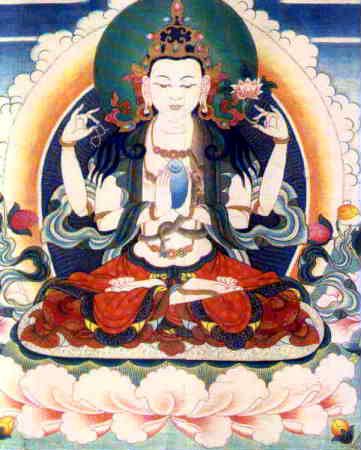
[Buddha of Compassion]


Joe Perez has a good post on equanimity. What follows is a slightly edited and expanded version of my response to his post. I'm glad Joe is thinking about this and took the time to post his thoughts. It's an important topic for all of us as the world we live in becomes more and more polarized.


Equanimity is something I struggle with all the time. For what it's worth, thinking about how we respond when our buttons get pushed is the most important act we can take in moving toward equanimity (at least in my experience).

We all have "hot buttons" that get pushed by other people. Most of mine, and I have MANY, revolve around the various forms of intolerance and attempts to restrict individual freedoms to live as we please (providing we are not in any way harming someone else).

What works for me when my buttons get pushed (when I can do it) is to follow the Shambhala path of Chogyam Trungpa. I try to take a step back from the situation and remember that the other person is also a human being who has gone through certain experiences, usually specific kinds of wounding/trauma, that created the worldview they now hold.

If and when I can humanize the person, it becomes much easier not to become reactive in the face of their intolerance. The goal is to feel compassion for whatever experience they have had that makes them so miserable that they have to hold hate for other people in their hearts (even when they don't call it hate). If we feel compassion for our enemies, they have no power to push our buttons.

Now this does not mean we do not act to change their hearts and minds. The Shambhala path requires us to work for the enlightenment of all sentient beings, so doing nothing is never an option. But we are much more likely to create allies with compassion than we are with anger. Maybe we can't change their hearts, but we will have acted with integrity and the tender heart of the warrior (as Trungpa calls it).

I agree with what Joe says about the progression of history toward greater depth and span, greater freedom and compassion (my words, I guess, not his).


The challenge for a liberal spirituality is to locate Spirit in the right place: in the midst of the evolution of nature and culture, in the thick of multicultural diversity, as the ground for liberal freedoms and all authentic liberation.
Equanimity is the act of aligning ourselves with that movement of Spirit, that drive, the Eros of evolution. When we are aligned with Eros, when we feel compassion for all beings, when we are no longer attached to the pettiness of ego, we are free in the truest sense of the word.

That is my sense of equanimity.

If we hope to be great, in any sense, we must do it with tender, open hearts. And we must do it together, with compassion, aligned with Spirit.

Easier said than done, but that is why we have this lifetime to work at getting it right.

Thursday, January 19, 2006

Follow-Up: Painful Confession

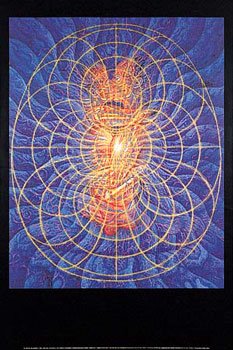
[Image by Alex Grey]

Thanks to everyone who commented on or mentioned my previous post on their blog.

After thinking about this for a while, and feeling as if I had been foolish to surrender my critical thinking capacity to Wilber for several years, I have come to understand what happened in a new way. Rather than being self-critical, I am looking for the deeper lesson in this experience (thanks to Maude for helping me sort through this).

What really bothered me was that I had surrendered to Wilber as though he were my guru. It wasn't a conscious choice--my rational brain and clinging ego can't tolerate the idea of surrender inherent in the guru/student relationship. However, there is meaning in the desire to surrender--a desire that is now conscious.

Wilber and his work provided a sense that the Universe has meaning, purpose, and order, and that I could possibly get a taste of that. For much of my life until reading Wilber (and Jung, among others, all in a two-year period), I held a very nihilistic view of life. Yet I craved the meaning I once found as a child in the Catholic church. Not in their idea of God, but that there was a God who was wise and compassionate (don't ask me how I got this out of Catholicism, because I have no idea).

One other element, the shadow side of this, also was important. I am a control junky, and I consume information as a way to feel a measure of control in a chaotic world. Wilber presents himself as almost "all-knowing," which allowed my shadow need for control to think that if I simply read all of his books, I too will know enormous amounts of information--therefore, I will have more control.

The shadow stuff is a minor detail, however. The important element that I have discovered is the craving for wholeness, meaning, and safety that is at the base of every human being's quest for the divine. Having dismissed God as a teenager, and having not yet found Buddhism, I sought the surrender to God through a surrender to Wilber as my guru--no matter how unconscious that process was.

Yesterday I was beating myself up for even holding that need. Today I see it as the fuel for the next phase of my growth. I crave the experience of being enfolded into nonduality, of surrendering ego with a full sense of safety. I crave the knowledge that I am loved by some power/force greater than me and my little ego. I don't think I am alone in this feeling.

Ego doesn't want to surrender. I have rejected the guru relationship in my Buddhist work because my ego rejects the idea that anything is greater than it is. Realistically, I know there are few teachers who have transcended their ego enough to be true gurus. Still, there are many who can be good teachers. I am now open to seeking that out.

Looking back over the past several years, I can ask myself if any good came from simply allowing myself to accept Wilber's worldview without question. The answer is yes. I moved out of the hopelessness I once felt as an angry teenager. I have grown as a person as a result of the work I have done with integral theory. I have a magnificent tool for understanding my world. And a door has been opened in me that I can work toward--a door into a region of my life that is beyond ego.

Finally, I have discovered that the only place I ever feel the sense of wholeness and meaning that I now realize has been driving me is with my girlfriend. In surrendering to Kira and the love she offers me, I move beyond my little ego. In feeling my love for her and giving it without condition, I also transcend my little ego.

Relationship can be an integral path. There is no gender distinction in this, no man/woman thing. We all contain a masculine and feminine element. When we are in true relationship, it is no longer one + one = two (male-female, female-male, or primary gender combination of your choice); it is one + one = four (male-female, female-male, male-male, female-female). Add this to the four quadrants, consider the developmental lines, think about states and stages, get to know your various subpersonalities, and never forget the Great Chain of Being, and relationship--the way all these elements interact between two people--becomes an amazing path to self-knowledge and self-transcendence.

In surrender to relationship, I get a taste of that enfolding into divinity that I crave. And I am a better person for allowing myself to need this kind of surrender.

Lu Yu: Poem


[Spring Rain at Yangtze River by Le Ran.]

Rain

In twilit crosslight begins
as cocoon unthreads,

brushes earth,
then hard arrowheads, airborne.

Through mosquito net light rays
to daybreak-dreams

as the brass stove's sweet grass
steam spring clothes.

Pond fish whip caudal fin
to follow spillway;

over weir swallows zoom, wheel,
touch wings, return.

Petals have only fallen
not yet blown away,

but wet blooms ruddling bough
are where I put trust.


Lu Yu [Translated by David M. Gordon, The Wild Old Man]

Wednesday, January 18, 2006

Painful Confession

[Image from RavenCrow]

This morning Matthew Dallman posted a link to a summary of Geoffrey Falk's criticisms of Ken Wilber. Not content to simply read a list of bullet points, I read the Wilber chapter (Norman Einstein) from Falk's book, Stripping the Gurus. I'm late to the game on this since the book has been around--and generally dismissed by anyone who likes Wilber--for a quite a while now.

My first impression was that Falk is an asshole. That was also my second and third impression as I read other chapters of his book. However much Falk acts like the stupid kid in the class who has caught the smart kid making a mistake, some of the critics of Wilber that he quotes have valid concerns that have either been ignored or derided. I find this disturbing.

I followed the back and forth between Wilber, de Quincey, and Hargens back when it happened, but I did not know about some of the behind-the-scenes stuff that went into the exchange. I found both Wilber and de Quincey wanting in that exchange, but I sided with Wilber.

I have generally sided with Wilber even when I found him to be egotistical and belittling of his critics. Because I have found Wilber's overall model useful and insightful, I didn't question some of the smaller details that Falk addresses. I committed the cardinal sin: I found the Buddha beside the road and did not kill him.

I was a Wilber follower. My girlfriend recently referred to me as a "Wilber freak," which I sort of took as a compliment and sort of felt embarrassed by. "Am I that obsessive? Am I that fanatical?" I thought to myself later. Painfully, the answer has been yes, at least some of the time.

Let me say right now that I found Falk's attack on Wilber to be a kind of nitpicking, overlooking the big picture so that he can show Wilber's mistakes. But there is some truth behind the smartass comments and ridicule that Falk espouses.

Wilber's critics have not been given a place at the integral table. They have not be included in the new integral paradigm. It can't be a truly integral model unless it is open to debate, to criticism, to the possibility that it is not the only answer, or even the best answer. The value of any good theory is its testability. Will the Integral Institute allow a non-member peer review of its central tenets? Will it permit dissenters to be heard by its members and followers?

When will Wilber have a non-believer as a guest on his "Get Naked" series? When will Wilber allow a guest on Get Naked to disagree with Wilber's version of integral?

I have not abandoned the four quadrants, developmental lines, states and stages, or much else of Wilber's basic model. However, I will never again be as accepting of everything Wilber says as I have been in the past.

When I talked with my girlfriend about this a little while ago, she asked me how I felt about this new "revelation." I told her I was not disillusioned with Wilber--all men are mortal, as Simone de Beauvoir claimed in her book by the same title. I was angry with myself for not questioning Wilber's work in the same way that I am critical of every other writer/thinker I read.

More than anything else, I am disturbed that I so easily accepted most everything Wilber wrote as though it were the god-given truth. That has been shifting in the last year (largely due to my misgivings about how he has treated SDi), but it was true for a number of years. "I wanted to believe," as Mulder might have said.

I wanted to practice a kind of jhana yoga (the path of intellect) with Wilber as my guru. I feel foolish for having even wanted that. Yet I understand the desire in myself and where it may have come from--but that's another post.

[Thanks to MD for pointing me where I needed to go.]

Paul Chek Interview

[This interview is also posted at Integral Fitness Solutions.]

If you don't know who Paul Chek is, you should. He is the leading voice in the world of integral fitness. His ideas are way outside of the mainstream of performance athletics, yet he is enormously successful. He must be doing something right.

While most trainers look only at the physical elements of weight loss or muscle building (and maybe the emotional), Chek includes the physical, the emotional, the mental, subtle energies, earth energies, and the soul. Not your normal fitness guru.

T-Nation is not exactly known for its integral approach to training (aside from the occasional article on getting "psyched" for your workout or some other low-grade attempt at including the interior-individual quadrant), so this interview is unique for them, as the introduction indicates:
I'd been assigned to interview Paul Chek, I'd been on the phone with him for close to four hours, and I didn't understand a single goddamn thing he was saying.

How was I going to transcribe this? How was I supposed to cut it down to 5000 words for an article? How was I supposed to get info out of this guy when every question I asked about protein and training garnered me an hour long diatribe about magnetic poles, chi, God, the planets, "cosmic consciousness," and the soul?

Shit.

Was this interview a bust? Had I wasted his time and mine?

No, I didn't think so. Because in the back of my mind, I knew that Chek was one of the best in the world in his field: corrective and high-performance exercise kinesiology. In fact, with his holistic approach, he's practically reinvented the field. I knew that, at 44 years old, Chek could outperform a lot pro-athletes in their twenties. (In his own words, he can "hammer the shit out of them in the gym." And he really can.) And his physique is pretty damn impressive too. There was something to learn here. Maybe a lot.

I also knew that while a lot of Chek's ideas were "out there," all really innovative and powerful concepts sound a little crazy at first... Or hell, maybe he's just a nutcase. I'll leave that for you to decide.

Read the rest here.