There seems to be a great deal of confusion in understanding just what Buddhism means when it talks about transcending the ego. Part of the confusion arises due to differences in usage, and part of the confusion arises as a result of ego having a variety of meanings depending on the context in which it is used. Yet another source of confusion is that Buddhist teachers are often teaching from the perspective of absolute truth, not relative truth. Identifying the ego so that it may be transcended becomes problematic in the absence of a working definition.
In order to sort this out, it will be necessary to take a wider view than merely defining ego in a concrete way. At its most basic level, ego is Latin for "I." Freud never used the word ego in his writings; he used the German pronoun das Ich, the I. So in Freudian psychoanalytic theory, the ego is synonymous with the sense of an unique self, an I. This has become the most common usage among the general public. Among specialists, ego is often used in a slightly less general way to refer to the organizing principle of the psyche that acts as an intermediary between the self (as subject) and the world. In this sense, then, ego is an object that can be observed by a subject, the self.
A more precise explanation, however, might dispel some of the confusion. If we use a simple model of human development that moves from simple to more complex, with each stage transcending and including the previous stage (assuming an absence of pathology), we then see how ego develops in relation to other elements of the psyche, such as the self and the Witness. A basic nine-stage developmental model (many of whose broader stages can be broken down into one or more sub-stages) moves through the following fulcrums:
F1, sensorimotor: material self (autistic self)
F2, impulse-emotion: body-ego
F3, representative mind: transition from body-ego to persona (early ego development)
F4, concrete operations (rules & roles): full emergence of ego
F5, formal operations: mature ego
F6, post-formal (existential): integrated self
F7, psychic (vision): soul
F8, subtle (archetype): soul becoming aware of spirit (Witness)
F9, causal (formless): emergence of spirit
Beyond the causal realm, all forms of separate identity are subsumed in non-dual consciousness.
As the self develops through each of the basic fulcrums, it becomes more complex and expansive in its capabilities. To simplify the process, fulcrums 1-3 may be considered prepersonal (pre-egoic), fulcrums 4-6 may be considered personal (egoic), and fulcrums 7-9 may be considered transpersonal (post-egoic). Most of Western psychology is concerned with the first six fulcrums.
The first three fulcrums are often considered egocentric, which does not mean ego-centered since the ego has not yet emerged. The term egocentric is used to refer to the absence of any differentiation between self and the world -- the world is experienced as an extension of the self. Egocentrism persists all the way through the end of fulcrum six (becoming weaker at each new stage), when the self begins to move beyond its own concerns and is able to hold the needs of others as equal to its own needs.
Buddhism is concerned primarily with the final three fulcrums. While many Buddhist meditation techniques actually work to strengthen the ego, the higher teachings work to bring forth the soul consciousness and spirit consciousness (Witness) that transcend ego development. More on this in a moment.
Ego development might be better understood as a "frontal" line of development in that its role is to act as an intermediary between the outside world and the self. Soul development occurs concurrently with ego development, but can only become an element of the subjective self when the ego has reached the final fulcrums of its growth. [However, a peak experience of higher-level consciousness can occur well before the self has reached that level as a stable entity, but the experience will be transient and unable to persist as an element of the self since stages cannot be skipped.] The Self (or Witness) also develops concurrently, and like the soul cannot become an integrated aspect of the self-sense until all the preliminary stages have been integrated.
When Buddhism talks of the ego as illusion or as neurosis, the point of view is that of the Witness, the highest aspect of the self-sense. This is where much of the confusion comes from in understanding the ego. At the deepest levels, the ego is illusion -- our truest Self is one with Spirit, non-dual, perfect. So Tibetan Buddhists refer to the ego as dak dzin, which translates as "grasping to a self." Sogyal Rinpoche is fairly blunt in his disregard for the ego, which is also equated with the self.
Ego is then defined as incessant movements of grasping at a delusory notion of "I" and "mine," self and other, and all the concepts, ideas, desires, and activity that will sustain that false construction. Such a grasping is futile from the start and condemned to frustration, for there is no truth in it, and what we are grasping at is by its very nature ungraspable. The fact that we need to grasp at all and go on grasping shows that in the depths of our being we know that the self does not inherently exist. From this secret, unnerving knowledge spring all our fundamental insecurities and fear. (Tibetan Book of Living and Dying, 116-17)
However (and this is where Buddhist teachings are difficult for Westerners), we must also function in a world with cars and telephones, and more importantly, other people. We need ego to navigate the daily elements of our lives.
Strangely enough, some Western psychologists -- Mark Epstein (Going to Pieces Without Falling Apart and Thoughts Without a Thinker) seems to be the most well-known, and therefore, the target of my disdain -- have adopted the ideal of no-self, that self is illusory, as a primary goal in therapy. It's hard to imagine anything more dangerous and short-sighted for the majority of people seeking therapy. In order for a person to approach the experience of no-self, there absolutely must be a solid and well-formed ego in place or any existing pathologies from earlier developmental stages will manifest in possibly dangerous forms. The mantra for this process as a project of therapy is "regression in service of the ego." Epstein rejects this project, as well as Ken Wilber's formulation of developmental levels and the process of ego development (Spectrum of Consciousness was the first articulation of Wilber's model, which has been fleshed out in The Atman Project and Integral Psychology), despite the near-universal acceptance of this model in psychology circles. Everyone from Jung to Piaget, Kohlberg to Gilligan, Kegan to Aurobindo have shown without a doubt that human beings move through distinct developmental stages, that each stage transcends and includes the previous stage, and that no stage can be skipped without the occurrence of pathology.
In order for anyone to enter the three highest fulcrums of development, all of the previous six must have been mastered and integrated into the self-sense. If there were any developmental traumas along the way -- and there are always are -- they must be addressed and healed (this is the meaning of "regression in service of the ego"). We must often re-experience the emotional elements of the original trauma in order to release the blocked energies and integrate the experience into a healthy ego. Likewise, we may need to symbolically address the original trauma through the acquisition of new skills or behaviors that mirror the original trauma -- for example, learning to breathe through anxiety attacks and calm oneself can work to alleviate the fear of helplessness that originally gave rise to the anxiety. Finally, some traumas are profound enough that we develop split-off parts of ourselves, often referred to as subpersonalities, which act as protectors from the original trauma. Over time they can become autonomous complexes in the psyche, acting outside the control of the ego. If any of these issues are present, they must be healed or they will manifest as pathologies in each of the succeeding fulcrums, including those of the soul and the Witness.
When we embark on the spiritual path, no matter what religion we hold as truth, transcending ego becomes the path to experiencing God or Spirit or Nirvana -- whatever you want to call it. Yet, even when we succeed in transcending the ego and, for example, the center of gravity for the self-sense lies in fulcrum eight, that of the soul, all of the previous fulcrums remain as integrated elements of the self-sense and are available as behavioral options for problem solving. That is to say, even if we have transcended purely egoic consciousness, if we must deal with someone who is attacking us we possess the option of responding in kind -- we still possess a body-ego capable of defending itself in order to preserve its physical integrity. The difference would be that rather than addressing the violent person with an equal degree of violence, we might try to subdue him or her without causing harm (as is taught in Aikido).
Having taken up the spiritual path, having done a lot of inner work to heal past traumas, and having adopted mindfulness practice as a way to move beyond ego, how do we identify what is ego and what is not ego?
Most simply (for the purposes of meditation), ego is that which is connected to samsara -- the world of suffering. Ego clings to the things of the material world, to its sense of who and what it is, and most crucially, to the notion that it is separate and unique. Because manifest reality is ultimately an illusion and is transient, we experience suffering through our attachment to that which is not real. Yet the closer we come to undoing the ego's hold on our lives, the harder it will fight to keep its control. Breaking free from ego is the toughest work we will ever take on as part of our spiritual lives. For this reason, many teachers highly recommend that anyone undertaking this work have an experienced "guru" to help him or her through the process. Wilber suggests that teachers must be tough -- a Rude Boy or Rude Girl who will not be nice in the face of ego's resistance and who will be ruthless in his/her compassion for our freedom.
In the next installment, I will address the ways we can identify the workings of the ego in our lives and how to work with the ego through mindfulness, especially as exemplified in the Shambhala tradition of Tibetan Buddhism.
Sunday, August 14, 2005


Wednesday, August 10, 2005
On Renunciation
The new issue of What Is Enlightenment? features a short column by noted Zen teacher Cheri Huber, founder and resident teacher at the Zen Monastery Practice Center in Murphys, CA, and the Mountain View Zen Center. In her column ("Enlightenment is the Easiest Way in the World to Live"), she talks about the nature and value of renunciation as a crucial element of the spiritual path.
Too many people think of renunciation as giving up sex, or certain foods, or drugs, or money, or whatever the individual's particular weakness might entail. Yet what all of these things -- and so many others -- have in common is that they are things onto which the ego grasps. Renunciation is about seeing the ego for what it is -- an illusion -- and learning to undo its grasp on the things of the world and on its desire to have things its way.
"The ego wants this and doesn't want that. It is always in pursuit of something -- that's what keeps it at the center of the universe." However, Huber suggests that "people don't even know what the ego is; they can't tell when it's in charge. They really believe they are their ego. So we need a structure that enables us to begin to see ego for what it is and to differentiate between ego -- that which believes itself to be continuous and real and living outside of life -- and the Self -- that which was here before we were and will be here after we are not."
Huber concludes with the following wisdom teaching:
Enlightenment is the easiest way in the world to live. What's hard, grim, grisly, depressing, miserable, and oppressive is ego. And when we're identified with that little illusion of a separate self, we don't realize that the whole universe is behind us. That little ego is, in fact, an illusion, and everything that is true and authentic -- all of the love, the awareness, the gratitude, the expansiveness, the generosity, the kindness -- that's who we are. That spirit is who we are and it's calling us home. But the ego's onslaught, which tries to keep us in its grip, is awe-inspiring. So anything that gives us a little lift up and offers us a clearer view, anything that reveals ego for what it is, is helpful. That's the real value of renunciation.
I call my own form of renunciation coming undone. It's an ongoing process based in mindfulness practice that attempts to see the ways I allow my ego to shape my perception of the world, to define who I am. What Huber advocates is not easy. Most of us can spend our entire lives working on this one small element of enlightenment, and to have done so will be a major achievement. The path is the purpose.
Too many people think of renunciation as giving up sex, or certain foods, or drugs, or money, or whatever the individual's particular weakness might entail. Yet what all of these things -- and so many others -- have in common is that they are things onto which the ego grasps. Renunciation is about seeing the ego for what it is -- an illusion -- and learning to undo its grasp on the things of the world and on its desire to have things its way.
"The ego wants this and doesn't want that. It is always in pursuit of something -- that's what keeps it at the center of the universe." However, Huber suggests that "people don't even know what the ego is; they can't tell when it's in charge. They really believe they are their ego. So we need a structure that enables us to begin to see ego for what it is and to differentiate between ego -- that which believes itself to be continuous and real and living outside of life -- and the Self -- that which was here before we were and will be here after we are not."
Huber concludes with the following wisdom teaching:
Enlightenment is the easiest way in the world to live. What's hard, grim, grisly, depressing, miserable, and oppressive is ego. And when we're identified with that little illusion of a separate self, we don't realize that the whole universe is behind us. That little ego is, in fact, an illusion, and everything that is true and authentic -- all of the love, the awareness, the gratitude, the expansiveness, the generosity, the kindness -- that's who we are. That spirit is who we are and it's calling us home. But the ego's onslaught, which tries to keep us in its grip, is awe-inspiring. So anything that gives us a little lift up and offers us a clearer view, anything that reveals ego for what it is, is helpful. That's the real value of renunciation.
I call my own form of renunciation coming undone. It's an ongoing process based in mindfulness practice that attempts to see the ways I allow my ego to shape my perception of the world, to define who I am. What Huber advocates is not easy. Most of us can spend our entire lives working on this one small element of enlightenment, and to have done so will be a major achievement. The path is the purpose.
Thursday, August 04, 2005
Intelligent Design Is Not Science
I've been wondering whether or not I wanted to weigh in on Bush's statements that Intelligent Design should be taught in the science curriculum, but it seems necessary considering how much play his words have received in the press. There needs to be a rational stance taken by someone (though I know better than to assume I am being rational).
BeliefNet has posted an article by William Dembski supporting Bush's suggestion that Intelligent Design should be taught alongside Evolution in the science curriculum. Dembski is a well-known anti-evolutionist, so it comes as no surprise that he would support Bush's stance. His arguments are lame, at best, and most often silly. He lacks any understanding of the advances the Enlightenment brought to scientific endeavors. Still, he is well-known and gaining followers as some more educated "creationists" begin to see the futility of their position.
However, no matter how they try to dress it up and take it dancing, Intelligent Design is not science. Why, you ask? Because any and all scientific theories are only useful insofar as they are testable. There is no way to test Intelligent Design. Furthermore, science deals with the realm of things, with physical objects, whether they are rocks, trees, or human beings. An "intelligent designer" can only be inferred, at best, as it is not of the realm of things.
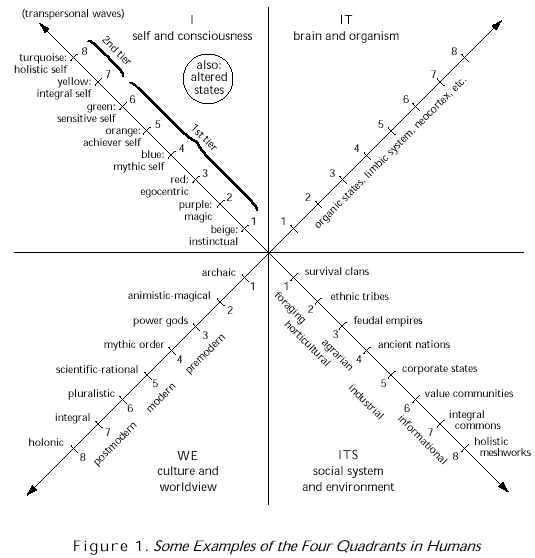
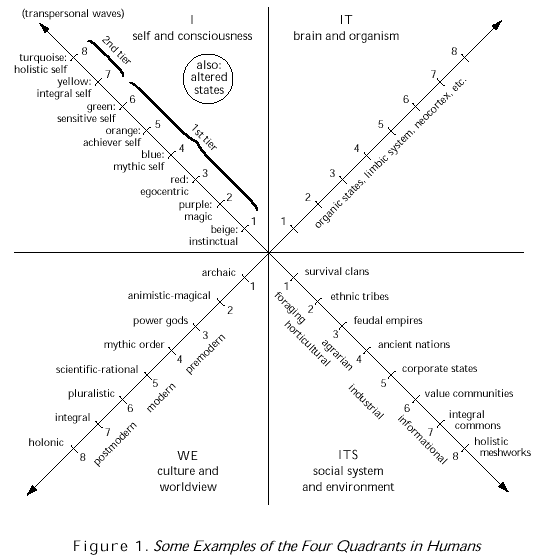
Please refer to Ken Wilber's four-quadrant map of the Kosmos (above). The right-hand side of the grid covers exterior realities, the realm of ITS. The left-hand side covers the interior realities, the realm of I and WE. The realm of ITS is the proper domain of science. This is not where you will find God, Spirit, or any other scientifically verifiable version of an intelligent designer.
Notice I said verifiable. God or Spirit is, of course, present throughout Its creation. Yes, It's creation -- as in, there is an intelligent designer. How one defines the Creator will depend upon the religion or spiritual tradition to which one belongs. Therefore, God or Spirit can only be experienced in the realm of I or WE, not in the realm of ITS.
If they (Bush and his followers) want to teach Intelligent Design in the schools, be my guest -- but it should be taught in a humanities class, not in a science class. And while they are teaching creation stories, they should include stories from all the world's major religious traditions and from indigenous cultures as well. If they refuse to teach other versions of how the world came to be, the true intent of their agenda will be apparent.
Sunday, July 31, 2005
Conscious Evolution
I struggle daily with conflicting beliefs in my psyche regarding the fate of humanity. I'm sure there are much better things to do with my brain cells, but then I have never been terribly pragmatic.
On the one hand, I am convinced humanity is well on the way to its total and self-imposed annihilation. On the other hand, I am hopeful that we will awaken to our fate and act to change the course we have set for ourselves. Most days, I believe both are true.
The thing that has changed over the years is which belief I choose to put my energy behind. For much of my adult life, I was proudly nihilistic and resigned to our self-extermination. In fact, I thought it would be a good thing for the planet to be rid of Homo sapiens. But over the years, something has shifted. I am still not a big fan of human beings, in general, but I find that individual human beings show amazing depth of heart and a genuine desire to make the world a better place.
Somehow, we must find a way to get people to act on those higher impulses.
Barbara Marx Hubbard, one of the co-founding board members of the World Future Society, has a vision for how that might happen that she has termed conscious evolution.
What we are seeking is a worldview that will call forth our creative action and direct our immense powers toward life-oriented and evolutionary purposes. That guiding worldview is, I believe, conscious evolution. It holds that through unprecedented scientific, social, and spiritual capacities we can evolve consciously and cocreatively with nature and the deeper patterns of creation (traditionally called God), thus enabling us to manifest a future commensurate with our unlimited species and planetary potential.
Conscious evolution as a worldview began to emerge in the latter half of the 20th century because of scientific, social, and technological abilities that have given us the power to affect the evolution of life on Earth. Conscious evolution is a metadiscipline; the purpose of this metadiscipline is to learn how to be responsible for the ethical guidance of our evolution. It is a quest to understand the process of developmental change, to identify inherent values for the purpose of learning how to cooperate with these processes toward chosen and positive futures, both near and long range.
This worldview is the fruit of all human history and the opening of the next stage of human development. It has come into focus midway in the life cycle of our planet with the maturation of the noosphere. Conscious evolution is awakening in imaginal cells as a vision of a new life to come and a desire to fulfill unique creativity in the cocreation of that new life.
On the one hand, I am convinced humanity is well on the way to its total and self-imposed annihilation. On the other hand, I am hopeful that we will awaken to our fate and act to change the course we have set for ourselves. Most days, I believe both are true.
The thing that has changed over the years is which belief I choose to put my energy behind. For much of my adult life, I was proudly nihilistic and resigned to our self-extermination. In fact, I thought it would be a good thing for the planet to be rid of Homo sapiens. But over the years, something has shifted. I am still not a big fan of human beings, in general, but I find that individual human beings show amazing depth of heart and a genuine desire to make the world a better place.
Somehow, we must find a way to get people to act on those higher impulses.
Barbara Marx Hubbard, one of the co-founding board members of the World Future Society, has a vision for how that might happen that she has termed conscious evolution.
What we are seeking is a worldview that will call forth our creative action and direct our immense powers toward life-oriented and evolutionary purposes. That guiding worldview is, I believe, conscious evolution. It holds that through unprecedented scientific, social, and spiritual capacities we can evolve consciously and cocreatively with nature and the deeper patterns of creation (traditionally called God), thus enabling us to manifest a future commensurate with our unlimited species and planetary potential.
Conscious evolution as a worldview began to emerge in the latter half of the 20th century because of scientific, social, and technological abilities that have given us the power to affect the evolution of life on Earth. Conscious evolution is a metadiscipline; the purpose of this metadiscipline is to learn how to be responsible for the ethical guidance of our evolution. It is a quest to understand the process of developmental change, to identify inherent values for the purpose of learning how to cooperate with these processes toward chosen and positive futures, both near and long range.
This worldview is the fruit of all human history and the opening of the next stage of human development. It has come into focus midway in the life cycle of our planet with the maturation of the noosphere. Conscious evolution is awakening in imaginal cells as a vision of a new life to come and a desire to fulfill unique creativity in the cocreation of that new life.
--Barbara Marx Hubbard, Conscious Evolution, 57-58 (New World Library, 1998)
If she is even halfway right, sign me up. Hubbard is a little more enthusiastic than I am comfortable with at this point, but I admire her willingness to dream big. That's what we seem to be lacking -- the big dream.
We elect politicians who promise to support a "culture of life" while they send our young people to die in a war that can never be won. We elect politicians who are owned by corporate interests. We have chosen a collection of liars and thieves to lead us, and we wonder why feel so betrayed.
We must rethink how we choose our leaders in every way. We need leaders who have a vision of the future that is hopeful and not based on fear of people who are different. We need big ideas and even bigger dreams. We need leaders who are soulful without being zealots.
We need leaders who want to make the world a cleaner, safer place where no one is starving to death or lacking clean water to drink. We need leaders who seek equal rights for all citizens without exception. We need leaders who will not exploit the weaknesses of their community, but rather who seek to support the strengths and "better angels" of all their constituents.
The change begins with us. How can we change ourselves today to become better people tomorrow? How do we become the leaders we need? This is how we become consciously involved in our evolution.
Thursday, July 28, 2005
On Spiritual Materialism
Spiritual materialism . . . is the tendency of the ego to appropriate a religious or spiritual path to strengthen, rather than dismantle, our sense of self-importance. Chogyam Trungpa, who popularized this term, often used it to point to the self-congratulatory use of Eastern religions and New Age philosophies, especially in the sixties and seventies in North America. It can, however, refer to the tendency within any religious movement to use spirituality to reinforce rather than reveal.
We often avoid authentic spiritual engagement that involves humbling ourselves or giving in. A pernicious form of spiritual materialism, orchestrated by the Lord of Mind, is to imitate or ape spiritual experiences, rather than to actually engage them. We get high, we get absorbed in nothingness or the godhead, we have a cathartic religious experience, but all on our own terms. God loves us, the universe loves us, we love ourselves.
Genuine spirituality offers various paths to investigate what we might call the real mysteries of life. It offers the opportunity both to look more deeply into life and to open out further into the world. It offers exploration, it offers communication, it offers investigation. It offers genuine questions. Spiritual materialism, on the other hand, says: You don't have to question. Do this and you'll be fine. Believe this and you'll be fine. When you die, you'll be fine.
Carolyn Rose Gimian, "The Three Lords of Materialism," Shambhala Sun (Sept 2005)
Chogyam Trungpa wrote Cutting Through Spiritual Materialism in response to his experiences after coming to teach in America in the late sixties. Even moreso now, spiritual materialism is the dominant form of spiritual and religious expression in this country. Whether we are talking about Sunday Christians, who believe that attending church once a week, saying a prayer or two, and voting Republican is a sufficient form of religious practice to get them into heaven, or Buddhists who have a bronze statue of the Buddha on a shelf, go to a meditation class now and then, and believe that volunteering at a food bank will produce a good reincarnation, or any other group who engages in external behaviors rather than internal transformation and calls it religious practice, the result is the same -- spiritual materialism.
We often avoid authentic spiritual engagement that involves humbling ourselves or giving in. A pernicious form of spiritual materialism, orchestrated by the Lord of Mind, is to imitate or ape spiritual experiences, rather than to actually engage them. We get high, we get absorbed in nothingness or the godhead, we have a cathartic religious experience, but all on our own terms. God loves us, the universe loves us, we love ourselves.
Genuine spirituality offers various paths to investigate what we might call the real mysteries of life. It offers the opportunity both to look more deeply into life and to open out further into the world. It offers exploration, it offers communication, it offers investigation. It offers genuine questions. Spiritual materialism, on the other hand, says: You don't have to question. Do this and you'll be fine. Believe this and you'll be fine. When you die, you'll be fine.
Carolyn Rose Gimian, "The Three Lords of Materialism," Shambhala Sun (Sept 2005)
Chogyam Trungpa wrote Cutting Through Spiritual Materialism in response to his experiences after coming to teach in America in the late sixties. Even moreso now, spiritual materialism is the dominant form of spiritual and religious expression in this country. Whether we are talking about Sunday Christians, who believe that attending church once a week, saying a prayer or two, and voting Republican is a sufficient form of religious practice to get them into heaven, or Buddhists who have a bronze statue of the Buddha on a shelf, go to a meditation class now and then, and believe that volunteering at a food bank will produce a good reincarnation, or any other group who engages in external behaviors rather than internal transformation and calls it religious practice, the result is the same -- spiritual materialism.
True spiritual practice, as Gimian suggests, is not about having all the answers, feeling good about ourselves, or feeling secure that we won't go to hell (in whatever form that might take). True spiritual practice is about learning to live within the question, in a state of liminality. It's about learning to be comfortable in ambiguity, in paradox, and finally, in that realm of Spirit where our sense of self expands beyond personal identity into something uncontained, unbounded, infinite.
This doesn't happen in a weekend retreat, although one might get a taste of it there, but rather over the course of a lifetime of practice and investigation. The more we investigate the meaning of our lives -- the meaning of existence -- the closer we come to knowing God, and the less we are tied to moral absolutes, static identity, or any other manifestation of the material world.
Monday, July 25, 2005
Ryokan: Two Poems
You stop to point at the moon in the sky,
but the finger's blind unless the moon is shining.
One moon, one careless finger pointing --
are these two things or one?
The question is a pointer guiding
a novice from ignorance thick as fog.
Look deeper. The mystery calls and calls:
no moon, no finger -- nothing there at all.
*****
I never longed for the wilder side of life.
Rivers and mountains were my friends.
Clouds consumed my shadow where I roamed,
and birds pass high above my resting place.
Straw sandals in snowy villages,
a walking stick in spring,
I sought a timeless truth: the flower's glory
is just another form of dust.
[Translations by Sam Hamill, from A Dragon in the Clouds]
but the finger's blind unless the moon is shining.
One moon, one careless finger pointing --
are these two things or one?
The question is a pointer guiding
a novice from ignorance thick as fog.
Look deeper. The mystery calls and calls:
no moon, no finger -- nothing there at all.
*****
I never longed for the wilder side of life.
Rivers and mountains were my friends.
Clouds consumed my shadow where I roamed,
and birds pass high above my resting place.
Straw sandals in snowy villages,
a walking stick in spring,
I sought a timeless truth: the flower's glory
is just another form of dust.
[Translations by Sam Hamill, from A Dragon in the Clouds]
Saturday, July 16, 2005
Confession of a Thawing Heart
Every once in a while, the past unexpectedly intrudes into the present. People or feelings I thought were long ago set aside knock on the door of my consciousness and demand admittance. With no warning, I am immersed in memories I didn't know I possessed, feelings I thought had resolved themselves, and regrets I had accepted as final. Strange how a gap of seven years can suddenly drop away, bringing past and present together in a single moment.
I was once a very different man. I had chosen – or was chosen by – the archetype of the radical poet as the blueprint for my life. I sought Rimbaud's complete disordering of the senses as a means to mystic, poetic revelation. I sought to transcend reason to achieve higher insights, but more often, I simply succeeded in plunging into the murky depths of my unconscious mind.
My life at that time was creative, passionate, and built around repressing a spectrum of pain and fear I could hardly acknowledge, let alone face. The poetry I published betrayed the image I projected, revealing a deeply tormented psyche and soul.
Most of all, my life at that time was defined by my love of a young woman who was as creative and troubled as was I. The alchemy of our bond conjured great magic, yet we hurt each other in profound ways. Our connection was deeper than anything we had ever known, and we lacked the tools and the strength to contain such intensity in a healthy way.
That relationship ended in pain and a sense of insurmountable loss. For more than two years, I descended into the blackest Dark Night of the Soul I had ever known. Everything I knew about myself began to come unraveled until I felt as though I had been stripped of any identity I could recognize. The best poetry of my life came from that darkness. I embraced the pain and liminality of loss, even as I felt it might destroy me.
Then one morning I got out of bed and I knew it was over. I stopped drinking, and with the wine went the poetry. I began to eat healthy foods instead of doughnuts and pizza. I bought a weight set and started to work out. I imposed structure and discipline on my body, and at the same time, I gave up the life I had known. As I grew stronger and healthier, I became increasingly divorced from my feelings (not that I ever was the most emotional person in the room). My heart had frozen, and now I buried it away, afraid to allow that pain any presence in my life.
A couple of years later, I rediscovered love with the woman who is still my partner. Yet I have not been able to fully thaw the fragile muscle encased in my ribs. Rather than spontaneous, I am disciplined. Rather than creative, I am diligent. Rather than passionate, I am intense. There is energy, but it lacks the full depth and soulfulness I once knew.
It's not all bad, however. I learned how to have a healthy relationship through having had such an unhealthy one in my youth. In giving up the life of the imagination and the soul, I have increased my intellectual skills and breadth of knowledge. What I lack in inspiration, I make up for in education. My health has never been better. And there is an emptiness in my life that led me into therapy as a way to explore a path back into the grief I have hidden away.
To borrow some terms from Nietzsche, I gave up the path of Dionysos and embraced the path of Apollo. I put away a life of the senses and pursued a life of the mind. I rejected a horizontal orientation in the world and have sought a vertical orientation in Spirit.
Strange choice, that. The more I learn of Spirit, the more it reveals itself in all things. I've known that intellectually for years, but it's different to feel its truth, to sense it in my body. It is not possible to embrace Spirit and reject the world – they are one in the same. I am learning to feel what I know, and little by little I am rediscovering the tender heart I long ago put away.
***
So, one day a letter comes in the mail and seven years fall away. I remember her voice, her laugh, and all the ways she hurt me. Yet, it is only one small voice in my head recounting all the horrors of our years together. I can step away from the pain and hear its message without identifying with it. There is a distance that only time can provide.
She wants to be friends. I feel drawn to contact her, to know who she has become. I hope that she is happy and healthy in her life as a married woman. I wonder if she, like me, carries scars from the years we spent together. I want to apologize for how I was unable to be anything other than who I was – for being lost and confused, for being young.
But the more I think about contacting her, the more I realize it isn't her I want to reconnect with – it's me. I want to connect with the best parts of who I was when I was with her. I want to know the poet and mystic too sensitive to own his gifts, too insecure to trust his vision, too young to know he would grow stronger with age.
I want to reach back through the years and tell him it will be okay – he will survive. I have survived. Seven years feels like a lifetime and an instant.
I miss her some days, but it isn't the painful absence I knew when she first was gone. It's more like compassion – a gentle sympathy for how young and lost we were in those days. In the time since her note arrived, I have discovered a soft spot in my heart where the young woman I once loved will always remain. She is no longer that innocent and wild girl, and I am no longer the young man I was then.
Seven years have passed since I last saw her, and it does feel like a lifetime. Whoever we were to each other, we are no more. My time with her feels no more real to me than last night's dream, yet I know she walks and ages and sent me a note.
This is my reply. I wish her peace and happiness – a long and joyful life. If she should ever read these words, she will know I have not forgotten the magic, that I once promised we will meet again in some other life, that I look forward to it.
I was once a very different man. I had chosen – or was chosen by – the archetype of the radical poet as the blueprint for my life. I sought Rimbaud's complete disordering of the senses as a means to mystic, poetic revelation. I sought to transcend reason to achieve higher insights, but more often, I simply succeeded in plunging into the murky depths of my unconscious mind.
My life at that time was creative, passionate, and built around repressing a spectrum of pain and fear I could hardly acknowledge, let alone face. The poetry I published betrayed the image I projected, revealing a deeply tormented psyche and soul.
Most of all, my life at that time was defined by my love of a young woman who was as creative and troubled as was I. The alchemy of our bond conjured great magic, yet we hurt each other in profound ways. Our connection was deeper than anything we had ever known, and we lacked the tools and the strength to contain such intensity in a healthy way.
That relationship ended in pain and a sense of insurmountable loss. For more than two years, I descended into the blackest Dark Night of the Soul I had ever known. Everything I knew about myself began to come unraveled until I felt as though I had been stripped of any identity I could recognize. The best poetry of my life came from that darkness. I embraced the pain and liminality of loss, even as I felt it might destroy me.
Then one morning I got out of bed and I knew it was over. I stopped drinking, and with the wine went the poetry. I began to eat healthy foods instead of doughnuts and pizza. I bought a weight set and started to work out. I imposed structure and discipline on my body, and at the same time, I gave up the life I had known. As I grew stronger and healthier, I became increasingly divorced from my feelings (not that I ever was the most emotional person in the room). My heart had frozen, and now I buried it away, afraid to allow that pain any presence in my life.
A couple of years later, I rediscovered love with the woman who is still my partner. Yet I have not been able to fully thaw the fragile muscle encased in my ribs. Rather than spontaneous, I am disciplined. Rather than creative, I am diligent. Rather than passionate, I am intense. There is energy, but it lacks the full depth and soulfulness I once knew.
It's not all bad, however. I learned how to have a healthy relationship through having had such an unhealthy one in my youth. In giving up the life of the imagination and the soul, I have increased my intellectual skills and breadth of knowledge. What I lack in inspiration, I make up for in education. My health has never been better. And there is an emptiness in my life that led me into therapy as a way to explore a path back into the grief I have hidden away.
To borrow some terms from Nietzsche, I gave up the path of Dionysos and embraced the path of Apollo. I put away a life of the senses and pursued a life of the mind. I rejected a horizontal orientation in the world and have sought a vertical orientation in Spirit.
Strange choice, that. The more I learn of Spirit, the more it reveals itself in all things. I've known that intellectually for years, but it's different to feel its truth, to sense it in my body. It is not possible to embrace Spirit and reject the world – they are one in the same. I am learning to feel what I know, and little by little I am rediscovering the tender heart I long ago put away.
***
So, one day a letter comes in the mail and seven years fall away. I remember her voice, her laugh, and all the ways she hurt me. Yet, it is only one small voice in my head recounting all the horrors of our years together. I can step away from the pain and hear its message without identifying with it. There is a distance that only time can provide.
She wants to be friends. I feel drawn to contact her, to know who she has become. I hope that she is happy and healthy in her life as a married woman. I wonder if she, like me, carries scars from the years we spent together. I want to apologize for how I was unable to be anything other than who I was – for being lost and confused, for being young.
But the more I think about contacting her, the more I realize it isn't her I want to reconnect with – it's me. I want to connect with the best parts of who I was when I was with her. I want to know the poet and mystic too sensitive to own his gifts, too insecure to trust his vision, too young to know he would grow stronger with age.
I want to reach back through the years and tell him it will be okay – he will survive. I have survived. Seven years feels like a lifetime and an instant.
I miss her some days, but it isn't the painful absence I knew when she first was gone. It's more like compassion – a gentle sympathy for how young and lost we were in those days. In the time since her note arrived, I have discovered a soft spot in my heart where the young woman I once loved will always remain. She is no longer that innocent and wild girl, and I am no longer the young man I was then.
Seven years have passed since I last saw her, and it does feel like a lifetime. Whoever we were to each other, we are no more. My time with her feels no more real to me than last night's dream, yet I know she walks and ages and sent me a note.
This is my reply. I wish her peace and happiness – a long and joyful life. If she should ever read these words, she will know I have not forgotten the magic, that I once promised we will meet again in some other life, that I look forward to it.
On Escaping the World
In response to a previous post on the nature of attachment, John made the following comment:
In many ways, Christianity and Buddhism share the same beliefs when it comes to the diagnosis of our problems - that we are too attached to the things of this transient world instead of being attached to the things that are eternal. The differences (and they are severe) come when we start to talk of the solution to our problem. Buddhism teaches that we need to sever our connections to the things of this world, to become detached, in order to escape suffering. Christianity teaches that the answer to suffering is to form new attachments to the God who created this world, and that these new attachments will enable us to withstand suffering, grow from it and make the world a better place. That is, Christianity teaches us not to escape from the world but to transform it.
I have been thinking about this issue since first reading John's comments, and although I had a clear sense of how Buddhism is not about escaping from the world, I wasn't clear about how to express that truth. While reading the current issue of Buddhadharma, I came across the following quote from Tenzin Palmo, the British nun best known for having meditated in a Himalayan cave for twelve years.
". . . we don't want to go to heaven. We want to be reborn so that we can keep going and realize the dharma so as to benefit other beings endlessly. It's a very different thing. We're not collecting merit scores for ourselves. We're making merit so that we can be reborn in a situation where we can really live to benefit others, and ourselves, again and again and again, more and more every time. We are in a position to deepen our understanding to be of genuine benefit to other beings."
What she is describing here is known as the bodhisattva vow, a commitment that is central to the Mahayana branch of Buddhism. Essentially, one promises to devote one's life to becoming enlightened -- to attaining non-dual consciousness through relinquishing attachments to this world, or to knowing Spirit as source and destination of all things -- so that one may be reborn again and again to help others become enlightened. One commits to continuous rebirth until all sentient beings are enlightened.
There is nothing in Mahayana Buddhism that encourages escape from the world. Rather, one is encouraged to transcend the attachments of this world so that one may devote one's lives to helping others do the same.
Buddhism does not reject the world out of fear (as do fundamentalist versions of other traditions), but rather in recognition that the manifest world is an illusion hiding the true face of Spirit. And even in being clear that all is illusion, Buddhism is also clear that ultimate truth is to be found in the dharma, but that we live as physical beings in a world that is relative. Knowing this, we work with what we have in this reality. We practice bodhicitta (loving-kindness) and attempt to develop the tender heart of the Shambala warrior.
In many ways, Christianity and Buddhism share the same beliefs when it comes to the diagnosis of our problems - that we are too attached to the things of this transient world instead of being attached to the things that are eternal. The differences (and they are severe) come when we start to talk of the solution to our problem. Buddhism teaches that we need to sever our connections to the things of this world, to become detached, in order to escape suffering. Christianity teaches that the answer to suffering is to form new attachments to the God who created this world, and that these new attachments will enable us to withstand suffering, grow from it and make the world a better place. That is, Christianity teaches us not to escape from the world but to transform it.
I have been thinking about this issue since first reading John's comments, and although I had a clear sense of how Buddhism is not about escaping from the world, I wasn't clear about how to express that truth. While reading the current issue of Buddhadharma, I came across the following quote from Tenzin Palmo, the British nun best known for having meditated in a Himalayan cave for twelve years.
". . . we don't want to go to heaven. We want to be reborn so that we can keep going and realize the dharma so as to benefit other beings endlessly. It's a very different thing. We're not collecting merit scores for ourselves. We're making merit so that we can be reborn in a situation where we can really live to benefit others, and ourselves, again and again and again, more and more every time. We are in a position to deepen our understanding to be of genuine benefit to other beings."
What she is describing here is known as the bodhisattva vow, a commitment that is central to the Mahayana branch of Buddhism. Essentially, one promises to devote one's life to becoming enlightened -- to attaining non-dual consciousness through relinquishing attachments to this world, or to knowing Spirit as source and destination of all things -- so that one may be reborn again and again to help others become enlightened. One commits to continuous rebirth until all sentient beings are enlightened.
There is nothing in Mahayana Buddhism that encourages escape from the world. Rather, one is encouraged to transcend the attachments of this world so that one may devote one's lives to helping others do the same.
Buddhism does not reject the world out of fear (as do fundamentalist versions of other traditions), but rather in recognition that the manifest world is an illusion hiding the true face of Spirit. And even in being clear that all is illusion, Buddhism is also clear that ultimate truth is to be found in the dharma, but that we live as physical beings in a world that is relative. Knowing this, we work with what we have in this reality. We practice bodhicitta (loving-kindness) and attempt to develop the tender heart of the Shambala warrior.
Tuesday, July 12, 2005
Andrew Cohen: "The Rude Boy of Enlightenment"
Beliefnet has posted an interview with controversial "enlightenment guru" Andrew Cohen. Cohen is the founder of What Is Enlightenment? a magazine dedicated to covering the cutting edge of enlightenment practice, research, and theory. In recent years, Cohen has aligned himself and his magazine with Ken Wilber (founder of Integral Institute) and Don Beck (Spiral Dynamics creator). He now espouses an approach he calls Evolutionary Enlightenment. But just how enlightened is Andrew Cohen? He often comes across in his magazine as a pompous, ego-ridden power seeker. Even his mother has problems with her son and former guru.
Q: For those who aren't familiar with your work, how would you describe yourself?
A: I'm a spiritual teacher, first and foremost. I teach what I call "evolutionary enlightenment." Traditionally, in the pre-modern or ancient notion of enlightenment, the spiritual experience or revelation called enlightenment was considered to be the end of the path. Someone who was supposedly an enlightened human being was no longer developing. They had reached some kind of final end point.
I'm saying that kind of awakening really is the beginning of awakening to the fact that we're part of a developmental process. We're part of the evolutionary process where human beings, I believe, ultimately, will function at the level of consciousness and recognize that we are that very process that started 14 billion years ago with the Big Bang. That we are that very evolutionary process that has the capacity to become conscious of itself.
The traditional notion of enlightenment was the attainment of a state of consciousness that freed us from the world, it freed us from the time process. In the traditional notion of enlightenment one was trying to experience nirvana or achieve a nirvanic state or enter into a nirvanic realm which would free one from the experience of embodiment. It would free from one from being embedded in the world process.
Read the rest of the interview for yourself here.
Q: For those who aren't familiar with your work, how would you describe yourself?
A: I'm a spiritual teacher, first and foremost. I teach what I call "evolutionary enlightenment." Traditionally, in the pre-modern or ancient notion of enlightenment, the spiritual experience or revelation called enlightenment was considered to be the end of the path. Someone who was supposedly an enlightened human being was no longer developing. They had reached some kind of final end point.
I'm saying that kind of awakening really is the beginning of awakening to the fact that we're part of a developmental process. We're part of the evolutionary process where human beings, I believe, ultimately, will function at the level of consciousness and recognize that we are that very process that started 14 billion years ago with the Big Bang. That we are that very evolutionary process that has the capacity to become conscious of itself.
The traditional notion of enlightenment was the attainment of a state of consciousness that freed us from the world, it freed us from the time process. In the traditional notion of enlightenment one was trying to experience nirvana or achieve a nirvanic state or enter into a nirvanic realm which would free one from the experience of embodiment. It would free from one from being embedded in the world process.
Read the rest of the interview for yourself here.
Wednesday, July 06, 2005
The Evolving Face of Spirit
In a recent post, John (at /musing/struggling/dreaming/) talked about whether or not God can change. In a nod toward the genderless nature of divinity, he used the feminine pronoun throughout the post, which I liked. He concluded, for those too lazy to go read the original post, that we must allow for the possibility that God can and does change.
I'd like to address the same issue from an integral perspective. Rather than speaking of God, however, since I don't want the baggage that comes with God most often being thought of in the Western world as the Christian God, I will speak about Spirit -- a more universal and gender-neutral designation for that which is beyond names anyway.
First and foremost, Integral theory believes that the entire Kosmos (the patterned Whole of all existence, including the physical, emotional, mental, and spiritual realms) is the manifestation of Spirit. From this perspective, Spirit is both the source and destination of the entire Kosmos. As source, Spirit is whole and complete and perfect. As Kosmos, Spirit is evolving toward Its eternal perfection. Wrap your head around that.
Spirit, which is formless, manifested Itself as the Kosmos (involution) as a way to know Itself through form. According to the Heart Sutra, one of the core texts of Buddhism, "Form is empty. Emptiness is form. Emptiness is not other than form and form is not other than emptiness." Here emptiness is equated with formlessness -- the terms are often, though not always, used interchangeably.
Once manifest, the Kosmos began to evolve. This is the reality that we can touch, smell, hear, see, feel, and measure. Despite what the fundamentalists of various faiths might believe, science has proposed that the universe has been around for at least 15 billion years (possibly forever, depending on which model you hold as true) and has been in a constant state of evolution since its inception. The two primary processes are always at work -- Spirit enters Its creation through involution, and Its creation (the physical aspect of Itself) slowly returns to the perfection of Its source through evolution.
Therefore, Spirit is both unchanging (perfect, non-dual) and changing (evolving physical reality) simultaneously. At the deepest levels, there is no contradiction in that statement.
If one holds this view, and I do, the horrible, excruciating truth is that all things -- RIGHT NOW -- are perfect. All things are a manifestation of perfect Spirit. And here is the hardest part: right now, you and I are exactly where we are supposed to be. Moreover, we are loved and valued by Spirit exactly as we are. Even if we are rejecting Spirit, or rejecting ourselves, or are filled with pain and anger and loss, we are loved and valued by Spirit as manifestations of Spirit.
Update: Some corrections have been made to the original post -- thanks to John for his comments. I also thought this quote might add to the original intent.
"[I]n the world of Form, the ultimate Omega point appears as an ever-receding horizon of fulfillment (the ever-receding horizon of the totality of manifestation), forever pulling us forward, forever retreating itself, thus always conferring wholeness and partialness in the same breath: the wholeness of this moment is part of the whole of the next moment: the world is always comlete and incomplete in any given moment, and thus condemned to a fulfillment that is never fulfilled: the forms rush and run forward to a reward that retreats with the run itself." (Emphasis added.)
***
"Evolution seeks only this Formless summum bonum -- it wants only this ultimate Omega -- it rushes forward always and solely in search of this -- and it will never find it, because evolution unfolds in the world of form. The Kosmos is driven forward endlessly, searching in the world of time for that which is altogether timeless. And since it will never find it, it will never cease the search. Samsara circles endlessly, and that is always the brutal nightmare hidden in its heart."
-- Ken Wilber: CW6: Sex, Ecology, Spirituality, 323-325
I'd like to address the same issue from an integral perspective. Rather than speaking of God, however, since I don't want the baggage that comes with God most often being thought of in the Western world as the Christian God, I will speak about Spirit -- a more universal and gender-neutral designation for that which is beyond names anyway.
First and foremost, Integral theory believes that the entire Kosmos (the patterned Whole of all existence, including the physical, emotional, mental, and spiritual realms) is the manifestation of Spirit. From this perspective, Spirit is both the source and destination of the entire Kosmos. As source, Spirit is whole and complete and perfect. As Kosmos, Spirit is evolving toward Its eternal perfection. Wrap your head around that.
Spirit, which is formless, manifested Itself as the Kosmos (involution) as a way to know Itself through form. According to the Heart Sutra, one of the core texts of Buddhism, "Form is empty. Emptiness is form. Emptiness is not other than form and form is not other than emptiness." Here emptiness is equated with formlessness -- the terms are often, though not always, used interchangeably.
Once manifest, the Kosmos began to evolve. This is the reality that we can touch, smell, hear, see, feel, and measure. Despite what the fundamentalists of various faiths might believe, science has proposed that the universe has been around for at least 15 billion years (possibly forever, depending on which model you hold as true) and has been in a constant state of evolution since its inception. The two primary processes are always at work -- Spirit enters Its creation through involution, and Its creation (the physical aspect of Itself) slowly returns to the perfection of Its source through evolution.
Therefore, Spirit is both unchanging (perfect, non-dual) and changing (evolving physical reality) simultaneously. At the deepest levels, there is no contradiction in that statement.
If one holds this view, and I do, the horrible, excruciating truth is that all things -- RIGHT NOW -- are perfect. All things are a manifestation of perfect Spirit. And here is the hardest part: right now, you and I are exactly where we are supposed to be. Moreover, we are loved and valued by Spirit exactly as we are. Even if we are rejecting Spirit, or rejecting ourselves, or are filled with pain and anger and loss, we are loved and valued by Spirit as manifestations of Spirit.
Update: Some corrections have been made to the original post -- thanks to John for his comments. I also thought this quote might add to the original intent.
"[I]n the world of Form, the ultimate Omega point appears as an ever-receding horizon of fulfillment (the ever-receding horizon of the totality of manifestation), forever pulling us forward, forever retreating itself, thus always conferring wholeness and partialness in the same breath: the wholeness of this moment is part of the whole of the next moment: the world is always comlete and incomplete in any given moment, and thus condemned to a fulfillment that is never fulfilled: the forms rush and run forward to a reward that retreats with the run itself." (Emphasis added.)
***
"Evolution seeks only this Formless summum bonum -- it wants only this ultimate Omega -- it rushes forward always and solely in search of this -- and it will never find it, because evolution unfolds in the world of form. The Kosmos is driven forward endlessly, searching in the world of time for that which is altogether timeless. And since it will never find it, it will never cease the search. Samsara circles endlessly, and that is always the brutal nightmare hidden in its heart."
-- Ken Wilber: CW6: Sex, Ecology, Spirituality, 323-325
Sunday, July 03, 2005
Breaking the Consensus Trance

Little by little, wean yourself.
This is the gist of what I have to say.
From an embryo, whose nourishment comes in the blood,
move to an infant drinking milk,
to a child on solid food,
to a searcher after wisdom,
to a hunter of more invisible game.
--Rumi
Integral Psychology (IP) posits a developmental model of human consciousness based on the work of developmental psychologists, cultural anthropologists, and Eastern contemplative practices. The upper right quadrant of the graph (above) represents the interior-individual aspect that IP covers.
The earliest developmental stages are all considered pre-personal or pre-formal. This means that the individual hasn't yet developed the means to think and act independently of cultural norms and roles. In Jungian terms, the person has not yet individuated. However, these stages are crucial in creating civilized human beings. It is during these stages that we learn our culture's values, mores, and beliefs. We adopt the prevalent worldview and accept its understanding of the universe and ourselves as individuals.
Two of the three monotheistic religions (Christianity and Islam, as practiced by the majority of adherents) are considered pre-personal in that they require this unquestioning conformity to dogmatic prescriptions for belief and behavior. Certainly not all those who follow these religions are operating at pre-personal developmental levels, but the center of gravity for both religions lies in the "mythic order" level of individual and cultural values, which is distinctly pre-rational and pre-personal.
I'm sure many readers will reject the notion that their chosen religion is pre-rational. The test would be in being able to prove or disprove the major tenets of one's religion -- are they testable or are they totally dependent on faith. Can one prove that Mary was a virgin, that Jesus was resurrected, that Lazarus was raised from the dead, that God is masculine? (I was raised Catholic, so these were some of my issues during my confirmation process.) By definition, belief in myth (and many Christian, Islamic, and other religious beliefs must be considered myth in the absence of proof) is pre-rational in all developmental models.
Some Eastern religions, and some more advanced elements of the New Age movement, consider the mythic order level of development to be a form of consensus trance in which all believers are required to hold the same views and beliefs. This trance state is maintained through fear of eternal damnation for straying from the accepted rules and roles. Nowhere is this worldview more prevalent right now than in the Middle East (radical Islam) and in the United States (fundamentalist Christianity).
However, all the world's major traditions (Judaism, Christianity, Islam, Hinduism, Buddhism, Taoism, and Confucianism) regard consensus reality as flawed and in need of transformation. "Both Christianity and Islam describe our vision as veiled, while existential philosophers complain that conventional living is unreflective and superficial" (Roger Walsh, Essential Spirituality, 25). All the world's wisdom traditions agree: we are barely out of our developmental infancy, and our eyes are still clouded with sleep.
The first step in breaking free of that trance state is to become self-reflective. Until one can critically examine his/her own beliefs, then there is little hope for changing them. The majority of meditative practices, East and West, as well as many forms of psychotherapy, teach the individual how to have an "observer self" -- an element of the psyche that can step outside the ego state and act as an impartial observer.
We can't change how other people view their world, but we can work to elevate our own consciousness one step at a time. Working to become more self-reflective, thus breaking the consensus trance, is an enormous step in the right direction.
*****
An Exercise to Identify the Observer Self
The observer self is that aspect of consciousness which can watch us act like fools and stand back at a safe distance, shaking its head in disbelief. The observer is a deeper structure of the self-sense than the ego, closer to the actual Self at our core. It is capable of observing our behaviors with an even, unattached point of view. As such, the observer can help us see our wounded areas more clearly, without the interference of the ego and its desire to maintain the status quo. The observer self is an invaluable ally in personal growth that can lead us into higher levels of consciousness.
The following exercise, adapted from Roberto Assagioli’s disidentification process in Psychosynthesis and Ken Wilber’s meditations in One Taste, can help us detach from ego-consciousness and step back into the observer self. For each of the steps there is a mantra that some people find quite useful in detaching from each element of the ego-self.
Practicing Detachment
Get into a comfortable position, either sitting or lying down. Take a few deep, centering breaths, allowing the body to relax. Closing the eyes can help focus attention. Feel the air moving in an out of your lungs as you breathe. Become aware of your body, its position, how your limbs feel, where you are holding tension. Become aware of your whole body and all the sensations it experiences. If you are comfortable with mantras, the one for this step is, "I have a body, but I am not my body." Repeat aloud or in your thoughts.
Take three deep cleansing breaths. Now leave your body and move to your emotions. What feelings do you notice? Are you bored, anxious, happy? Notice your current feelings, and then think about the most common feelings in your life. Do not dwell on those feelings -- just recall them and then release them. Mantra: "I have feelings, but I am not my feelings." This mantra works well as a reminder when you are angry or afraid that you are frozen in an emotion.
Take three deep cleansing breaths. Move from your feelings to your desires. Desires are those things that motivate us. We all have many things that motivate our behaviors, such as simplicity, comfort, quiet, money, health, or others. Observe the things that motivate you, but do not judge them. Simply call them up and notice them. Mantra: "I have desires, but I am not my desires."
Take three deep cleansing breaths. Now move to your thoughts. As each thought rises to consciousness, observe it but do not dwell on it. Then watch as the next one rises to replace it, over and over again. This is the state of consciousness most of us experience. However, we often get stuck on a handful of thoughts that return over and over again in our lives. Notice the pattern, but do not hold on to it. Notice the flotsam and jetsam of consciousness, the memories, the ideas, the fears, the opinions, and the ways you tell yourself who you are as a person. Mantra: "I have thoughts, but I am not my thoughts." This mantra works in meditation to return a wandering mind to the breath.
Take three deep cleansing breaths. Finally, become aware of that part of you that has been observing your body, your feelings, your desires, and your thoughts. Who is that self behind all these realms of ego? The self is not an image or a thought, but a deeper essence. The self is at the core of our humanity. Mantra: "I am the self, a center of pure consciousness."
Having detached from the basic elements of consciousness, repeat the mantras: I have a body, but I am not my body; I have feelings, but I am not my feelings; I have desires, but I am not my desires; I have thoughts, but I am not my thoughts. What is the source of your awareness? Who is the "I" who observes but cannot be observed?
Whatever comes into awareness is fine. You are none of those things, so just watch them pass like clouds across a blue sky. "And this witnessing awareness is not itself anything specific you can see. It is just a vast, background sense of Freedom – or pure Emptiness – and in that pure Emptiness, which you are, the entire manifest world arises. You are that Freedom, Openness, Emptiness – and not any itty bitty thing that arises in it" (Ken Wilber, One Taste, 88).
Wednesday, June 29, 2005
Ken Wilber's Introduction to Joe Perez's New Book
Ken Wilber's "Sense and Soul" column for this month, on Belief.net, is the introduction to a new book by Joe Perez, Soulfully Gay. Here is a brief excerpt from the article.
"As it happens, this rather extraordinary chronicle unfolds around several conflict-inducing facts, one of which is that Joe is indeed gay; another of which is that Joe was raised Roman (homophobic) Catholic; another is that he often has authentic mystical states; and yet another is that Joe is, but only occasionally, clinically psychotic. It is the jolting collision of those items, held together by Joe’s courage in the face of all of them, that makes this chronicle so extraordinary in so many ways.
"The last item—the occasional trip into realms labeled madness—can mean, especially if you are a writer, that you are given to telling the unvarnished, brutal, searing truth, whether society likes it or not. And not the Sylvia Plath look-at-me kinds of truth, but the spiritual-seer and mad-shaman types of truth, the truths that really hurt, the truths that get into society’s craw and stick there, causing festering metaphysical sores indicative of social cancers or worse—but also the types of truth that speak to you deeply, authentically, radiantly, if you have the courage to listen."
To read the rest of the introduction to this fascinating book, click here.
"As it happens, this rather extraordinary chronicle unfolds around several conflict-inducing facts, one of which is that Joe is indeed gay; another of which is that Joe was raised Roman (homophobic) Catholic; another is that he often has authentic mystical states; and yet another is that Joe is, but only occasionally, clinically psychotic. It is the jolting collision of those items, held together by Joe’s courage in the face of all of them, that makes this chronicle so extraordinary in so many ways.
"The last item—the occasional trip into realms labeled madness—can mean, especially if you are a writer, that you are given to telling the unvarnished, brutal, searing truth, whether society likes it or not. And not the Sylvia Plath look-at-me kinds of truth, but the spiritual-seer and mad-shaman types of truth, the truths that really hurt, the truths that get into society’s craw and stick there, causing festering metaphysical sores indicative of social cancers or worse—but also the types of truth that speak to you deeply, authentically, radiantly, if you have the courage to listen."
To read the rest of the introduction to this fascinating book, click here.
Sunday, June 26, 2005
On Evolution
The following quotes attempt to articulate an integral view of evolution -- not the mere flatland view of scientific evolution, which is devoid of Spirit, but evolution as the unfolding of Spirit becoming conscious of itself. All quotes are from the books of Ken Wilber and are cited according to their place in the Collected Works (with individual book titles noted where appropriate). A brief commentary follows.
Evolution is best thought of as Spirit-in-action, God-in-the-making, where Spirit unfolds itself at every stage of development, thus manifesting more of itself, and realizing more of itself, at every unfolding. Spirit is not some particular stage, or some favorite ideology, or some specific god or goddess, but rather the entire process of unfolding itself, an infinite process that is completely present at every finite stage, but becomes more available to itself with evolutionary opening.
--CW 7: A Brief History of Everything, 61
Evolution -- wherever it appears -- manifests itself as a series of transcendences, of ascents, or emergences -- and emergences of higher-order wholes. For to remember is really to re-member, or join again in unity, and that is just why evolution consists of a series of ever-higher wholes until there is only Wholeness. Evolution is holistic because it is nature's remembrance of God.
--CW 2: The Atman Project, 267
Spirit is unfolding itself in each new transcendence, which it also enfolds into its own being at the new stage. Transcends and includes, brings forth and embraces, creates and loves, Eros and Agape, unfolds and enfolds -- different ways of saying the same thing.
So we can summarize all this very simply: because evolution goes beyond what went before, but because it must embrace what went before, then its very nature is to transcend and include, and thus it has an inherent directionality, a secret impulse, toward increasing depth, increasing intrinsic value, increasing consciousness. In order for evolution to move at all, it must move in those directions -- there's no place else for it to go.
--CW 7: A Brief History of Everything, 89-90
Spirit or Godhead, when apprehended by the mind, is a paradox: both Goal and Ground, Source and Summit, Alpha and Omega. From the view of Ground, history is pure illusion. Since God is equally and wholly present at every point of time, then history can neither add to nor subtract from God's omnipresence. From the view of summit of Goal, however, history is the unfolding of God to Itself, or the movement from subconscious to selfconscious to superconscious modes; only the latter or superconscious mode can directly realize an everpresent unity with God-as-Ground, and thus the latter alone, of all the modes, is the direct realization of God by God. From that point of view, history is the unfolding of God to Itself, an unfolding that appears to us, through a glass darkly, as evolution. From this side of the paradox, history is no mere illusion, it is the very substance of this drama and the very means of its enactment.
--CW 4: "Sociocultural Evolution," 337
Commentary:
I have fought the notion of Intelligent Design as it applies to teaching evolution in the classroom. No matter how much its proponents attempt to hide their agenda, it always comes across as a way to get Christian creationism into science classes. I firmly believe that the science classroom, no matter how reductionist it might feel to those of us who believe in a divine intelligence, is the domain of science, not faith.
However, I would fully support a humanities class on the spiritual elements of evolutionary theory. This class could include the creation stories of the world's major (and minor) religions, as well as an integral overview such as that provided by the Perennial Philosophy of Aldous Huxley and/or Houston Smith, and the work of Ken Wilber, Alan Combs, and others.
The proper domain of science is the world of Its (the exterior aspect of experience). The proper domain of faith is the world of I and We (the interior aspects of experience). We get into trouble when we value one above the other, when in truth they are inseparable -- two ways of looking at the same reality. For a long time, science has held sway among the intellectual elite of Western culture, and the result has been a flatland view of the world -- all surface and no depth.
During the last twenty years or so in America, a Christian backlash has been growing in an attempt to reclaim a place for Spirit in the discourse of culture. Seeing itself as threatened with annihilation by the predominant line of thinking among the intellectual elite, this backlash has been as reductionistic as is the scientific view. Each denies the other a place at the table. Rather than an integral model, each offers a fragment of the whole. Neither is wrong, but neither has the whole truth.
An integral approach to teaching evolution would be to honor individual belief systems and the partial truths they offer as an explanation of our world, while at the same time honoring what we know to be true through the exploration of our world with the scientific method. Neither approach should be privileged above the other. Every object, every theory, every belief has an exterior truth and an interior truth -- they are not mutually exclusive.
We need an integral view of our place in the Universe. We need to understand that all of nature is a manifestation of Spirit becoming conscious of Itself. How different might our environmental policy be if we held such a view? How different might our politics be if we believed that human beings are not the end-point of evolution, but merely an impressive stage in a grander scheme? How would such a view change the ways in which we treat the poor and the sick?
Evolution is best thought of as Spirit-in-action, God-in-the-making, where Spirit unfolds itself at every stage of development, thus manifesting more of itself, and realizing more of itself, at every unfolding. Spirit is not some particular stage, or some favorite ideology, or some specific god or goddess, but rather the entire process of unfolding itself, an infinite process that is completely present at every finite stage, but becomes more available to itself with evolutionary opening.
--CW 7: A Brief History of Everything, 61
Evolution -- wherever it appears -- manifests itself as a series of transcendences, of ascents, or emergences -- and emergences of higher-order wholes. For to remember is really to re-member, or join again in unity, and that is just why evolution consists of a series of ever-higher wholes until there is only Wholeness. Evolution is holistic because it is nature's remembrance of God.
--CW 2: The Atman Project, 267
Spirit is unfolding itself in each new transcendence, which it also enfolds into its own being at the new stage. Transcends and includes, brings forth and embraces, creates and loves, Eros and Agape, unfolds and enfolds -- different ways of saying the same thing.
So we can summarize all this very simply: because evolution goes beyond what went before, but because it must embrace what went before, then its very nature is to transcend and include, and thus it has an inherent directionality, a secret impulse, toward increasing depth, increasing intrinsic value, increasing consciousness. In order for evolution to move at all, it must move in those directions -- there's no place else for it to go.
--CW 7: A Brief History of Everything, 89-90
Spirit or Godhead, when apprehended by the mind, is a paradox: both Goal and Ground, Source and Summit, Alpha and Omega. From the view of Ground, history is pure illusion. Since God is equally and wholly present at every point of time, then history can neither add to nor subtract from God's omnipresence. From the view of summit of Goal, however, history is the unfolding of God to Itself, or the movement from subconscious to selfconscious to superconscious modes; only the latter or superconscious mode can directly realize an everpresent unity with God-as-Ground, and thus the latter alone, of all the modes, is the direct realization of God by God. From that point of view, history is the unfolding of God to Itself, an unfolding that appears to us, through a glass darkly, as evolution. From this side of the paradox, history is no mere illusion, it is the very substance of this drama and the very means of its enactment.
--CW 4: "Sociocultural Evolution," 337
Commentary:
I have fought the notion of Intelligent Design as it applies to teaching evolution in the classroom. No matter how much its proponents attempt to hide their agenda, it always comes across as a way to get Christian creationism into science classes. I firmly believe that the science classroom, no matter how reductionist it might feel to those of us who believe in a divine intelligence, is the domain of science, not faith.
However, I would fully support a humanities class on the spiritual elements of evolutionary theory. This class could include the creation stories of the world's major (and minor) religions, as well as an integral overview such as that provided by the Perennial Philosophy of Aldous Huxley and/or Houston Smith, and the work of Ken Wilber, Alan Combs, and others.
The proper domain of science is the world of Its (the exterior aspect of experience). The proper domain of faith is the world of I and We (the interior aspects of experience). We get into trouble when we value one above the other, when in truth they are inseparable -- two ways of looking at the same reality. For a long time, science has held sway among the intellectual elite of Western culture, and the result has been a flatland view of the world -- all surface and no depth.
During the last twenty years or so in America, a Christian backlash has been growing in an attempt to reclaim a place for Spirit in the discourse of culture. Seeing itself as threatened with annihilation by the predominant line of thinking among the intellectual elite, this backlash has been as reductionistic as is the scientific view. Each denies the other a place at the table. Rather than an integral model, each offers a fragment of the whole. Neither is wrong, but neither has the whole truth.
An integral approach to teaching evolution would be to honor individual belief systems and the partial truths they offer as an explanation of our world, while at the same time honoring what we know to be true through the exploration of our world with the scientific method. Neither approach should be privileged above the other. Every object, every theory, every belief has an exterior truth and an interior truth -- they are not mutually exclusive.
We need an integral view of our place in the Universe. We need to understand that all of nature is a manifestation of Spirit becoming conscious of Itself. How different might our environmental policy be if we held such a view? How different might our politics be if we believed that human beings are not the end-point of evolution, but merely an impressive stage in a grander scheme? How would such a view change the ways in which we treat the poor and the sick?
Subscribe to:
Comments (Atom)